Asexual Awareness Week is an international campaign that seeks to educate about asexual, aromantic, demisexual, and grey-asexual experiences and to create materials that are accessible to our community and our allies around the world.
Asexuality is not a widely known orientation so when I realized Holly Drummond in Perfect Rhythm identifies as ace, I was absolutely thrilled. And a little worried.
Pop star Leontyne Blake might sing about love, but she stopped believing in it a long time ago. What women want is her image, not the real her. When her father has a stroke, she flees the spotlight and returns to her tiny Missouri hometown.
In her childhood home, she meets small-town nurse Holly Drummond, who isn’t impressed by Leo’s fame at all. That isn’t the only thing that makes Holly different from other women. She’s also asexual. For her, dating is a minefield of expectations that she has decided to avoid.
Can the tentative friendship between a burned-out pop star and a woman not interested in sex develop into something more despite their diverse expectations?
A lesbian romance about seeking the perfect rhythm between two very different people—and finding happiness where they least expect it.
Thankfully, I didn’t need to be. Jae is a fantastic writer and I’m so glad I grabbed this book. I saw a promo for in on Tumblr and the mention of a lesbian from my home state of Missouri piqued my interest. Granted, I’d never read contemporary f/f before and I wasn’t certain what to expect.
What I got was a lovely, blossoming relationship between two amazing women. When I first started I braced myself, unsure if I’d be able to connect with Leo Blake, the main protagonist. I needn’t have worried. She is wonderfully down to earth and relatable for a pop star. She’s stubborn and full of pride but not so much that she won’t admit mistakes or try her best to rectify things that have gone wrong.
While I love Leo, Holly was the one I really connected with for obvious reasons. I really appreciated how Jae handled Holly’s asexuality, including being frank about how pressured we can feel in relationships.
So many parts of this book hit home for me and not just the setting. It was refreshing to read a story where the asexual character wasn’t ‘fixed’ by having sex or ever pressured into the act at all. I also greatly appreciated the content warning before the chapter that had a sex scene in it.
All the characters were wonderfully fleshed out and made the whole journey with Leo and Holly that much more interesting. I loved having plenty of time to get to know them. I know a lot of people call this a ‘slow burn’ romance, but it is still fast-paced by my standards. xD
Overall, I delighted in reading this book. It was thoughtful, funny and moving.
I apologize for this post being late, but I spent some extra time to make sure I covered as many topics as possible.
For the last couple of weeks we’ve been looking at the asexuality spectrum and how to write asexual characters. Last week we discussed more about the spectrum and went over some terminology for various points on the spectrum as well as things to keep in mind and questions to ask yourself.
This week I’d like to show you how to put these things into practice. We’ll look at some examples of asexual characters in the media and why the character may or may not be a good representative of asexuals. We’ll also go over how to write romance with a character who identifies as asexual.
As you’ll hear me say many, many times over the course of this series; you are writing a person, not an orientation. This fact needs to be in the forefront of your mind at all times to avoid stereotypes and othering language.
Last week we discussed what asexuality is and the challenges faced by many asexuals. We really only dipped our toe in the water though, there is a lot more to being asexual than what I can cover in a couple of blog posts, so I very much encourage you to click through the links and do your own research too.
So how do you go about writing this mythological creature? First, lets see where on the spectrum your character might fit.
The above flow chart should give you a good idea where to start with your character. (You can also download the full chart here).
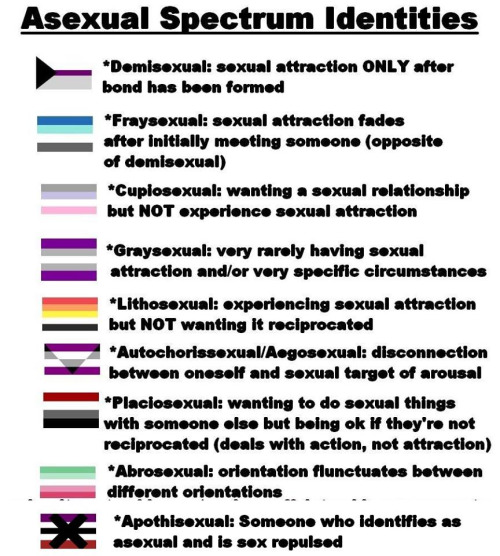
There are a lot of terms up there you are probably seeing for the first time. Don’t panic. Though if you need a moment to panic go ahead. No judging here. To help let me go through some definitions for you.
Image from Asexualscience on Tumblr
Demisexual: attraction only after an emotional bond is formed.
Fraysexual: attraction fade after getting to know someone (opposite of demi).
Cupiosexual: wanting a sexual relationship but not experiencing sexual attraction
Graysexual: very rarely having sexual attraction and/on in very specific circumstances.
Lithosexual: experiencing sexual attraction but NOT wanting it reciprocated.
Autochorissexual/Aegosexual: disconnect between oneself and target of arousal.*
Placiosexual: wanting to do sexual things with someone but being alright with the feeling not being reciprocated or acted on.
Abrosexual: orientation is fluid
Apothisexual: someone who is asexual and sex repulsed.
Okay, I’ll give you a moment to digest all that because it is a lot to take in all at once. Who knew there were so many ways to not want sex?
But wait, you say, how do I write a romance without sex being a part of the equation? Or how do I show that my character really loves their partner/significant other if they don’t find them sexually attractive?
Easy. No really it is easy. I promise.
You know how to write friendships. Of course you do! You know that there are ways to show affection, appreciation and consideration for another person that do not involve anything overtly sexual or physically intimate. There you go. (For a great list of non-sexual intimacies see Nonsexual Intimacies (Part 1 of 5) – The Wordsmith’s Forge).
Ah I see your brow furrowing. That’s just friendship, right?
Is it? You care deeply about your friends don’t you? You love them, want the best for them and care what happens to them. But we make the distinction between friends and those we are romantically involved with for our own reasons. While you love your friends, you may, or may not, find them sexually attractive. That’s the difference; the ability to feel sexual attraction. Of course, this can, and sometimes does change. It all depends on the person. There is no wrong way to be asexual.
On The Big Bang Theory it is hinted that the character Sheldon is asexual.
So while you consider that let’s look at some tips for writing asexual characters:
Keep in mind that asexual does not mean emotionless. Your character should still have emotional actions and reactions to events in line with their personality.
If the setting allows for it, it might be good to have your character specifically state they are asexual. This will help the reader understand where your character is coming from. Having other characters react and ask questions will help mitigate an info dump.
Be wary of having a plot that calls for the character’s asexuality to be a problem fixed by ‘good’ sex or a sexual relationship. In this instance it might be better to rethink your character’s orientation.
Do let your character have close intimate non-sexual relationships with other characters.
Try to avoid making your character asexual simply as a plot device. It should be an integral part of who they are, not a quirk.
If your asexual character is a minor character it might be best to avoid having them be the comedic relief as this can reinforce stereotypes of asexuals being socially inept, naive or virginal.
Asexual does not always mean aromantic and vice versa.
As with every other orientation keep in mind you are writing a person first and foremost. If you are still a bit unsure about how to go about this why don’t we focus on your character and who they are and how they practice their asexuality.
Decide where on the asexual spectrum your character lies. Does it change/fluctuate? Under what circumstances does it fluctuate? (Keep in mind that this can change over time)
How does your character think/feel about being on the asexual spectrum?
How does your character feel towards sex? Neutral, sex-repulsed, sex-positive? Does it depend on the circumstance/person?
If your character were to find themselves in a sexual situation, what would their reaction be?
How does your character tell people about being asexual (if they tell people at all)?
How do other characters react to your character’s asexuality? How does your character react/respond to these reactions?
How does the society in your story react to asexuality? How does this affect your character? What assumptions do others have about asexuality/your character?
When did/will your character realize that they are on the asexual spectrum? How does/will your character think/feel about this? Is the realization because of a specific event, a gradual understanding/coming to terms, etc?
Writing an asexual character isn’t any more challenging that writing any other character. We are just people after all. Please join me next week as I go further into ways to write asexual relationships using non-sexual intimacies and tropes to avoid.
*Autochorissexual was a term coined by psychologist Anthony Bogaert to describe identity-less sexuality and is listed as a paraphilia. To combat the negative stereotypes associated with paraphilias the term aegosexual might be more preferred. As someone who identifies as moderately aegosexual I take exception to it being listed as a paraphilia or fetish because, as defined, it doesn’t completely fit the definition of a paraphilia.
If you have any questions, comments or concerns please leave a comment. Next week I’ll go further into how to write your asexual character with examples and tropes to avoid and why.
If you enjoyed this post and would like access to exclusive content please consider supporting me on Patreon or please send me a coffee using the button above. Many thanks from this nerdy queer. ^_^

Pop star Leontyne Blake might sing about love, but she stopped believing in it a long time ago. What women want is her image, not the real her. When her father has a stroke, she flees the spotlight and returns to her tiny Missouri hometown.



 Bran Lindy Ayres