
I recently ran across a post on Tumblr where the OP was rather distraught. They’d been told that using the word asexual to describe their character’s orientation was historically inaccurate for their setting.
This brought up the issue of explicitly stating a character’s orientation within the prose and when and how this should be done. Some writers might feel that they’d rather not label their characters and let their readers decide the character’s orientation. However, I caution against this.
El at Just Love Romance recently brought out how many romance novels feature asexual and demisexual characters yet this is rarely explicitly stated for the reader. Often in movies and television a character’s sexuality is left vague and for the viewer to guess. This can lead to what is called queer-baiting and is a huge source of frustration within the community.
I’m here to help you avoid this problem no matter what genre you write.
Transparency in Prose
The best way to let your reader know a character’s orientation is to tell them. Let your character state their identity. Be explicit. If your character is questioning or unsure, let them talk about it to other (hopefully queer) characters. Don’t be afraid to show them being unsure or looking for answers. You don’t have to be writing a coming-out story to allow a character to realize who they are.
Okay … don’t look at me like that. I know what you are thinking. It doesn’t fit in the narrative, they are a secondary character, the terms are too modern for my setting, I’m afraid of reader backlash, I don’t even know how they identify, blah, blah, blah. Sorry, I’m not letting you off the hook on this one. No excuses.
Subtext is not enough. Readers want context. Which means you, my dear writer, have to be transparent when it comes to your character’s sexuality. It must be stated and shown for the reader.
But how?
Please allow me to show you.
Show and Tell
This is one of those times you can throw aside the advice to ‘show don’t tell.’ However, there are ways to show your character’s orientation. The graphic below lists the main ways to do this. As with any other characterization details there are a number of ways to get the information across to your reader.
Dialog
This is one of the easier ways to show the reader a character’s orientation. It doesn’t have to be a pages of discussion, it can be just a line or two of dialog. As long as it is clearly stated by someone. Here is an example:
Maggie stared at the curvy young woman behind the counter. A bump to her hip jolted her to the side. She glanced over to see her friend grinning at her.
“Come on Maggie, either ask her out or stop leering.”
“I … uh,” Maggie blinked rapidly as her brain went on autopilot. “She’s probably not even interested in women.”
Okay let’s stop right there. ‘Interested in women’ could mean lesbian, bisexual, or pansexual. So let’s try this:
“I … uh,” Maggie blinked rapidly as her brain went on autopilot. “She’s probably not even a lesbian.”
“Actually I’m pan,” The woman smiled showing two cute dimples.
Simple, right?
Action
Another way to show it is by your character’s actions around those they find attractive. This works nicely if it’s difficult to work the terms into dialog or you want to add extra reassurance for the reader. This is like any other scene that shows characterization, it just deals with your character’s sexual orientation. Again there is no reason to spend multiple paragraphs, get the information out there and let the reader do the rest. If you’re unsure how to show attraction check out One Stop For Writers Emotion Thesaurus. There are several entries to help you show emotional attachment. And don’t forget there are plenty of non-sexual intimacies that can show your character being attracted to or in love with someone.
Internal Dialog
This is an often under-utilized tool for characterization. You are allowed to let your character think about things, dwell on them, process them. This helps your reader too. If you feel dialog or action isn’t appropriate for your character to express their orientation then this might be a good alternative. Of course balance is needed as with all plot and characterization tools.
External Circumstances
What I mean by external circumstances is that it is not the character in question who tells/shows the reader what their orientation is. It could be anther character discussing them or something that happens in the larger world around them. Something as simple as another character stating “X is asexual, they might be uncomfortable watching this movie” or you can even tell your reader as the following paragraph demostrates.
Alice talked to Bert about her feelings for Charlie. Bert informed her that Charlie’s asexual, so whilst he might be open to a romantic relationship, he’d not be likely to respond to sexual flirting. Maybe she should try another tactic to get Charlie’s attention.
Not fantastic but you get the idea. But what if you write historical fiction, fantasy or science fiction? Can you still use the modern terms?
Absolutely.
Here are a few quick, easy ways to do so.
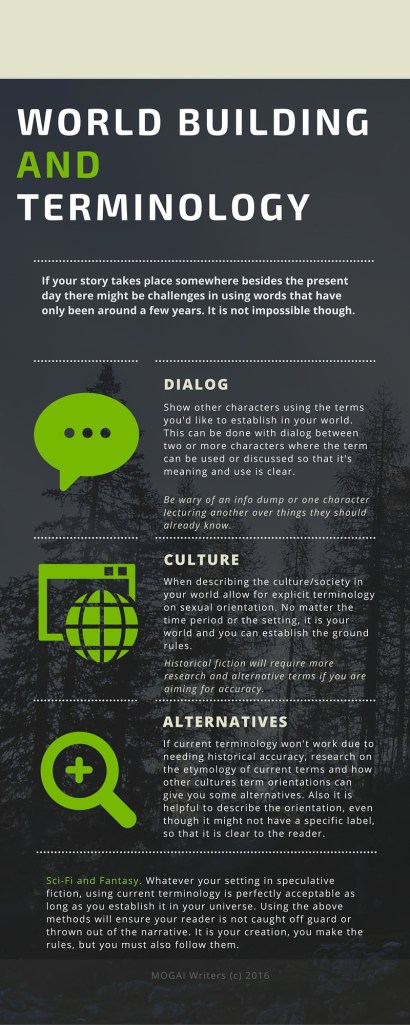
What are your thoughts on this? How would you approach revealing a character’s orientation? Have you read any books where you weren’t sure of a character’s orientation?
If you enjoyed this post and would like access to exclusive content please consider supporting me on Patreon.
 Bran Lindy Ayres