Characters · Going Over the Rainbow · writing

Going Over the Rainbow: Pronouns and Cons

On January 8, 2016 the American Dialect Society voted singular they as the word of the year.

The use of singular they builds on centuries of usage, appearing in the work of writers such as Chaucer, Shakespeare, and Jane Austen. In 2015, singular they was embraced by the Washington Post style guide. Bill Walsh, copy editor for the Post, described it as “the only sensible solution to English’s lack of a gender-neutral third-person singular personal pronoun.” – http://www.americandialect.org/2015-word-of-the-year-is-singular-they

This is a big deal. Especially for people like me who are not comfortable with gendered pronouns. It means that people cannot tell me that it is improper grammar to use they as my pronoun. It might take some time for people to get used to the idea of singular they, but it’s not the first time English as a language as changed and it most certainly won’t be the last.

Even the argument that it will be awkward to say things such as: “I saw Bran today, they were working on a new project.” doesn’t fly with me. It might sound off to an English major but for the general populace it won’t matter.

However, it will matter a great deal to non-binary, trans and genderfluid people who are not comfortable with gendered pronouns.

I understand this might be a hard concept for cis-gendered persons to grasp and truly there is no way for them to sympathize. They simply do not have the mental framework for it.

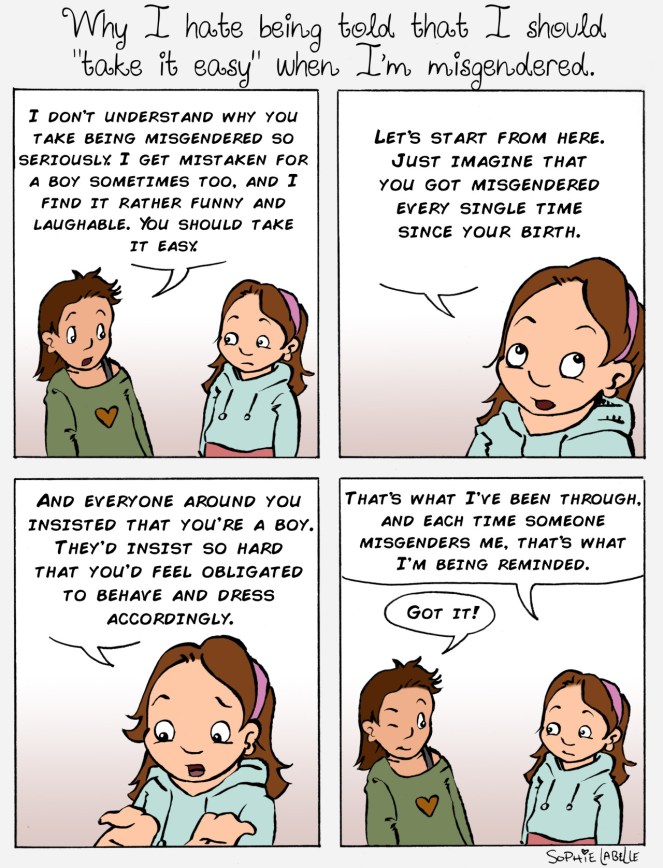
When someone calls me by female pronouns, it really unravels all the daily work (mentally, physically and emotionally) that I have done for years in order to find a gender that feels comfortable to me. I do not see anything wrong with being a woman or feminine (if anything, I often wish I could identify as this because it would be easier in some ways), but I simply do not feel like a female-bodied person. I can hardly remember a moment in my life when I did. -Janke Seltsam (http://www.huffingtonpost.com/james-nichols/misidentification-and-transphobia-one-musicians-experiences-touring-america_b_3362069.html)


With that being said, this does not mean that cis-gendered persons cannot and should not try to understand other genders. It involves being open and sensitive to the knowledge that not everyone goes by he or she.
tumblr_nj4gt27kk31tm163xo1_1280

Identity Crisis

I’m a big Transformers fan. The cool thing about them is they are robots. They do not have gender or gender binaries. Some choose to identify as male or female and use the appropriate pronouns. But what if you are writing a character who is trans, non-binary or gender-queer? What do you do then?

You, my dear writer, use their correct pronouns.

But, you say, what if they are a trans woman and the reader needs to know they are trans and were assigned male at birth?

A valid question; you want your readers to know how your character identifies but you also don’t want run the risk of turning your character into a walking stereotype, or make readers feel as though your character is wearing a sign that says ‘Hi I’m trans.’
transgender

That does not mean that the subject should not be addressed. It absolutely should. Below is a list of ways you can show, and tell, your readers which gender—if any—your character identifies with.

  • If a character’s gender is in question, have other characters comment on or think about it. This is perfectly alright. Here is an example from Masquerade, my upcoming short story prequel to The Jeweled Dagger:

He turned back to find Sivil staring at him with a strange expression. “I … apologize, from your dress and demeanor I thought you were a man. I should have realized, with the long hair and pretty face—”

“Sivil, does the Steward need a footman or a housemaid because I can do either.”

“A footman.” Sivil nodded, his gaze darting around the room, only settling briefly on Lafayette. “Is it true what they say about Kedonians then? That you don’t have genders?”

Lafayette stared at Sivil a strange cold knot tightening in his gut. He’d heard a lot of idiotic rumors about Kedonians but this one was new. He took a step closer to Sivil, “My gender is my own business. Not yours. If the Steward needs a footman, he will get a footman.”

  • If the character is a viewpoint character it is just fine to let them think about it, our gender identities and expression are a large part of how we socialize.
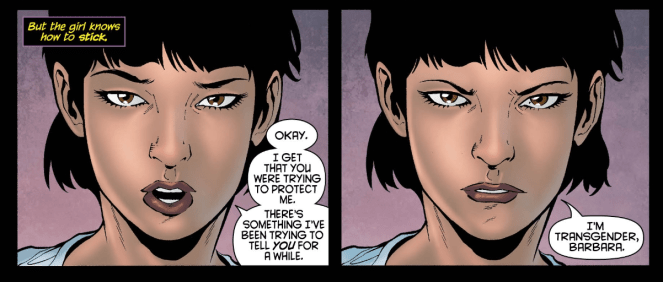
  • Let your character come right out and confirm their gender. This is best done in dialog with other characters, though depending on the story there are other ways to approach this as well.
  • Have other characters comment on their gender expression. Non-binary, trans and gender queer persons are beset with misunderstanding and misgendering on a daily basis, so it’s likely they will encounter this in your narrative.*
  • They can ask to be called by their correct pronouns or inform other characters of their correct pronouns.
  • Use description to show their gender expression. This one is a bit trickier and can come off as being transphobic and othering. Here is a good example of how to handle it without going overboard:

I was living in Vancouver’s West End, still wet behind the ears, having just arrived from the Yukon in a Volkswagen van. It was only the second apartment I ever rented, and the first time I laid eyes on Rosie it was raining, and there she was, skinny, wiry, restless-eyed Rosie right behind me on the sidewalk that led to our building’s front door with bother her arms burdened down with grocery bags. So I held the door open for her, just like my gran had taught me to.

“Chivalry lives,” she snorted as she clunked in past me in her skin-tight Levi’s and low-cut blouse and kitten heels. Of course I did not know the words for kitten heels. Yet.

Except her voice was low, like an eighteen-wheeler gearing down with its engine brakes grinding on a long steep hill down from the summit, and her bare skin above her black bra was covered in five o’clock shadow and painted with now bleeding-edged and sailor-flash faded tattoos.

I had never met any other woman quite like Rosie before.

Gender Failure

As the example shows, the description of Rosie is vivid but there is no mistaking that the narrator sees her as a woman. A little later in the story the narrator makes the mistake of calling her, he. Rosie is quick to correct them. Other than that, the fact that Rosie is trans is never really discussed. She is Rosie.

I see you squinting at the screen as you think … but the only pronouns I am aware of are he and she. Am I supposed to make up something?

Nope. As I mentioned above singular they is perfectly acceptable. My genderfluid character Lafayette, mentioned in the above excerpt, goes by he/she/they depending on the circumstances and who they are with. There are also several accepted gender-less pronouns. The only issue with the list below is that they are not very well known outside the genderqueer community and can draw your reader out of the story as they try to parse the new words. Personally, I like Spivak (ey,em, eir) as it is the least visually jarring but it is entirely up to you.

Please do not be afraid to let your character use these pronouns. They’ll never enter wider use if we don’t actually use them.

pronoun-cards-2
Image from the University of Wisconsin LGBT Resource Center

pronoun-card-1-1024x585

Contrary

You will likely get some irate readers asking why you decided to use ‘made-up’ pronouns. Be brave. Your desire to be inclusive of all genders is more important that their momentary discomfort.

Everyone deserves to be respected, even fictional characters. You cannot please everyone, but you could make a huge difference in someone’s life by showing them they have the right to be respected and treated as human no matter what gender they identify as.

As with all orientations and identities we must keep in mind that we are writing people. Which pronouns they prefer is a good clue to who they are and how they see themselves, but we must remember not to beat our reader over the head with this detail. It’s just another facet of who your character is as a person.

Ideally, your character’s gender should not be a major source of characterization. Relying on gender expression and society’s gender expectations to show character perpetuates and reinforces stereotypes. It is just fine to let gender be addressed, but a light hand usually works best. Treat it like backstory: leave it to a sentence or two here and there. The reader will do the rest.

*Sadly, in many instances (especially for non-white trans women) this situation is deadly. Please be careful how you approach this so that you’re not accidentally promoting transphobia. The only exception would be if you are writing a transphobic character.

Is there anything you feel I’ve left out? How would you handle writing a non-binary, trans or gender-queer character? Have you ever written one? If you haven’t, would you consider it?

If you enjoyed this post and would like access to exclusive content please consider supporting me on Patreon.

Characters · lgbt · mogai · Uncategorized · writing

Going Over the Rainbow: The Gender Divide

Most of us go through life never thinking much about our gender or how we express it. We might feel it is something we were born with, something absolute and  immutable. We might think there are only two genders and that we are one or the other.

‘But aren’t there only two genders?’ I hear you asking.

Nope. Male and female are only two ends of a vast spectrum. Also it helps not to confuse gender with sex. Sex is biology/physiology and even then there are intersex persons whose bodies are not clearly one or the other.

“When we think of gender, we often think of male or female; that’s only half of understanding gender. The denotations of male and female actually refer to biological and physiological sex. Gender is a sociological construct of values, ideals, and behaviors about what it means to be either male or female, and are often regarded in terms of masculine or feminine, respectively. Many people use sex and gender interchangeably, but one does not have to be male to identify as masculine, and vice versa.”

-Boundless. “Context of Culture and Gender.” Boundless Communications. Boundless, 21 Jul. 2015. 

In addition to exploring the sexual orientations in the coming months we’ll be looking at different gender identities . We’ll discuss gender identity and expression and how you can use these to make your characters more diverse.

‘Why? Can’t I just have my character be male or female?’ You ask.

Of course you can but you’re here so you’re obviously interested in being more diverse in your writing.

The Culture of Gender

Ripley, the main character in Alien originally was to be male.

Have you ever thought about how your favorite book or movie might have been different if the main character had been a different gender? What would have made it different? Why?

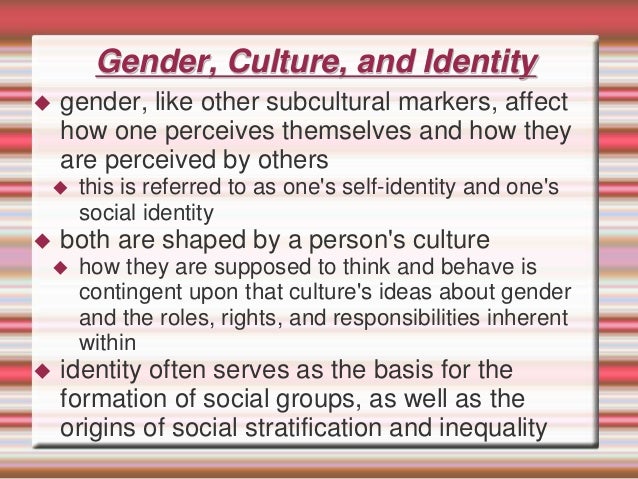
In our society (I’m speaking as someone who lives in the US) identifying as male or female comes with a host of gender specific expectations: men are macho, women are feminine, men don’t cry, women are emotionally compromised, men like cars, women like shoes, ad nauseam.  These gender stereotypes are social constructs and have little basis in biology or psychology.

“Gender theorists point to the variations in gender roles observed among different cultures in arguing that gender – our masculinity or femininity – is a social construct rather than an innate biological characteristic. Because there is no universal “right” way to be a man or a woman, they argue that our ways of “doing gender” are shaped by social cues and influences.”

Dr. Abby Palko

This is why we as writers need to be more cognizant of the variety around us.  Challenging these stereotypes can help us broaden our social consciousness and that of our readers.

‘But why should I worry about gender when I only write men or women?’ You wonder.

Because even cisgendered persons, or persons whose gender identity aligns with their gender assigned at birth, are impacted by society’s gender culture and expected to conform to certain norms. It’s not enough to  throw a bunch of ‘masculine’ traits into a character’s personality and call her a ‘strong’ female. And conversely taking a female character and switching to masculine pronouns won’t give you the sensitive male you are looking for. They each will have skin-deep traits and no real depth to them.

Sex and Gender: A Cross Cultural Perspective

It’s my hope that you’ll find the following articles interesting and maybe a little enlightening as we study the wide variation of genders and sexualities and how we can accurately write these identities.

If you enjoyed this and would like access to additional content, please consider supporting me on Patreon

Do you struggle writing a certain gender? Why do you feel that is the case? Have you ever written a character and then decided to change their gender? What prompted the change and how do you feel it turned out?


Characters · Transformers

I’m Not Male, I’m Not Female, I am Me.

Our perception of gender is tainted by the media, by what we are told is feminine and beautiful and strong and masculine.  Strong and feminine aren’t supposed to go together just as beautiful and masculine should not.   Right?

Wrong.

Gender bias is just that bias.

bias

As recently brought out in the article Gender Dichotomy is a Fairy Tale We Have Been Telling Ourselves to Sleep at Night on The Mary Sue  Anika Torruella addresses the difference between being physically male or female and being mentally male or female.  Surprise, mentally there is little to no difference, other than things we are conditioned by society to think is gender appropriate.  She quotes a new study in the Journal of Personality and Social Psychology, “Men and Women Are From Earth: Examining the Latent Structure of Gender,” headed byBobbi J. Carothers and Harry T. Reis, who are from Washington University in St. Louis and the University of Rochester.  Their goal was to “provide empirical evidence that sex and gender are not the same thing.”

So what did they find?

‘122 unique indicators from 13 studies comprising 13,301 individuals provided later, Carothers and Reis point out “clear empirical evidence to support the belief of researchers who see psychological gender differences in dimensional terms”. In other words even among those with strong and unambiguous gender identities, men and women do not exhibit all the characteristics and behaviors expected of their sex and “may also display some of the characteristics and behaviors associated with the other sex.”’

So in other words when physical gender is ignored men and women are remarkably similar.

Well I could have told you that.  And so could James Roberts, writer of the IDW Publishing comic series Transformers: More than Meets the Eye.  He’s done a masterful job at writing physically gender-less characters while still allowing them to have multidimensional personalities that either gender could identify with.  This was beautifully illustrated in Issue #13 as I will explain in a bit.

That Giant Gun Totting Robot is Female?

When you have no gender and do not identify with either gender having someone try to fit you into one role or the other can be infuriating.  So why do we do it?  Why must things that ‘look’ male automatically be male and vice versa?  Can we not choose what we feel best represents our psyche.  For myself personally, I have never identified fully with either gender.  Intellectually, I know what biology says I am but that has never affected my self-perception.

I am going to use the comic I mentioned earlier to illustrate this point.   I’m going to use two of the characters in Issue #13.   First will be Whirl, second will be Ultra Magnus.  If you are unsure why I am using Transformers, its for the simple reason that they have no gender.  They are not male or female or anything in between.  They do not reproduce sexually (at least not in the established canon, fan fiction begs to differ).  They are giant, non-organic, intelligent life forms.  (For more on their interpersonal relationships see last week’s post.)

A little backstory:

In issue #13 of IDW Publishing’s Transformers: More Than Meets the Eye the Autobots of the ship Lost Light are on shore leave on the planet Hedonia.  Being giant metal beings, they are not always welcome by the smaller organic beings who squish easily.  Sensitive to this, a few of them agree to adopt holomatter avatars in order to scout out locales where they will be welcome to come and unwind for a bit.  The program they install to adapt these avatars has been upgraded so that their avatar more closely represents their personalities.  Which makes sense because the risk for being misunderstood would jump considerably if you were uncomfortable with, or misrepresented by your avatar.

Rhodimus explains the new avatars (MTMTE #13)

Probably the biggest shock to fans was the fact that the sometimes rather insane and violent Whirl had this for ‘his’ avatar.

Autobot Whirl’s holomatter avatar. MTMTE Issue #13

In case you are unfamiliar this is his actual form:

Autobot Whirl

That’s right.  That bot that the Transformers wikia describes as  ‘ . . .a rather reckless fighter and can take damage because of it. He’s okay with that, because he absolutely LOVES his job . . .’ has what looks to be a preteen girl for an avatar.  A very tomboyish girl who obviously loves her weapons, but that’s Whirl.    Honestly, I love the fact that his avatar is so fun.  It’s obviously a perfect reflection of his personality, forget anything about it being a girl.  He didn’t choose this avatar.  The program, after analyzing his personality, chose it for him.

On the other hand we have Ultra Magnus.  He is first and foremost a soldier.  His loyalty and self-sacrifice are tempered by his reluctance to form close bonds with anyone.  That and his strict adherence to rules and regulations to the point of being obsessive compulsive.  Magnus chose his own avatar.   He chose the likeness of the one human he felt closest to who just happened to be female.

MtMtE cover issue #13

Ultra Magnus is front and center of the cover looking quite sexy with his avatar.  (Love the power pose he’s got going on.)  Those who have followed the comics will recognize the woman.  For this post her identity is not important.  What is important is that Magnus respected her enough to want to use her likeness to represent himself.  He was not concerned that she was female.  I’d wager that thought never occurred to him.  To him she was simply a human he admired and called a friend.

Maybe They are on to Something

So why do we get so hung up on the male/female dichotomy?  Why does it matter so much in our daily interactions?  Why can’t we just see people as people instead of their gender?

It goes back to what I said in the beginning, we are conditioned to think this way.  We can, however, unlearn it.  And a good way to start is by realizing that just because I look a certain way doesn’t mean I’m going to behave a certain way.   Just like with the Transformers.