Characters · Going Over the Rainbow · lgbt · mogai · writing

Going Over the Rainbow: The Diversity Dilema

GoingOver theRainbow (1)

Ever since BookCon 2014 diversity has become one of the new buzz words around the publishing industry and among writers. The #WeNeedDiverseBooks tag showed a massive outpouring of support and desire for diversity in children’s books. While at the time the movement was primarily focused on cultural diversity it has grown over the last couple of years to reflect the need for all kinds of diversity; racial, physical ability, mental illness, sexual orientation and gender identity, and not just in children’s books. While this has been needed for years and nearly everyone your meet acknowledges this to some degree, there has been some push-back. Some authors felt as though they were being forced to write characters that might not fit their stories.

Thus came the rise of tokenism, diversity quotas and many instances of misrepresentation as well meaning authors attempted to correct their lack of diversity. Others refused to add diverstiy, citing the fear of getting it wrong. While the We Need Diverse Books campaign is crucial in highlighting where the industry lacks, it has not helped authors write more diversely.

Writing with diversity is something that every author should strive for. Yet, there isn’t much out there to show you how to do so. I’ve mentioned before, there are some stories that are not ours to tell. Jami Gold had a very helpful blog post about writing more diversely and I myself have written about it in the past. Yet there still seems to be a lot of confusion about what it means and how to go about it.

Especially how to go about it.

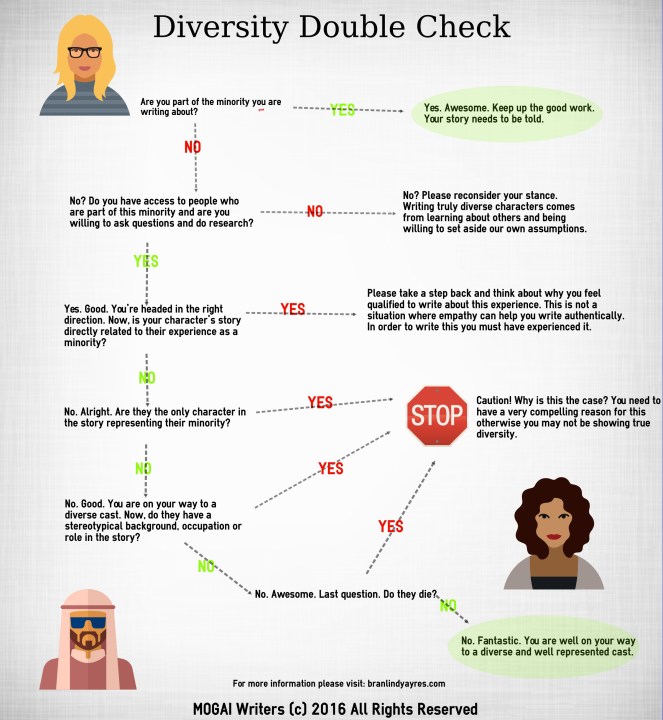
So, to that end I’ve developed a worksheet that you will hopefully find helpful in writing more diversely without falling back on stereotypes or feeling as though you’re just filling a perceived quota. The following info graphic is a shorthand version of the worksheet and is something I hope you’ll find both useful and educational.
Diversity Graphic

The Diversity Double Check (Info-graphic text)

  • Are you part of the minority you are writing about? Yes or no?
    • Yes. Awesome. Keep up the good work. Your story needs to be told.
  • No? Do you have access to people who are part of this minority and are you willing to ask questions and do research? Yes or no?
    • No. Please reconsider your stance. Writing truly diverse characters comes from learning about others and being willing to set aside our own assumptions.
  • Yes. Good. You’re headed in the right direction. Now, is your character’s story directly related to their experience as a minority? Yes or no?
    • Yes. Please take a step back and think about why you feel qualified to write about this experience. This is not a situation where empathy can help you write authentically. In order to write this you must have experienced it.
  • No. Alright. Are they the only character in the story representing their minority? Yes or no?
    • Yes. Caution! Why is this the case? You need to have a very compelling reason for this otherwise you may not be showing true diversity.
  • No. Good. You are on your way to a diverse cast. Now, do they have a stereotypical background, occupation or role in the story? Yes or no?
    • Yes. Caution! Why is this the case? You need to have a very compelling reason for this otherwise you may not be showing true diversity.
  • No. Awesome. Last question. Do they die? Yes or no?
    • Yes. Caution! Why is this the case? You need to have a very compelling reason for this otherwise you may not be showing true diversity.
  • No. Fantastic. You are well on your way to a diverse and well represented cast.

The questionnaire worksheet was created to help you ensure your story is diverse without resorting to tokenism or filling a perceived quota. You might find the answers to some questions uncomfortable. All this means is that you’ve uncovered internalized bigotry. This is not a reflection on you, but on the culture and society in which you’ve been raised. Knowledge is the first step to overcoming this perceived default state.

Even those of us who are part of a minority often find ourselves defaulting to white straight cis-gendered characters simply because this is what we see the most. It will take work to overcome this. The worksheet will help you find ways to incorporate diversity into your story—not effortlessly—but hopefully, seamlessly.

It will start you off with big picture questions about your story as a whole, from there it will take you to character specifics to help you better grasp the ways in which to reflect diversity. Lastly, there are a couple of exercises to help you get your muse used to the idea of writing diverse characters. This is not a quick fix thing. You will have to work at this, just like any other aspect of writing. It will take practice and you are going to make mistakes. It is part of learning and being a writer. But, I know you can do it and it will be awesome.

Diversity Worksheet generic (PDF)

Diversity Worksheet generic (docx)

Do you have any questions about how to incorporate more diversity into your stories? Have you found writing diversely a challenge? What about it feels challenging to you? What other kinds of worksheets or help would you like to see from me?

If you enjoy my posts please consider supporting me on Patreon. I would also be very happy if you would Buy Me a Coffee if you feel so inclined.

Characters · Uncategorized · Writing FUNdamentals

Complex Plotting: It’s Complicated

I recently stumbled across a post on Tumblr claiming that it is possible to write up a complex plot in a single day.

So can you?

Short answer. No.

A truly complex and layered plot is not something you can whip up in a day of brainstorming. What you can come up with is a premise and basic plot arc. Notice I said basic.

So what makes a plot complex? Adding more characters? Adding more events? More conflict? More themes?

Yes. All of the above. You cannot just throw one element at a plot in multitudes and expect the plot to suddenly seem complex. More than likely it will just be confusing. A truly complex plot is a careful balance of theme, character, subplot, subtext, narrative arc and premise. A truly complex plot has layers and those layers can’t just lay on top of each other, they have to connect and be intertwined and relate back to each other in every way relevant to the main story arc.

Does it sound hard? Good. It is. Writing is work. Get used to it.

What is your premise and basic plot? Pick your plot. I recommend just pulling one from this list. No plots are “original” so making yours interesting and complicated will easily distract from that fact, that and interesting characters. Characters will be something for you to work on another day, because this is plotting day. You’ll want the main plot to be fairly straight forward, because a confusing main plot will doom you if you want subplots.

Plot is something happening to someone. Without the someone to react to the something there is no plot. You need to know today who this stuff is happening to or you don’t have a plot. The 36 Dramatic Situations is a nice jumping off point. Having a complicated main plot isn’t going to hurt anything as long as you can sum it up in one sentence. More importantly in order to pull off a complicated main plot you need to know intimately WHO this happens to and why. Don’t be afraid to mix and match the 36 Dramatic Situations to come up with something unique.

Decide who the characters will be. They don’t have to have names at this point. You don’t even need to know who they are other than why they have to be in the story. The more characters there are the more complicated the plot will be. If you intend to have more than one subplot, then you’ll want more characters. Multiple interconnected subplots will give the illusion that the story is very complicated and will give the reader a lot of different things to look at at all times. It also gives you the chance to develop many side characters. The plot I worked out yesterday had 13 characters, all were necessary. Decide their “roles” don’t bother with much else. This seems shallow, but this is plot. Plot is shallow.

Now, decide what drives each character. Why specifically are they in this story? You can make this up. You don’t even know these characters yet. Just so long as everyone has their own motivations, you’re in the clear.

More characters doesn’t always equal a more complex plot. You can have as few as two named characters and have a complex plot. It depends on who they are and what they are doing. It is crucial to know why the character is doing what they are doing in the story. Having multiple interconnecting subplots is one way to create depth to the story, but if they are there just to give the illusion of substance then they are superfluous and should be cut. Deciding a character’s role in the plot is crucial as is their personality and how they are going to act and react to the events of the plot. They are what drives the plot forward so you have to know them and what is going to motivate them beyond their perceived ‘role’ in the narrative.

Shallow plots are boring plots. Dig deeper. Find that core. Find the true motivation for your character and why they are in this situation. True complexity will flow from how well you’ve crafted your character and how three dimensional you have made them.

What aren’t these characters giving away right off the bat? Give them a secret! It doesn’t have to be something that they are actively lying about or trying to hide, just find something that perhaps ties them into the plot or subplot. This is a moment to dig into subplot. This does not need to be at all connected to their drive to be present in the story.  Decide who is in love with who, what did this person do in the 70’s that’s coming back to bite them today, and what continues to haunt what-his-face to this very day. This is where you start to see the characters take shape. Don’t worry much about who they are or what they look like, just focus on what they’re doing to the story.

Backstory and character motivation are as inseparable as character and plot. Their actions, reactions and motivations are going to decide where the plot goes. Their ‘secret’ might work better as a backstory wound that affects how they deal with the events of the story. It must absolutely tie into the plot and maybe even a couple of sub plots. Otherwise it’s going to seem cheap and tacked on and your reader will feel cheated.

If a subplot doesn’t directly relate to the main characters or the main plot arc in some way, cut it. It should either emphasize the theme, help with characterization, mirror the main arc or in some other way enhance the narrative. Anything else is useless drivel. Don’t just throw in a random sub plot because you think it makes the plot more complicated. It doesn’t.

What is going to change these characters? Now this will take some thinking. Everyone wants at least a few of the characters to come out changed by the end of the story, so think, how will they be different as a result of the plot/subplot? It might not be plot that changes them, but if you have a lot of characters, a few changes that are worked into the bones of the plot might help you.

If this happens to one of the main characters it is known as the character arc and is often a sub plot of the main narrative. It will be important to fully understand your character’s motivation and backstory to fully realize what changes about them and why and how it relates to the main or sub plots.

Now list out the major events of the novel with subplot in chronological order. This will be your timeline. Especially list the historical things that you want to exist in backstory. List everything you can think of. Think about where the story is going. At this point, you likely haven’t focused too much on the main plot, yeah, it’s there, but now really focus on the rising actions, how this main plot builds its conflict, then the climactic moment. Make sure you get all of that in there. This might take a few hours.

A synopsis is worth having with a complex plot and multiple subplots. It will be crucial to have the outline to know if you have hit all the major plot points. I highly recommend using Jami Gold’s Beat Sheets to help with this. This part of planning a novel will likely take a few days if you put any real effort into it and things will probably need to be reworked multiple times.

Decide where to start writing. This part will take a LOT of thinking. It’s hard! But now that you’ve got the timeline, pick an interesting point to begin at. Something with action. Something relevant. Preferably not at the beginning of your timeline – you want to have huge reveals later on where these important things that happened prior are exposed. This is the point where you think about what information should come out when. This will be a revision of your last list, except instead of being chronological, it exists to build tension.

The opening scene of the novel must grab the reader and throw them into the middle of the action. If you are using the beat sheets you will see where you need to start, somewhere just before everything changes for the main character.

Once you’ve gotten the second list done, you’ve got a plot. Does it need work? Probably. But with that said, at this point you probably have no idea who half your characters are. Save that for tomorrow, that too will be a lot of work.

If you don’t have a very, very good idea who your characters are by now you need to go back and fix that.  Ideally take a day to figure out your premise and theme or themes, then spend another few days figuring who your characters should be and ways to make them unique, then spend a week or four figuring out what all happens when and why.

I highly recommend using the Positive and Negative Character Trait Thesauri  by Angela Ackerman & Becca Puglisi to begin crafting your characters.

PA Framed1NT

A basic straightforward plot can be easily done in a day. However do not expect to plan a complex novel with multiple characters, themes and subplots in a day. You’ll end up with a tangled mess that will be a chore to write and even worse to read.

More recommended reading:

write from the middlec&S  outlining your novel self-editing savethecat 1ET