Characters · excerpt · Going Over the Rainbow · lgbt · mogai · writing

Going Over the Rainbow: What is Gender Dysphoria?

GoingOver theRainbow (1)

Yesterday on Tumblr I had an anon ask an excellent question about gender dysphoria and what having an episode feels like. So I thought I would share it with you all here as well. This is one of those things that unless you experience it yourself it can be difficult to comprehend. I did my best to explain it but I highly recommend that if you decide to write a character who experiences gender dysphoria while you do not, that you have someone who does, beta read for you.

gender dysphoria episode ask

[Text: Anonymous asked: Could you describe of what a gender dysphoria episode is like? I understand the basics I think, but was wandering if you could describe it in more detail? Or maybe you could point out a part in the Jeweled Dagger that shows this?]

My Answer:

sorrowsfall:

Gender dysphoria is something that is only briefly mentioned in JD during a conversation between Genevieve, Olivia and Nora.

“Nora often wishes she’d been born a boy. She hates being a girl.”

 “I am sorry, Nora. That is a difficult thing.” 

Nora shrugged. “I make do. Though if you can get away with dressing as a woman maybe you can show me how to dress as a man. It would make me a lot happier than wearing this fucking dress.” 

Genevieve blinked at the course language then smiled. “I’d be happy to help.” – (The Jeweled Dagger)

The scene I mentioned in my post yesterday has the dysphoria front and center. (This might be a bit spoilery for both JD and Daggers and a rather long reply, so I hope you don’t mind). Lafayette might be genderfluid but being forced to present as a gender they are not currently experiencing can be just as difficult and disorienting as it would be for a trans person.

Current circumstances have forced Lafayette to come to Court as Genevieve. The dysphoria starts as they’re getting ready with them not recognizing themselves in the mirror.

As he got ready Lafayette kept trying to get into the right mindset. He could pretend to be Genevieve but he hated doing that. It was like trying to wear something that didn’t quite fit and chaffed, except it was internal rather than external. Watching himself in the mirror as he started applying the paste to his skin made him uncomfortable and left him with a sick hollow feeling. Did Rona not understand what she was asking of him, demanding he only appear as Genevieve? He wasn’t some actor playing a role. Though he supposed this wasn’t much different from the days he had to pretend to be male too. – (The Daggers of Ariyon)

I’ve deal with this myself a lot (it’s one of the reasons I hate mirrors so much). Imagine going into your bathroom to get ready in the morning, yet the person staring back at you in the mirror is not you. Intellectually you know it’s your face but your gut is telling you this is all wrong. Sometimes, if I’m having a bad day, this will set off either a panic attack or a depressive episode that can last hours or days. Other times I end up self-harming. Yeah, mirrors are not my friend. :/

Hearing the wrong pronouns can result in an episode too.

Nate didn’t look convinced until Olivia stuck her head out the door. “Don’t worry, I’ll keep an eye on her.”
A small jolt shot through Lafayette at the ‘her’ but he shoved the feeling aside. – (The Daggers of Ariyon)

It always gives me a start, like a sudden drop, makes me dizzy, nauseated and confused. That’s usually when I have to stop and forcefully talk to myself to prevent a full episode. I have to remind myself that people look at me and see a certain gender.

You probably have a mental image of yourself. The way you see yourself when you’re imagining doing things, or even dreaming. This is very normal, yet I don’t have a mental image of myself. I *know* what I look like, yet my mental image is just a shadowy figure. I’m never ‘myself’ in dreams. If I am it’s probably a nightmare. From what I’ve read many trans persons experience similar things, their mental image of themselves doesn’t match the external. And I don’t mean just that you think your looks aren’t what you want. This goes a whole lot deeper.

Sometimes, for some people, just having to look at or feel parts of their anatomy that don’t fit their gender can result in an episode. Others actually feel as though they are missing breasts or a penis, it’s been likened to phantom limb syndrome. This has lead to speculation that while the brain is wired to have those parts of the anatomy, they aren’t physically present. As you can imagine this can be terribly disorienting. You never feel whole, or normal no matter how hard you try.

Lafayette doesn’t have the luxury of staying home. As many of us don’t. We have to deal with the dysphoria and hope we don’t break down in public. I personally felt it was important to explore this aspect of being gender non-conforming though I know Lafe’s experience won’t be exactly the same as other people who experience gender dysphoria. Their dysphoria is different even from my own.

It’s my sincere hope that writing about this helps educate people and provides a basis for understanding.

Here are some links that might help too and I’m always happy to talk. ^_^

What does gender dysphoria feel like?

How does gender dysphoria feel?


Characters · Going Over the Rainbow · writing

Going Over the Rainbow: Pronouns and Cons

On January 8, 2016 the American Dialect Society voted singular they as the word of the year.

The use of singular they builds on centuries of usage, appearing in the work of writers such as Chaucer, Shakespeare, and Jane Austen. In 2015, singular they was embraced by the Washington Post style guide. Bill Walsh, copy editor for the Post, described it as “the only sensible solution to English’s lack of a gender-neutral third-person singular personal pronoun.” – http://www.americandialect.org/2015-word-of-the-year-is-singular-they

This is a big deal. Especially for people like me who are not comfortable with gendered pronouns. It means that people cannot tell me that it is improper grammar to use they as my pronoun. It might take some time for people to get used to the idea of singular they, but it’s not the first time English as a language as changed and it most certainly won’t be the last.

Even the argument that it will be awkward to say things such as: “I saw Bran today, they were working on a new project.” doesn’t fly with me. It might sound off to an English major but for the general populace it won’t matter.

However, it will matter a great deal to non-binary, trans and genderfluid people who are not comfortable with gendered pronouns.

I understand this might be a hard concept for cis-gendered persons to grasp and truly there is no way for them to sympathize. They simply do not have the mental framework for it.

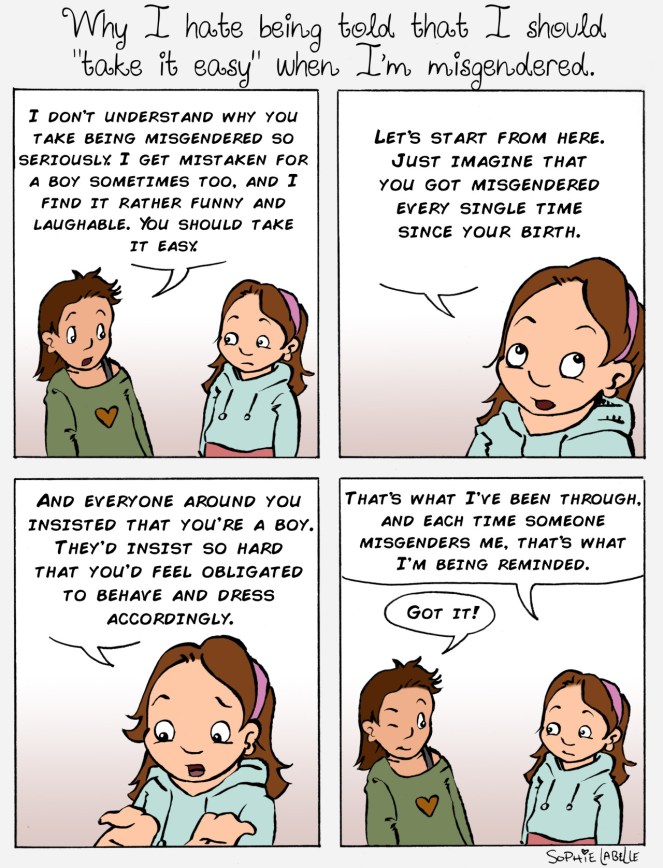
When someone calls me by female pronouns, it really unravels all the daily work (mentally, physically and emotionally) that I have done for years in order to find a gender that feels comfortable to me. I do not see anything wrong with being a woman or feminine (if anything, I often wish I could identify as this because it would be easier in some ways), but I simply do not feel like a female-bodied person. I can hardly remember a moment in my life when I did. -Janke Seltsam (http://www.huffingtonpost.com/james-nichols/misidentification-and-transphobia-one-musicians-experiences-touring-america_b_3362069.html)


With that being said, this does not mean that cis-gendered persons cannot and should not try to understand other genders. It involves being open and sensitive to the knowledge that not everyone goes by he or she.

tumblr_nj4gt27kk31tm163xo1_1280

Identity Crisis

I’m a big Transformers fan. The cool thing about them is they are robots. They do not have gender or gender binaries. Some choose to identify as male or female and use the appropriate pronouns. But what if you are writing a character who is trans, non-binary or gender-queer? What do you do then?

You, my dear writer, use their correct pronouns.

But, you say, what if they are a trans woman and the reader needs to know they are trans and were assigned male at birth?

A valid question; you want your readers to know how your character identifies but you also don’t want run the risk of turning your character into a walking stereotype, or make readers feel as though your character is wearing a sign that says ‘Hi I’m trans.’

transgender

That does not mean that the subject should not be addressed. It absolutely should. Below is a list of ways you can show, and tell, your readers which gender—if any—your character identifies with.

  • If a character’s gender is in question, have other characters comment on or think about it. This is perfectly alright. Here is an example from Masquerade, my upcoming short story prequel to The Jeweled Dagger:

He turned back to find Sivil staring at him with a strange expression. “I … apologize, from your dress and demeanor I thought you were a man. I should have realized, with the long hair and pretty face—”

“Sivil, does the Steward need a footman or a housemaid because I can do either.”

“A footman.” Sivil nodded, his gaze darting around the room, only settling briefly on Lafayette. “Is it true what they say about Kedonians then? That you don’t have genders?”

Lafayette stared at Sivil a strange cold knot tightening in his gut. He’d heard a lot of idiotic rumors about Kedonians but this one was new. He took a step closer to Sivil, “My gender is my own business. Not yours. If the Steward needs a footman, he will get a footman.”

  • If the character is a viewpoint character it is just fine to let them think about it, our gender identities and expression are a large part of how we socialize.
  • Let your character come right out and confirm their gender. This is best done in dialog with other characters, though depending on the story there are other ways to approach this as well.
  • Have other characters comment on their gender expression. Non-binary, trans and gender queer persons are beset with misunderstanding and misgendering on a daily basis, so it’s likely they will encounter this in your narrative.*
  • They can ask to be called by their correct pronouns or inform other characters of their correct pronouns.
  • Use description to show their gender expression. This one is a bit trickier and can come off as being transphobic and othering. Here is a good example of how to handle it without going overboard:

I was living in Vancouver’s West End, still wet behind the ears, having just arrived from the Yukon in a Volkswagen van. It was only the second apartment I ever rented, and the first time I laid eyes on Rosie it was raining, and there she was, skinny, wiry, restless-eyed Rosie right behind me on the sidewalk that led to our building’s front door with bother her arms burdened down with grocery bags. So I held the door open for her, just like my gran had taught me to.

“Chivalry lives,” she snorted as she clunked in past me in her skin-tight Levi’s and low-cut blouse and kitten heels. Of course I did not know the words for kitten heels. Yet.

Except her voice was low, like an eighteen-wheeler gearing down with its engine brakes grinding on a long steep hill down from the summit, and her bare skin above her black bra was covered in five o’clock shadow and painted with now bleeding-edged and sailor-flash faded tattoos.

I had never met any other woman quite like Rosie before.

Gender Failure

As the example shows, the description of Rosie is vivid but there is no mistaking that the narrator sees her as a woman. A little later in the story the narrator makes the mistake of calling her, he. Rosie is quick to correct them. Other than that, the fact that Rosie is trans is never really discussed. She is Rosie.

I see you squinting at the screen as you think … but the only pronouns I am aware of are he and she. Am I supposed to make up something?

Nope. As I mentioned above singular they is perfectly acceptable. My genderfluid character Lafayette, mentioned in the above excerpt, goes by he/she/they depending on the circumstances and who they are with. There are also several accepted gender-less pronouns. The only issue with the list below is that they are not very well known outside the genderqueer community and can draw your reader out of the story as they try to parse the new words. Personally, I like Spivak (ey,em, eir) as it is the least visually jarring but it is entirely up to you.

Please do not be afraid to let your character use these pronouns. They’ll never enter wider use if we don’t actually use them.

pronoun-cards-2
Image from the University of Wisconsin LGBT Resource Center

pronoun-card-1-1024x585

Contrary

You will likely get some irate readers asking why you decided to use ‘made-up’ pronouns. Be brave. Your desire to be inclusive of all genders is more important that their momentary discomfort.

Everyone deserves to be respected, even fictional characters. You cannot please everyone, but you could make a huge difference in someone’s life by showing them they have the right to be respected and treated as human no matter what gender they identify as.

As with all orientations and identities we must keep in mind that we are writing people. Which pronouns they prefer is a good clue to who they are and how they see themselves, but we must remember not to beat our reader over the head with this detail. It’s just another facet of who your character is as a person.

Ideally, your character’s gender should not be a major source of characterization. Relying on gender expression and society’s gender expectations to show character perpetuates and reinforces stereotypes. It is just fine to let gender be addressed, but a light hand usually works best. Treat it like backstory: leave it to a sentence or two here and there. The reader will do the rest.

*Sadly, in many instances (especially for non-white trans women) this situation is deadly. Please be careful how you approach this so that you’re not accidentally promoting transphobia. The only exception would be if you are writing a transphobic character.

Is there anything you feel I’ve left out? How would you handle writing a non-binary, trans or gender-queer character? Have you ever written one? If you haven’t, would you consider it?

If you enjoyed this post and would like access to exclusive content please consider supporting me on Patreon.

Books · gay romance

The Jeweled Dagger: Excerpt

If you like steampunk, adventure, conspiracies and grand masquerades along with technologically progressive lesbian queens, nonbinary spies and gay soldiers then my current WIP The Jeweled Dagger is probably right up your alley. Below is the introduction to Lafayette Goddard, one of the main characters.


The clang reverberated through the cell block, jolting Lafayette from where he sat leaning up against the bars of his cell. The movement set off a riot of aches and he gritted his teeth. Even as exhausted as he was sleep had been impossible with the stench, the pain, and the frustration. Blinking grit out of his eyes he reached up to pull his hair out of the way and winced as his shoulder protested. Getting slammed to the ground twice by that cretin after running all the way from the harbor made moving difficult. He should never have taken the shortcut through the garden. But he hadn’t been thinking clearly. He had only slept a handful of hours during the two days stowed away on the ship crossing the strait after running for his life in Galey. This week was becoming a string of miscalculations and bad decisions. Getting his papers stolen hadn’t even been the least of his problems.

If only he’d recognized the Captain’s uniform first off and not overreacted. He’d spent too long in Galey jumping at shadows. He was certain those same shadows had followed him back to Orandon. He lifted his head, peering down the corridor as footsteps echoed. It must be morning. His message was too late. He’d failed Rona and who knew what might happen now. He narrowed his eyes as the tall, dark haired Captain walked into view. The intent brown eyes regarded him for a long moment but his face remained impassive and Lafayette couldn’t discern what the man might be thinking.

“Get up.” The Captain man turned away and took the set of keys off his belt along with a pair of cuffs. “I’ll take you to the Queen.”