
Romance novels often get blown off by the wider reading community (and especially the literary) as frivolous emotional porn (and sometimes actual porn) lacking any real substance or plot. This couldn’t be further from the truth. However, like all genres, romance does have some troublesome tropes. Some of these tropes are perpetuated in common advice heard throughout the romance community. Particularly when it comes to what constitutes a romance plot and what ‘needs’ to happen at certain points.
There has been some backlash recently against overtly abusive relationships portrayed in some books. So how can we avoid troublesome tropes and instead show a loving, healthy relationship in our romance?
First, what is a healthy relationship? This might seem like a very simple question, but many of us are never taught (even in our personal lives) what it means to be in a healthy relationship. Showing one in a conflict-riddled romance can be a challenge, but one I know you’re up to facing. These points might even give you entirely new ways to write your next story. Just remember these points are character-centric, not plot points. Your plot can and will affect how the relationship develops, but that doesn’t mean it has to be an unhealthy relationship.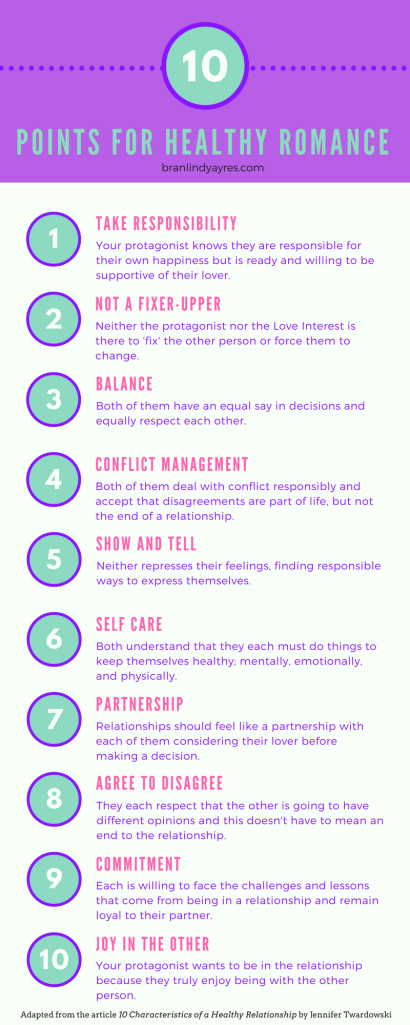
Take Responsibility:
What this means is that your main character knows their happiness is their own responsibility. They aren’t looking for someone to ‘fulfill’ them or ‘make them whole.’ The idea of two lovers being separate parts of a whole is very unhealthy for both. It is one thing for a partner to have personality traits that complement or support each other. It is very different to completely rely on the other for their personal happiness. It creates an imbalance.
Understandably this is a big trope in romance: finding the one who ‘completes’ you as a person. It’s also fraught with issues. Putting someone in the position of being responsible for your happiness isn’t just unkind, it’s unloving. The moment they can’t emotionally, mentally or physically provide that happiness, what happens? Romanticizing that kind of relationship can potentially mislead our readers into thinking they either must find someone to fulfill this or do so themselves.
This doesn’t mean you cannot write this trope, but I strongly caution you to evaluate why you are doing so. Can’t your main character be happy on their own and still find joy in their relationship? Or perhaps they can find their own happiness with support from their lover? Possibilities abound.
Not A-Fixer-Upper:
We’ve all run across those stories where the love of the main character is all that it takes to make the love interest change and become law abiding, gentle, loving, what have you. Bullshit. Like, really. Total BULLSHIT. Unless the love interest is actively wanting to change and the main character is there to unconditionally support them (or vice versa), this is just … no. We humans are very stubborn and stuck in our ways, and any change undergone to gain someone’s love is often superficial at best and deceitful at worst. In a truly healthy relationship neither partner is going to seek to change the other. They like each other for who they already are. That’s what drew them to each other in the first place. They respect each other. Respect. Remember that word. It’s important.
Balance:
Jane just loved it when John would take her menu away and order for her. He always knew exactly what she wanted. It was so romantic.
Urk. ‘scuse me, had to gag.
Jane, I hate to break it to you but either you are a doormat, or John is overbearing and controlling and you need to hightail it. Even if John really did know exactly what Jane wanted, this relationship would still be unbalanced. And probably not only when it came to ordering food.
A healthy relationship is balanced when it comes to decision making (and yes that includes ordering food). When both partners truly respect (there it is again) each other they will discuss decisions. Respect also comes into play when each partner realizes the other might have more experience in certain areas. If John is a 5-star chef, he might be off the hook. Maybe. Even then he needs to respect Jane’s personal preferences. The ‘alpha’ male portrayal is often (not always) a thinly veiled abuser. Men who must dominate in a relationship aren’t being loving or respectful of their partner. This includes MOGAI relationships too.
If you find yourself writing a lot of these kinds of characters, women characters especially, this might be a sign of internalized misogyny.
Conflict Management:
Oh boy, there’s the big C. Conflict. Romance novels thrive on conflict and tension. But is it the right kind of conflict? Hang on. I’ll explain.
As writers, we understand that conflict is often (not always) the driving force of a plot. James Scott Bell in his book Conflict & Suspense on page 7, says that conflict is a “clash between at least two incompatible sides.” Too often in romance the ‘incompatible sides’ are the main character and the love interest. Which leads to conflict. Lots of conflict.
Conflict is natural in a relationship. However, it should be seen as a time to learn and grow. Too many times in romances a petty argument has both sides slamming doors and proclaiming the relationship over. This is not a healthy relationship. If each truly cared about and respected the other they would deal with their frustrations together. If the two are so incompatible as to constantly be in conflict then why are they even together?
A better method is to have the conflict come from outside the relationship. This allows them to grow together in a partnership as they work together to resolve it.
Show and Tell:
No, no. Not the showing and telling in your prose. Deep breaths. There you go. This showing and telling has to do with your characters and how open and honest they are with each other. Understandably, being open about certain things comes after a relationship has begun or is in it’s early stages. Being able to honestly communicate and respect each other’s feelings is one of the foundations of a healthy relationship. Repressing emotions isn’t healthy and only leads to later conflicts. Not the right kind of conflict either. Again, respect comes into play, on both sides.
This one is a bit mutable depending on your plot and characters, their personalities, where they are in their relationship and how much they trust each other. However, if they respect each other at all, they will be honest and open about their true feelings. They will also find responsible ways to express those feelings. Again, this may also depend on your plot and the characters’ personalities.
Self-Care
This is related to taking responsibility for their own happiness. In order to maintain a healthy relationship the partner must first take care of themselves mentally, emotionally and physically as far as they are able. This will allow them to be properly supportive of their partner.
Partnership
An established relationship should feel like a close partnership, with each individual taking into consideration their lover’s thoughts and feelings before making a decision. This means they need to talk openly about things that concern them and make room in their lives for the other person.
Obviously, plot wise it may seem like a good idea for one or the other to go galavanting off to save the day. But this is a partnership. They’ve agreed together that they wish to be in each others lives. Could they not face the challenge together and further strengthen their relationship? If not, is there another way the partner left behind could show support or help? If you start looking, I’m certain you’ll find many ways to use this to your advantage.
Agree to Disagree
Your characters are people with their own opinions and beliefs. They aren’t going to agree on everything, and that’s just fine. If they did, it would be not only boring but either unrealistic or unbalanced.
This one is a little trickier because so many romance plots call for there to be something that drives the two lovers apart. Often times this is a disagreement over something, a closely held belief by one or the other, or ideas on how to proceed with a solution to the issue they are facing. Many times instead of talking to each other like adults, there is either no communication or spiteful arguing where one of them leaves until they are forced back together to finally confront the issue together. While this does increase the tension, it strains what could be a healthier relationship.
I challenge you to find alternate ways to introduce tension and reduce the amount of quarreling between the lovers.
Commitment
Your lovers are going to meet challenges. They have to, to test the strength of the relationship. If they are truly committed to each other, they will remain loyal and be ready to work through the challenges together.
Joy in the Other
Why did they choose each other? What is their real reason for wanting to be in the relationship? Is it for selfish reasons? Or only out of sexual attraction? Do they actually enjoy being with the other person? Why? What drew them together? What is keeping them together?
Every relationship is different, and will always have things both partners need to work on. No relationship will be perfect at each of these points, but by working at them together you’ll find yourself writing much healthier relationships that people can still identify with.
Now let’s look at how to incorporate this into the theory of 12 Key Romance Scenes as proposed by Michael Hauge.
- The Ordinary World: Your main character in their element. Show who they are and that while they may have a ‘need’ they are secure without needing a partner to feel complete. (Again, not all characters will be able to do this. They might grow over the course of the novel to learn that they are whole within themselves but that doesn’t exclude loving their partner).
- The Meet: Just what it says. Somewhere in the beginning they meet each other, and depending on your plot there may or may not be instant sparks of attraction. This is a good point to establish mutual respect at some level, even if it is an ‘enemies to lovers’ trope.
- Reconsideration: Here, many writers (Mr. Hauge included) would advise you to show that the pair are incompatible for one reason or another, or have there be an openly negative response by one of the characters. Why? Let them enjoy meeting each other and want to get to know each other. This doesn’t mean things will be perfect right off the bat. You can always have plot elements that will keep them from being able to get together. It doesn’t have to be the relationship itself that is a source of contention
- Wise Friend Counsels: Let’s make this Wise Friend Listens instead. Let your character know their own mind and make the decision for themselves. Too often women aren’t allowed to decide for themselves whether or not the relationship is for them. Their well-meaning friend will tell them why the man is ‘the one’ for them. This is often a sign of internalized misogyny on the author’s part, and needs to be very closely looked at before allowing it to stand in your story.
- Acknowledge Interest: Your main character has realized they have deeper feelings than they thought.
- First Quarrel: This can go several ways depending on your character’s personality, but use caution and remember that if they truly are invested in the relationship they will respect each other. This could be a good point to show that, and instead of pushing them apart it could draw them together as they talk through whatever is affecting their relationship.
- The Dance: A lot of writers would advise you to show the relationship development, except it’s always on the fence whether or not the relationship will actually work. There is no set rule that says this must be the case. There are plenty of ways to create tension without that tension constantly being on the verge of tearing the relationship apart.
- The Black Moment: The relationship is dead? What? Why? Instead of having something internal kill it, why not find some external reason that keeps them apart or makes the relationship impossible. If it is something internal it could be related to the character’s fatal flaw, something they have to overcome.
- Reunited: Don’t fall for the ‘fated lovers’ trope. Let them come together willingly and because they WANT to be together, not because they were ‘meant’ for each other. There obviously will still be obstacles to overcome, but don’t force them together. Let them come back to each other organically.
- Complications: This is where those obstacles really come into play. The outside forces aren’t about to let this stand for whatever reason.
- Finally together: Now they can face their issues as a couple, showing that they have grown together and can face the problem head-on. Their respect for each other allows them to defeat the issue and move on to …
Happily Ever After: There is nothing wrong with allowing your characters their happy ending. With the issues this world is facing, people crave something positive and uplifting.
Enjoyed the article? Please consider buying me a coffee or becoming a supporter on Patreon.


 Bran Lindy Ayres