Characters · gay romance · lgbt · mogai · writing · Writing FUNdamentals

Going Over the Rainbow: Crush Those Stereotypes

Get rid of stereotypical characters as easily as Dorothy got rid of the Wicked Witch of the East.

There is a lot of great advice out there when it comes to creating our characters. From Nancy Kress’ Dynamic Characters to The Positive and Negative Trait Thesaurus by Angela Ackerman and Becca Puglisi there are many excellent resources for writers looking to create truly unique and realistic characters.  Even as comprehensive as these helps are, there is one area many writers neglect.

A character’s sexuality and sexual orientation.

‘But I don’t write romance!’ I hear you saying. Romance isn’t always about sex and sex isn’t always about romance.  A character’s sexual orientation can have a huge impact on how they are treated by society, their family, how they interact with others around them and how they perceive themselves. It can be a source of both internal and external conflict.

‘But I only write straight characters!’ You say.  Okay, nothing wrong with that, but why? Why only write straight characters?  It’s almost guaranteed that you personally know, at the very least, one person of a different orientation and the likelihood is that the number is much higher. Our lives are filled with diversity and it stands to reason that our stories should be as well.

Diversity is a huge buzz word right now in the entertainment industry and while there is a great focus on it, the actual results have been marginal at best. Unfortunately some well-meaning writers have perpetuated harmful stereotypes, misrepresented an orientation or been less than accurate in their portrayals of queer* persons.

So how can you add diversity and be inclusive without stumbling into the stereotype trap?

Click your heels and we’re on our way.

The first step is to realize writing diversity is not hard. Writing a queer character is no harder than writing any other character because, first and foremost, you are writing people; not an orientation.  A lesbian is not just a lesbian, she might also be a sister, mother, accountant, scientist, police officer, volunteer firefighter or any number of things that make up someone’s identity. Her orientation is just one aspect of who she is, but it is something that helps define her, just as core traits help define personality.

Fearless Defenders #12

The second step is to decide if the character’s story is one for you to tell. As I stated last week, some stories need to be told by writers from that particular background. We should recognize when a character’s story might not be ours to tell, especially if the story centers on experiences or hardships related to their race, orientation, physical ability or mental health.  As the term goes, stay in your lane. In other words know when to check your privilege and don’t assume any amount of research is going to give you true insight into their struggles. Instead, support authors who are part of those diverse backgrounds.

Kaidan Alenko is a romanceable option for Commander Shepard in Mass Effect 3

With that being said, there is nothing wrong with including diverse characters. You absolutely should.

The final step in writing with diversity is actually creating a character that is a fair representation. Everyone’s experiences are going to be different and there is no one right way to write a queer character. However, there are most definitely wrong ways to write them.

Over the next several months I will be going through both the sexual orientation spectrum and the gender identity spectrum and helping you to avoid stereotypes and harmful misinformation. My goal is to help you not only understand your characters better but to feel more comfortable writing with diversity. I myself am a queer person. I identify as an agender/nonbinary panromantic demisexual. That’s probably is a bunch of gibberish right now, but I promise, if you stick with me I’ll show you what those labels mean and what they can mean for your character.

The first place we are going to start with is the Character Sexuality Worksheet. I designed this worksheet to help you answer orientation specific questions about your character. This should give you a launching point for your research. I’ve also included two handy flowcharts to help in case you are not sure where on the spectrum your character might fall.

Character Sexuality Worksheet

Please feel free to download and print the worksheet for your private use.

Over the next several months I will be exploring each of the various sexual orientations and gender identities in an effort to help my fellow authors write with more diversity. I will be inviting people of other orientations and gender identities to offer their advice and experiences as well. I sincerely hope you find this of value and please feel free to ask questions.

If you enjoyed this and would like access to additional content, please consider supporting me on Patreon

What orientation you are most curious about? What else would you like know about sexuality, sexual orientation, and gender identity? Have you written a character from the sexual orientation spectrum?  What challenges have you encountered in your effort to add diversity to your writing? Do you have any suggestions or comments for the worksheet or upcoming topics? I look forward to hearing from you.

*As someone who identifies as nonbinary and panromantic demisxual, I am comfortable using the term queer when describing myself or my characters. I am aware that many in the community still feel this is an insult. If you do not identify as part of the spectrum, please refrain from using the term.
Characters · Writing FUNdamentals

Non-Traditional Hero Part 3: Character Flaws and One Stop for Writers

Eeesh, it’s been awhile since I’ve been able to write a post. Sorry about that. Having a chronic illness and being a single parent can really flatten you sometimes.  So, on with the post!

Last time we talked about developing a non-traditional hero.  We discussed how archetypes are useful as a basis for creating a character and how to add traits and goals to make them truly unique and non-stereotypical. We looked at the waif archetype and discussed how to make them atypical including switching the gender typically associated with waifs.

I promised to show you how to fill out the lovely Character Pyramid available on Writers Helping Writers.  So we will focus on that today. If you have the Negative Trait Thesaurus by Angela Ackerman & Becca Puglisi you can find the pyramid in Appendix B, if not please click through to the link above where you can print out one for yourself. I like to do this so I can fill them out.

As a bonus I’m going to introduce you to One Stop for Writers. If you have followed my blog for long you’ll know I don’t really endorse writing software, but One Stop for Writers is completely different. Instead of just writing a review I thought I’d show you why I am so completely thrilled with this website and how incredibly helpful it is. So, we are going to use it to help us fill out the pyramid. You can access a lot of helpful information for free, but a subscription is only $9 a month.

So first, the pyramid. I’ve decided to use one of the characters from my upcoming novel to fill this out since I know him best. You’ll see on the page a place to put the character name and under that, a defining event. This is their backstory wound that results in the lie they believe about themselves.

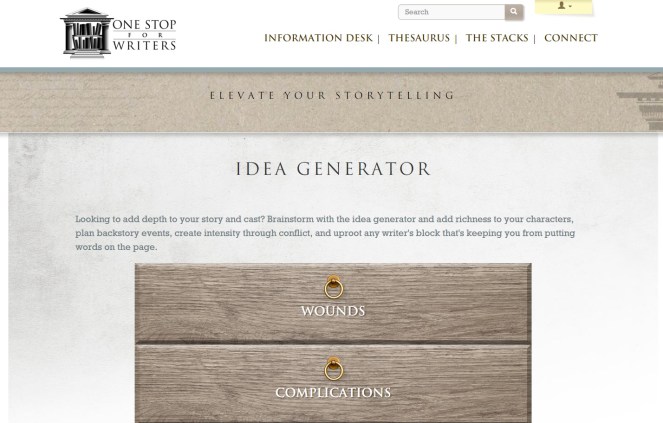
But what if you don’t know what your character’s defining event was?  One Stop for Writers has an idea generator and no it’s not random phrases strung together. At the top of the page you’ll see a drawer marked Wounds. Open and close it until something sparks an idea. That can be your defining event (just beware of getting sidetracked with all the other amazing generators as I tend to do, seriously it’s very tempting).Onestop1

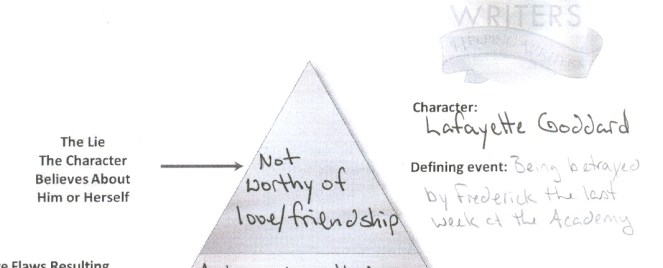
Now, we are ready for the pyramid itself. So depending on your character’s defining event what lie do they believe about themselves? Lafayette believes he is not worthy of love or close relationships because of being betrayed by someone he was in love with and trusted.

pyramid lie

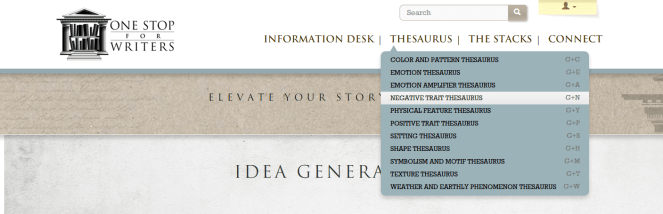
So what core flaws might result from that lie? Let’s head over to the Negative Trait Thesaurus and find some.Onestop2

One Stop for Writers makes it easy as they have the entire Negative Trait Thesaurus readily available.onestop3

So looking at our pyramid what core flaws might arise from our character’s wound and lie? To illustrate let’s look at Lafayette’s wound and lie and see what traits he could display. Having been the victim of a cruel betrayal he’s become antisocial, withdrawn, cynical, and uncooperative.

pyramid core flaws

If you are on the website you’ll find that clicking each trait gives you the entire thesaurus entry for that trait.  This should give you some ideas on how to fill the next step of the pyramid with their lesser flaws that grow from the core flaws.

Pyramid lesser flaws

For Lafayette I’ve gone with; disrespectful, jealous, suspicious, hostile and ungrateful. He’s starting to sound like a bit of a jerk. Well he is. These are your character’s bad traits, the grounding for their flaws and where they came from.

The last tier of the pyramid are the ways you will actually show these traits in your narrative. By how they think, what they think about, how they behave and act and what quirks they have, you’ll be able to show your reader your character’s flaws. So how are you going to fill this tier out?

Go through each entry and find associated behaviors that you feel fit your character. No one has all the associated behaviors and some traits might only have one main behavior to contend with. You might find that there is some overlap within the behaviors, this is just fine. This is mostly to give you a basis for ideas of how your character behaves because of their backstory wound.

Pyramid behaviors

Lafayette avoids intimacy and pushes people away. He is brutally sarcastic and will play pranks to get back at people he feels slighted by. He hordes pillows.

So now you have, or hopefully have, a completed pyramid. It should look something like this (with your character’s detail of course):

pyramid completed lafe

Now you have something to refer back to when you’re not certain how your character might react to a situation and you’ve given them new depth and realism. This will help take your hero from a nice cake with pretty icing to something truly worthy of a place at your table and something your readers will devour.

I also hope you’ve enjoyed this very short tour of One Stop for Writers and can see why I think it is an incredible tool. I’ve barely even skimmed the surface of all the wonderful features they’ve included. I am very grateful to Becca Puglisi and Angela Ackerman, authors of The Emotion Thesaurus, and Lee Powell, creator of Scrivener for Windows for putting so much thought and effort into this resource.

I hope this helps you build your wonderfully non-traditional hero! If you enjoyed this, please consider supporting me on Patreon

As always your comments and questions are welcomed below. Do you find it difficult to incorporate a character’s flaws, especially if they are the hero? Do you find yourself worried the character might come across as unlikeable or unsympathetic? How do you handle this? Please let me know your thoughts in the comments.


Characters · Uncategorized · Writing FUNdamentals

Complex Plotting: It’s Complicated

I recently stumbled across a post on Tumblr claiming that it is possible to write up a complex plot in a single day.

So can you?

Short answer. No.

A truly complex and layered plot is not something you can whip up in a day of brainstorming. What you can come up with is a premise and basic plot arc. Notice I said basic.

So what makes a plot complex? Adding more characters? Adding more events? More conflict? More themes?

Yes. All of the above. You cannot just throw one element at a plot in multitudes and expect the plot to suddenly seem complex. More than likely it will just be confusing. A truly complex plot is a careful balance of theme, character, subplot, subtext, narrative arc and premise. A truly complex plot has layers and those layers can’t just lay on top of each other, they have to connect and be intertwined and relate back to each other in every way relevant to the main story arc.

Does it sound hard? Good. It is. Writing is work. Get used to it.

What is your premise and basic plot? Pick your plot. I recommend just pulling one from this list. No plots are “original” so making yours interesting and complicated will easily distract from that fact, that and interesting characters. Characters will be something for you to work on another day, because this is plotting day. You’ll want the main plot to be fairly straight forward, because a confusing main plot will doom you if you want subplots.

Plot is something happening to someone. Without the someone to react to the something there is no plot. You need to know today who this stuff is happening to or you don’t have a plot. The 36 Dramatic Situations is a nice jumping off point. Having a complicated main plot isn’t going to hurt anything as long as you can sum it up in one sentence. More importantly in order to pull off a complicated main plot you need to know intimately WHO this happens to and why. Don’t be afraid to mix and match the 36 Dramatic Situations to come up with something unique.

Decide who the characters will be. They don’t have to have names at this point. You don’t even need to know who they are other than why they have to be in the story. The more characters there are the more complicated the plot will be. If you intend to have more than one subplot, then you’ll want more characters. Multiple interconnected subplots will give the illusion that the story is very complicated and will give the reader a lot of different things to look at at all times. It also gives you the chance to develop many side characters. The plot I worked out yesterday had 13 characters, all were necessary. Decide their “roles” don’t bother with much else. This seems shallow, but this is plot. Plot is shallow.

Now, decide what drives each character. Why specifically are they in this story? You can make this up. You don’t even know these characters yet. Just so long as everyone has their own motivations, you’re in the clear.

More characters doesn’t always equal a more complex plot. You can have as few as two named characters and have a complex plot. It depends on who they are and what they are doing. It is crucial to know why the character is doing what they are doing in the story. Having multiple interconnecting subplots is one way to create depth to the story, but if they are there just to give the illusion of substance then they are superfluous and should be cut. Deciding a character’s role in the plot is crucial as is their personality and how they are going to act and react to the events of the plot. They are what drives the plot forward so you have to know them and what is going to motivate them beyond their perceived ‘role’ in the narrative.

Shallow plots are boring plots. Dig deeper. Find that core. Find the true motivation for your character and why they are in this situation. True complexity will flow from how well you’ve crafted your character and how three dimensional you have made them.

What aren’t these characters giving away right off the bat? Give them a secret! It doesn’t have to be something that they are actively lying about or trying to hide, just find something that perhaps ties them into the plot or subplot. This is a moment to dig into subplot. This does not need to be at all connected to their drive to be present in the story.  Decide who is in love with who, what did this person do in the 70’s that’s coming back to bite them today, and what continues to haunt what-his-face to this very day. This is where you start to see the characters take shape. Don’t worry much about who they are or what they look like, just focus on what they’re doing to the story.

Backstory and character motivation are as inseparable as character and plot. Their actions, reactions and motivations are going to decide where the plot goes. Their ‘secret’ might work better as a backstory wound that affects how they deal with the events of the story. It must absolutely tie into the plot and maybe even a couple of sub plots. Otherwise it’s going to seem cheap and tacked on and your reader will feel cheated.

If a subplot doesn’t directly relate to the main characters or the main plot arc in some way, cut it. It should either emphasize the theme, help with characterization, mirror the main arc or in some other way enhance the narrative. Anything else is useless drivel. Don’t just throw in a random sub plot because you think it makes the plot more complicated. It doesn’t.

What is going to change these characters? Now this will take some thinking. Everyone wants at least a few of the characters to come out changed by the end of the story, so think, how will they be different as a result of the plot/subplot? It might not be plot that changes them, but if you have a lot of characters, a few changes that are worked into the bones of the plot might help you.

If this happens to one of the main characters it is known as the character arc and is often a sub plot of the main narrative. It will be important to fully understand your character’s motivation and backstory to fully realize what changes about them and why and how it relates to the main or sub plots.

Now list out the major events of the novel with subplot in chronological order. This will be your timeline. Especially list the historical things that you want to exist in backstory. List everything you can think of. Think about where the story is going. At this point, you likely haven’t focused too much on the main plot, yeah, it’s there, but now really focus on the rising actions, how this main plot builds its conflict, then the climactic moment. Make sure you get all of that in there. This might take a few hours.

A synopsis is worth having with a complex plot and multiple subplots. It will be crucial to have the outline to know if you have hit all the major plot points. I highly recommend using Jami Gold’s Beat Sheets to help with this. This part of planning a novel will likely take a few days if you put any real effort into it and things will probably need to be reworked multiple times.

Decide where to start writing. This part will take a LOT of thinking. It’s hard! But now that you’ve got the timeline, pick an interesting point to begin at. Something with action. Something relevant. Preferably not at the beginning of your timeline – you want to have huge reveals later on where these important things that happened prior are exposed. This is the point where you think about what information should come out when. This will be a revision of your last list, except instead of being chronological, it exists to build tension.

The opening scene of the novel must grab the reader and throw them into the middle of the action. If you are using the beat sheets you will see where you need to start, somewhere just before everything changes for the main character.

Once you’ve gotten the second list done, you’ve got a plot. Does it need work? Probably. But with that said, at this point you probably have no idea who half your characters are. Save that for tomorrow, that too will be a lot of work.

If you don’t have a very, very good idea who your characters are by now you need to go back and fix that.  Ideally take a day to figure out your premise and theme or themes, then spend another few days figuring who your characters should be and ways to make them unique, then spend a week or four figuring out what all happens when and why.

I highly recommend using the Positive and Negative Character Trait Thesauri  by Angela Ackerman & Becca Puglisi to begin crafting your characters.

PA Framed1NT

A basic straightforward plot can be easily done in a day. However do not expect to plan a complex novel with multiple characters, themes and subplots in a day. You’ll end up with a tangled mess that will be a chore to write and even worse to read.

More recommended reading:

write from the middlec&S  outlining your novel self-editing savethecat 1ET

Books · Characters · Sorrow's Fall · Writing FUNdamentals

Let’s Get Complicated Part Two: The Positives of Being a Villain

So last time we talked about creating multi-dimensional characters and focused on the protagonist of my novel Sorrow’s Fall.  This week I’d like to help you look for ways to make your antagonist just as compelling and multi-faceted.  After reading my post about Sorrow you are probably wondering what kind of person could possibly be an impediment to him and his goals.  That’s a very good question. It’s also one you need to consider in your own story. For now we are going to assume that your antagonist is another person and not that your character is struggling against nature or something. Nature doesn’t really have a personality, though it might seem like it at times.

In Sorrow’s Fall we are quickly introduced to Qadira Fall. She is the daughter of Lady Zulyekha Fall and the Queen-In-Waiting. She is nearly as powerful as the Barendi Queen herself. She has been raised and groomed to be consummate royalty. She is gorgeous, highly-intelligent and disgustingly wealthy. She also hates Sorrow with a passion. In the book he has no idea why she detests him. All he knows is that she tries to kill him every chance she gets.

She is his antagonist. But outside of her hatred for Sorrow, what is she like?  We know she’s royalty, that she inspires great loyalty among her coterie and that she is driven by the need to save her race. But what core qualities does she possess that take her from just being the person who hates Sorrow to a force all her own?

Last time we started with a negative trait, since most heroes have issues with them. This time lets look at the positive qualities a villain could have.  Yes, even villains have positive traits.  Serious. I’ll prove it.

First I need to figure out her core moral value. The Postitive Trait Thesaurus by Angela Ackerman & Becca Puglisi offers some amazing insight as to why this is so necessary. Not just for villains, but for our heroes as well. In The Positive Trait Thesaurus Appendix B has a method for finding your character’s core moral value. This is the core belief that affects all their other traits.  After making my lovely list of her positive traits I went to Appendix A to see which of them were moral values.  The main one was professional.  I’ll be honest. That confused me. Until I went to the entry for it.  There they list the definition as: exhibiting specialized knowledge and applying it with courtesy and good judgement.

Whoa. Wait-a-minute.  Now I’m more confused. My villain is courteous and has good judgement?  Well, let’s think about this for a moment. She is extremely well educated by the best instructors money can buy. She’s talented, smart, career and success focused, she’s ambitious and mature for her age. She is confident with high self-esteem and is highly ethical.

She’s not sounding very vile.  And if you are not a threat to her, she’s won’t be.  So what associated behaviors might she display where Sorrow can see them?  Lets look at the list.

  • Having the education and knowledge required to be proficient at one’s job
  • Being experienced in a specific field of work
  • Reliability, trustworthiness and honesty
  • Having strong people skills
  • Objectivity
  • Working well under pressure
  • Having a strong command of language and being able to articulate oneself well
  • Adaptability
  • Keeping one’s promises
  • Maintaining control over one’s emotions
  • Being proactive
  • Thinking before acting
  • Treating others with respect and courtesy
  • Being proactive
  • Being a strong listener
  • Assessing the politics of a situation and acting accordingly
  • Using good hygiene
  • Being well dressed
  • Acting appropriately for the situation

I could go on but you get the idea. A couple of the ones I highlighted as far as things Sorrow sees are; being experienced, adaptability, keeping promises, using good hygiene and being well dressed. Each of these things on their own seems pretty neutral or at least positive. So how do we grow her character beyond just being professional?  Well according to Appendix B the next layer beyond the moral core is achievement traits. This was a new thought for me and it took me a little getting used to, but now I see how invaluable it is. So let’s look further into Qadira’s personality and see what achievement traits she’s might posses that build on her core trait of professionalism.

The first one that pops out for me is ambitious but decisive actually wins out as the dominant trait here. Mostly because you can’t get much more successful than she already is, though she does have ambitions. Her decisiveness on the other hand is partly her and partly her upbringing. She’s had to bear a lot of responsibility since she was very young and much is expected of her. Her core value also influences her decisiveness since she is driven by a strong sense of responsibility and has the desire to lead.

Cool, we are on a roll here. Can you see how working from the inmost core trait outward is helping us build her personality and keep her well rounded? Let’s move on to the next layer: interactive.

These traits develop through interaction with others and the world in which the character lives. These traits help her work with her subordinates, handle conflicts, convey ideas and create healthy relationships. So building on our core trait of professionalism and our achievement trait of decisiveness what might be her dominant interactive trait? Here I run across several that are worth noting such as bold, flirtatious, inspirational, patriotic, persuasive, sophisticated and traditional. She is all these traits to varying degrees, but which one is dominant and why? Looking through the book both patriotic and sophistication are good choices, but sophisticated wins.  This is mostly due to her upbringing and the culture in which she was raised. She was brought up to be royalty so sophistication is not only needed, it’s demanded.

Now we come to the out most layer, the identity layer. The book describes this layer as “attributes [that] are tied to a personal sense of identity, leading to satisfaction and contentment with who one is. Traits emerge to allow the character to explore and better understand what makes them unique.” (The Positive Trait Thesaurus 2013, Ackerman & Puglisi, Appendix B page 233). It’s in this layer that I would put patriotic along with traditional. Here traditional actually compliments patriotic. She is very concerned with keeping her native culture untainted by outside influences which is directly tied to politics. She even went so far as to disown her mother who went against the established tradition and is willing to start a war to keep things as they have been.

You’ll notice we’ve not once considered the negative side of any of these traits, yet we already have a very good basis for her character. And she doesn’t seem all that evil does she? 

All of this just from a core value of professionalism.