Characters · Going Over the Rainbow · lgbt · mogai · writing

Going Over the Rainbow: The Diversity Dilema

GoingOver theRainbow (1)

Ever since BookCon 2014 diversity has become one of the new buzz words around the publishing industry and among writers. The #WeNeedDiverseBooks tag showed a massive outpouring of support and desire for diversity in children’s books. While at the time the movement was primarily focused on cultural diversity it has grown over the last couple of years to reflect the need for all kinds of diversity; racial, physical ability, mental illness, sexual orientation and gender identity, and not just in children’s books. While this has been needed for years and nearly everyone your meet acknowledges this to some degree, there has been some push-back. Some authors felt as though they were being forced to write characters that might not fit their stories.

Thus came the rise of tokenism, diversity quotas and many instances of misrepresentation as well meaning authors attempted to correct their lack of diversity. Others refused to add diverstiy, citing the fear of getting it wrong. While the We Need Diverse Books campaign is crucial in highlighting where the industry lacks, it has not helped authors write more diversely.

Writing with diversity is something that every author should strive for. Yet, there isn’t much out there to show you how to do so. I’ve mentioned before, there are some stories that are not ours to tell. Jami Gold had a very helpful blog post about writing more diversely and I myself have written about it in the past. Yet there still seems to be a lot of confusion about what it means and how to go about it.

Especially how to go about it.

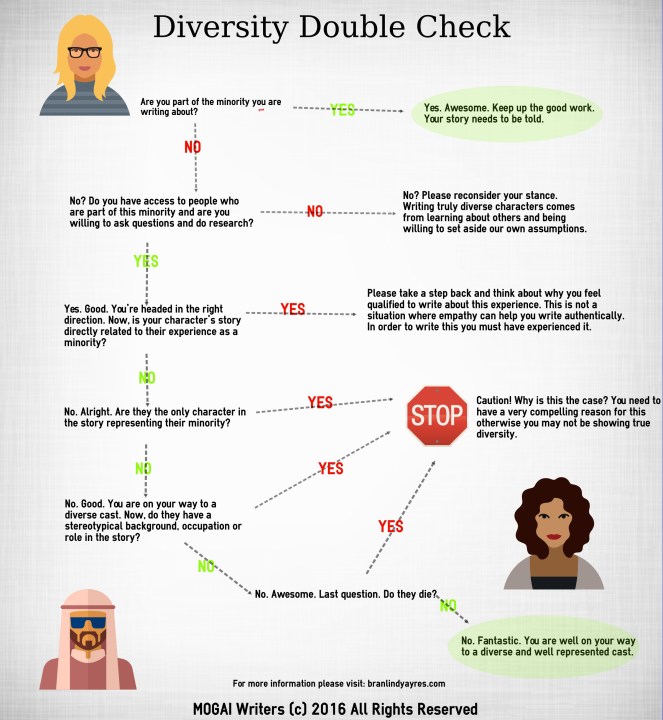
So, to that end I’ve developed a worksheet that you will hopefully find helpful in writing more diversely without falling back on stereotypes or feeling as though you’re just filling a perceived quota. The following info graphic is a shorthand version of the worksheet and is something I hope you’ll find both useful and educational.
Diversity Graphic

The Diversity Double Check (Info-graphic text)

  • Are you part of the minority you are writing about? Yes or no?
    • Yes. Awesome. Keep up the good work. Your story needs to be told.
  • No? Do you have access to people who are part of this minority and are you willing to ask questions and do research? Yes or no?
    • No. Please reconsider your stance. Writing truly diverse characters comes from learning about others and being willing to set aside our own assumptions.
  • Yes. Good. You’re headed in the right direction. Now, is your character’s story directly related to their experience as a minority? Yes or no?
    • Yes. Please take a step back and think about why you feel qualified to write about this experience. This is not a situation where empathy can help you write authentically. In order to write this you must have experienced it.
  • No. Alright. Are they the only character in the story representing their minority? Yes or no?
    • Yes. Caution! Why is this the case? You need to have a very compelling reason for this otherwise you may not be showing true diversity.
  • No. Good. You are on your way to a diverse cast. Now, do they have a stereotypical background, occupation or role in the story? Yes or no?
    • Yes. Caution! Why is this the case? You need to have a very compelling reason for this otherwise you may not be showing true diversity.
  • No. Awesome. Last question. Do they die? Yes or no?
    • Yes. Caution! Why is this the case? You need to have a very compelling reason for this otherwise you may not be showing true diversity.
  • No. Fantastic. You are well on your way to a diverse and well represented cast.

The questionnaire worksheet was created to help you ensure your story is diverse without resorting to tokenism or filling a perceived quota. You might find the answers to some questions uncomfortable. All this means is that you’ve uncovered internalized bigotry. This is not a reflection on you, but on the culture and society in which you’ve been raised. Knowledge is the first step to overcoming this perceived default state.

Even those of us who are part of a minority often find ourselves defaulting to white straight cis-gendered characters simply because this is what we see the most. It will take work to overcome this. The worksheet will help you find ways to incorporate diversity into your story—not effortlessly—but hopefully, seamlessly.

It will start you off with big picture questions about your story as a whole, from there it will take you to character specifics to help you better grasp the ways in which to reflect diversity. Lastly, there are a couple of exercises to help you get your muse used to the idea of writing diverse characters. This is not a quick fix thing. You will have to work at this, just like any other aspect of writing. It will take practice and you are going to make mistakes. It is part of learning and being a writer. But, I know you can do it and it will be awesome.

Diversity Worksheet generic (PDF)

Diversity Worksheet generic (docx)

Do you have any questions about how to incorporate more diversity into your stories? Have you found writing diversely a challenge? What about it feels challenging to you? What other kinds of worksheets or help would you like to see from me?

If you enjoy my posts please consider supporting me on Patreon. I would also be very happy if you would Buy Me a Coffee if you feel so inclined.
Characters · Going Over the Rainbow · lgbt · mogai · writing · Writing FUNdamentals

Going Over the Rainbow: Aromantic

When Romance is Not an Option

I was having a hard time deciding where to start, so I thought I’d just do this alphabetically. ^^ I personally am between pan and aro when it comes to romantic orientation. I don’t claim to understand everything about either, and my experiences will vary widely from other aromantics.

Aromanticism is:

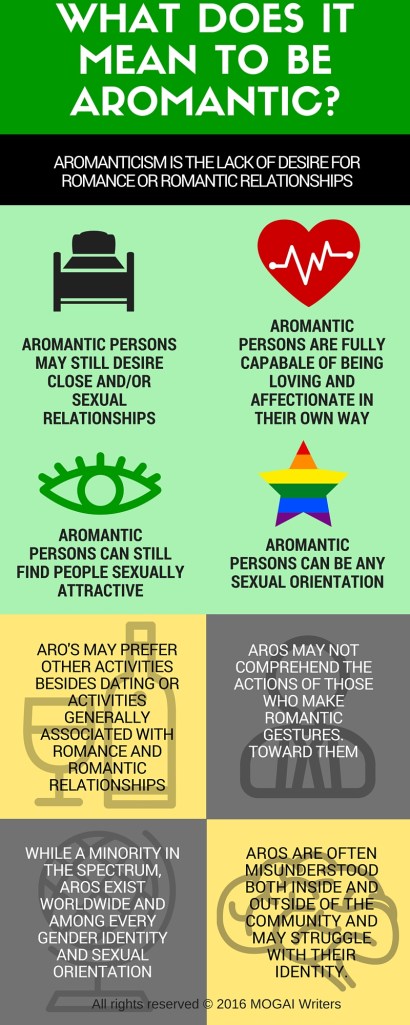
not experiencing romantic attraction.

Aromanticism is not:  

a personal choice or lack of emotional connection.

Definition (From AVEN Wiki): An aromantic is a person who experiences lAromanticittle or no romantic attraction to others. Where romantic people have an emotional need to be with another person in a romantic relationship, aromantics are often satisfied with friendships and other non-romantic relationships. What distinguishes romantic relationships from a non-romantic relationships can vary diversely, but often includes physical connection (holding hands, cuddling, etc.) (Italics mine).The aromantic attribute is usually considered to be innate and not a personal choice, just as the lack of sexual attraction is innate to asexuals. It is important to note that aromantics do not lack emotional/personal connection, but simply have no instinctual need to develop connections of a romantic nature. Aromantics can have needs for just as much empathetic support as romantics, but these needs can be fulfilled in a platonic way.

It is possible for an aromantic individual to be involved in, and enjoy, a devoted relationship with another person, but these relations are often closer friendships, naturally reflecting the closeness of the two individuals and not a purposely initiated monogamous separation as is often found in romantic couples. Aromantics may experience squishes which are the aromantic or platonic equivalent of a romantic crush. When an aromatic get’s into a relationship that’s more than friends – but less than romantic – that is known as a queerplatonic relationship.

Like all romantic identities aromatics can be of any sexual orientation.

Writing the Aromantic Character

The first thing to remember when writing an aromantic character is that being aromantic does not mean incapable of love, affection or sexual intimacy. It simply means they do not experience romantic attraction. They have friends and other relationships but not with a goal of a romance. (http://www.buzzfeed.com/mcrosswell/5-myths-about-aromanticism-tysc#.lvwnEXPxq)

Romantic Orientation – Describes an individual’s pattern of romantic attraction based on a person’s gender(s) regardless of one’s sexual orientation. For individuals who experience sexual attraction, their sexual orientation and romantic orientation are often in alignment (i.e. they experience sexual attraction toward individuals of the same gender(s) as the individuals they are interested in forming romantic relationships with). (AVEN Wiki).

As when writing any character, you need to ask yourself several questions:

  • Have I given them other meaningful, close relationships?
  • Have I fallen into the stereotype of the aromantic asexual as an unfeeling, friendless, virginal robot who hates everyone? Not all aromantic people are asexual.
  • Do I fully understand what it means to be aromantic? Is this my story to tell?
  • Have I tried to ‘fix’ the character’s or tried to show them suddenly being romantic when they find the ‘right’ person?
  • What are my reasons for having this character be aromantic? Have I made them a whole person or is their orientation their primary characteristic? Am I trying to fill a perceived quota?
  • Have I made the character aromantic due to mental illness, trauma, personal failing or some outside factor? If so, why and how does it serve the plot?
  • Have I made this character’s orientation the comedic relief?

Now some questions for your aromantic character:

  • Do they realize they are aromantic? How do they feel about this? Do they wish they were ‘normal’ or are they content with their orientation? Do they try to force themselves into romantic relationships? What are the consequences?
  • When did they discover their orientation? Was it a gradual understanding that took years. Are they still a teen and trying to come to grips with how different they might seem from all their peers?
  • Who else knows about their orientation or have they told anyone? If so, who and why or why not? How did those they told react? How did they handle this reaction?
  • How has their orientation affected their other relationships?
  • Do they want a close platonic or even sexual relationship?
  • Does their orientation intersect with other things such as gender identity, race, physical disability, mental illness, or other factors? How do they handle this intersectionality?

Once you’ve addressed these questions, it is important to remember that you are writing a person. A whole person not just an orientation. While a person’s orientation is integral to who they are and defines them up to a point it shouldn’t be the sole basis for their personality. This can lead to falling into the trope trap. While tropes themselves are not bad some can perpetuate harmful stereotypes. Aromantics are seldom, if ever, seen in media so there are very few tropes about them, though many of the asexual tropes can apply as well.

Don’t shy away from writing them just because they are rare. They are part of the spectrum and need to be favorably represented so that other aromantics can read their stories and see that they are not broken, ‘messed up,’ or ‘weird.’ They are normal people who just happen to not be interested in romance. This might feel like a challenge at first and if you are romantically inclined it might be difficult to comprehend. It’s okay. Their story might not be yours to write and that’s fine. But don’t let that scare you off from including their orientation in your stories. If anything the research can help you, as it has me, come to a better understanding of others and to have greater empathy.

Here are some more references I found helpful that I’d like to share with you:

Aromantic – AVENwiki

5 Myths About Aromanticism – BuzzFeed

ASK AN AROMANTIC (if asking questions please remember to be courteous and not assume things)

Anagnori : You might be aromantic if…

Resources for Aromantic Sexual People | The Thinking Aro

Asexual Romances Are Necessary

Going Over the Rainbow: Like a Moth to a Flame

Going Over the Rainbow: The Trope Trap

Going Over the Rainbow: Crush Those Stereotypes

Please share your thoughts with me. Were you aware of the aromantic orientation? Have you met an aromantic person? Would you consider including one in a story? What challenges do you think aromantics face in our society? How might this affect their portrayal in media? Do you know of any canon aromantic characters in a book, movie or game? 

If you enjoyed this post and would like access to exclusive content please consider supporting me on Patreon.