asexual · Characters · Going Over the Rainbow · lgbt · mogai · writing

Going Over the Rainbow: Writing an Asexual Character Part 2

GoingOver theRainbow (1)

I apologize for this post being late, but I spent some extra time to make sure I covered as many topics as possible.

For the last couple of weeks we’ve been looking at the asexuality spectrum and how to write asexual characters.  Last week we discussed more about the spectrum and went over some terminology for various points on the spectrum as well as things to keep in mind and questions to ask yourself.

This week I’d like to show you how to put these things into practice. We’ll look at some examples of asexual characters in the media and why the character may or may not be a good representative of asexuals. We’ll also go over how to write romance with a character who identifies as asexual.

As you’ll hear me say many, many times over the course of this series; you are writing a person, not an orientation. This fact needs to be in the forefront of your mind at all times to avoid stereotypes and othering language.

Continue reading “Going Over the Rainbow: Writing an Asexual Character Part 2”

asexual · Characters · Going Over the Rainbow · lgbt · mogai · writing

Going Over the Rainbow: Writing an Asexual Character

Last week we discussed what asexuality is and the challenges faced by many asexuals. We really only dipped our toe in the water though, there is a lot more to being asexual than what I can cover in a couple of blog posts, so I very much encourage you to click through the links and do your own research too.

So how do you go about writing this mythological creature? First, lets see where on the spectrum your character might fit.

Asexuality Flowchart

The above flow chart should give you a good idea where to start with your character. (You can also download the full chart here).

There are a lot of terms up there you are probably seeing for the first time. Don’t panic. Though if you need a moment to panic go ahead. No judging here. To help let me go through some definitions for you.

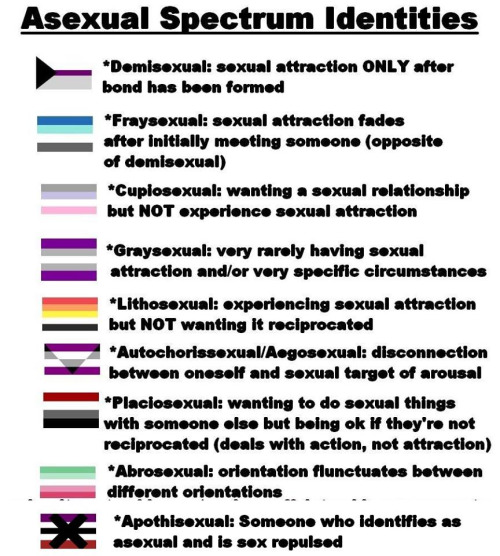
  • tumblr_nppf4wwfpm1tdi2euo1_500
    Image from Asexualscience on Tumblr

    Demisexual: attraction only after an emotional bond is formed.

  • Fraysexual: attraction fade after getting to know someone (opposite of demi).
  • Cupiosexual: wanting a sexual relationship but not experiencing sexual attraction
  • Graysexual: very rarely having sexual attraction and/on in very specific circumstances.
  • Lithosexual: experiencing sexual attraction but NOT wanting it reciprocated.
  • Autochorissexual/Aegosexual: disconnect between oneself and target of arousal.*
  • Placiosexual: wanting to do sexual things with someone but being alright with the feeling not being reciprocated or acted on.
  • Abrosexual: orientation is fluid
  • Apothisexual: someone who is asexual and sex repulsed.

Okay, I’ll give you a moment to digest all that because it is a lot to take in all at once. Who knew there were so many ways to not want sex?

But wait, you say, how do I write a romance without sex being a part of the equation? Or how do I show that my character really loves their partner/significant other if they don’t find them sexually attractive?

Easy. No really it is easy. I promise.

You know how to write friendships. Of course you do! You know that there are ways to show affection, appreciation and consideration for another person that do not involve anything overtly sexual or physically intimate. There you go. (For a great list of non-sexual intimacies see Nonsexual Intimacies (Part 1 of 5) – The Wordsmith’s Forge).

Ah I see your brow furrowing. That’s just friendship, right?

Is it? You care deeply about your friends don’t you? You love them, want the best for them and care what happens to them. But we make the distinction between friends and those we are romantically involved with for our own reasons. While you love your friends, you may, or may not, find them sexually attractive. That’s the difference; the ability to feel sexual attraction. Of course, this can, and sometimes does change. It all depends on the person. There is no wrong way to be asexual.

5075celebrity-pictures-big-bang-theory-boobs-vista
On The Big Bang Theory it is hinted that the character Sheldon is asexual.

So while you consider that let’s look at some tips for writing asexual characters:

  • Keep in mind that asexual does not mean emotionless. Your character should still have emotional actions and reactions to events in line with their personality.
  • If the setting allows for it, it might be good to have your character specifically state they are asexual. This will help the reader understand where your character is coming from. Having other characters react and ask questions will help mitigate an info dump.
  • Be wary of having a plot that calls for the character’s asexuality to be a problem fixed by ‘good’ sex or a sexual relationship. In this instance it might be better to rethink your character’s orientation.
  • Do let your character have close intimate non-sexual relationships with other characters.
  • Try to avoid making your character asexual simply as a plot device. It should be an integral part of who they are, not a quirk.
  • If your asexual character is a minor character it might be best to avoid having them be the comedic relief as this can reinforce stereotypes of asexuals being socially inept, naive or virginal.
  • Asexual does not always mean aromantic and vice versa.

As with every other orientation keep in mind you are writing a person first and foremost. If you are still a bit unsure about how to go about this why don’t we focus on your character and who they are and how they practice their asexuality.

  • Decide where on the asexual spectrum your character lies. Does it change/fluctuate? Under what circumstances does it fluctuate? (Keep in mind that this can change over time)
  • How does your character think/feel about being on the asexual spectrum?
  • How does your character feel towards sex? Neutral, sex-repulsed, sex-positive? Does it depend on the circumstance/person?
  • If your character were to find themselves in a sexual situation, what would their reaction be?
  • How does your character tell people about being asexual (if they tell people at all)?
  • How do other characters react to your character’s asexuality? How does your character react/respond to these reactions?
  • How does the society in your story react to asexuality? How does this affect your character? What assumptions do others have about asexuality/your character?
  • When did/will your character realize that they are on the asexual spectrum? How does/will your character think/feel about this? Is the realization because of a specific event, a gradual understanding/coming to terms, etc?

Writing an asexual character isn’t any more challenging that writing any other character. We are just people after all. Please join me next week as I go further into ways to write asexual relationships using non-sexual intimacies and tropes to avoid.

*Autochorissexual was a term coined by psychologist Anthony Bogaert to describe identity-less sexuality and is listed as a paraphilia. To combat the negative stereotypes associated with paraphilias the term aegosexual might be more preferred. As someone who identifies as moderately aegosexual I take exception to it being listed as a paraphilia or fetish because, as defined, it doesn’t completely fit the definition of a paraphilia.

If you have any questions, comments or concerns please leave a comment. Next week I’ll go further into how to write your asexual character with examples and tropes to avoid and why.

If you enjoyed this post and would like access to exclusive content please consider supporting me on Patreon or please send me a coffee using the button above. Many thanks from this nerdy queer. ^_^

Going Over the Rainbow: The Asexuality Spectrum

Going Over the Rainbow: Aromantic

Going Over the Rainbow: Getting the Kinks Out

Going Over the Rainbow: Moving Beyond the LG in LGBT.

Understand Asexual People

Asexual Orientation

What is it like to be asexual?

Asexual Spectrum

Asexuals Anonymous

The Thinking Asexual

PRIDE-Sexuality-as-a-Spectrum.pdf

On Autochorissexualism and Akiosexuality

asexual · Characters · Going Over the Rainbow · lgbt · mogai · writing · Writing FUNdamentals

Going Over the Rainbow: The Asexuality Spectrum

GoingOver theRainbow (1)

For this month’s Going Over the Rainbow post we are going to look at one of the more misunderstood orientations—asexuality. I’ve broken this post up across two weeks because there are a lot of misconceptions as to what being asexual is and I want to address those before getting into actually writing an asexual character.

So what does it mean to be asexual? It varies by person but the simplest definition is a lack of sexual attraction. It is not the same as abstinence nor it is a mental illness. Asexual persons may not experience the desire to have sex with someone who they might otherwise find attractive or appealing, but that doesn’t always hold true either. Mostly because asexuality is, itself, a spectrum.

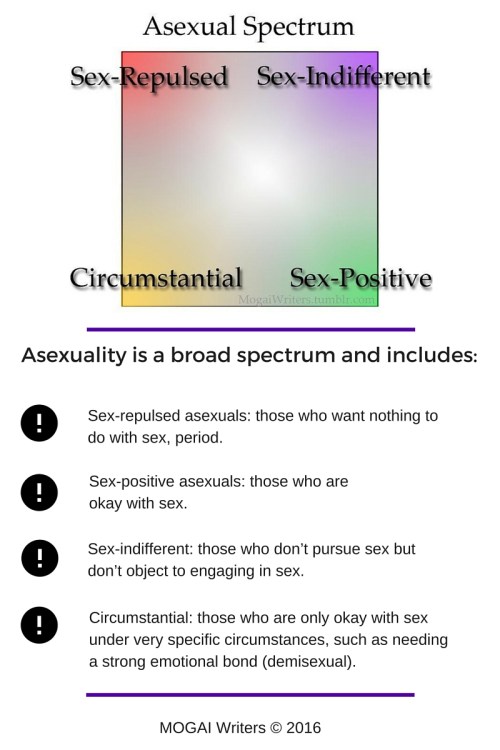
Asexual Spectrum

The asexual spectrum includes people who are completely repulsed by the thought of sex all the way to sex-positive individuals who may even enjoy sex with their partner. It’s a very personal thing for each asexual person and no one but them can tell you where they fall on the spectrum.

Many asexual persons will refer to a romantic orientation such as illustrated in the chart:

Romantic Attraction

Looking at the two charts combined you’ll see that there is a vast number of possible combinations. I personally identify as panromantic demisexual. What that means to me might not mean the exact same thing to someone else with the same chosen labels. For me personally, I am romantically attracted to people regardless of gender while I have only ever experienced sexual attraction twice in my entire life. To those who don’t know me I might appear to be a monogamous heterosexual. This is a misconception. Monogamy is a choice. My being sexually active with my partner doesn’t make me heterosexual, I am still asexual. I do not look at other people and find them sexually attractive. In fact trying to imagine sex with someone results in feelings of revulsion and panic. I quite literally cannot fathom it.

This doesn’t mean that asexuals can’t get turned on or don’t have a libido. Sexual attraction and libido are two separate things. You can experience sexual attraction yet have a low libido and there are people with a desire for sex that doesn’t relate to their orientation. There are asexuals who do engage in sex or who masturbate for a variety of reasons including but not limited to: pleasing a partner, releasing tension, to get to sleep or because they enjoy it. They are still asexual.

Asexuals also face unique issues within the community and recently there has been a call by some for them to be dropped from the LGBT community. Some asexuals feel that they would be better served by having their own separate community since the majority of the LGBT community is highly sex focused. This is an ongoing debate and will probably never be fully resolved.

It’s also good to keep in mind the kinds of challenges asexual face in our society. Sex is seen as normal, healthy and something that is integral to being human. Its even listed as a basic human need along with eating and breathing in Maslow’s theory of the hierarchy of needsmaslows_hierarchy_of_needs. Which any asexual will tell you is preposterous. No one has ever died because of a lack of sex. Lack of love, yes. But love is not sex. Sex can be an expression of love and intimacy but the act itself can be done for reasons outside of love. But, because of this view of sex and sexuality many asexuals report feeling broken or being seen as not wholly human by many, even being referred to as robots or plants or just being flat denied as existing. Acephobia is very common and often goes unrecognized and unchallenged.

Asexuals face being infantilized, fetishized as virginal, excluded by the LGBT community, labeled as mentally ill, and generally dismissed by society at large. These are all things your character might face as well. Don’t shy away from addressing these issues if your plot allows for it.

Next week we will delve deeper into how to actually go about writing an asexual character.

Asexual Orientation

The Thinking Asexual

Privileges Sexual People Have

Asexual Erasure and Mental Health

No Sex Please, I’m Asexual

If you enjoyed this post and would like access to exclusive content please consider supporting me on Patreon.


Fandoms · writing

Press Play: Tips for Making Fan Fiction Work for You


tips forMaking Fan Fiction Work for You (3)

It’s becoming more common for authors to get their start by writing fan fiction. There have been many famous authors who started out writing for fandom before transitioning to original works. Chances are you’ve heard of Cassandra Claire and E. L. James, I’m not holding either up as a good examples of morally responsible writers, but they both got their start writing for particular fandoms.

They, for all their faults, might have been on to something. Something that the traditional publishers have been taking a much keener interest in over the last several years.

Fandom.

Now, before you take me out back and expound on the vices of following in the footsteps of plagiarists and pompous swindlers, let me explain what I mean.

First off, I do write fan fiction and have for several years now. I’m currently well into a 4 book (and growing) series for the Thief (2014 © Square Enix & Eidos Montreal) fandom. Yes, you read that right. There are currently 2 full novels, I’m working on the 3, the fourth is planned and a fifth is being discussed. These aren’t novellas either. The last fic was well over 100K. Not that I’m bragging, it just kind of happened.

So why do I spend my time writing things that I’ll never be paid for? For couple of reasons. Reasons I think you too would benefit from.

Improved Writing:

Over the last two years, I’ve written nearly quarter of a million words for fandom. That’s a lot of words. But it’s allowed me the chance to improve in areas I really struggled with. Setting for example. I was able to practice writing more immersive settings as well as complicated, multi-layer plots. And I didn’t have to wait months to get back edits. The feedback was instant. I could know quickly what was working and what wasn’t, what the readers were focusing on and what they skimmed over, what threads they were really enjoying and what things annoyed them. This kind of feedback is invaluable as an author and one of the reason I will continue to write fan fiction.

Caution: Instant gratification with comments/reviews can get addictive. Especially when you go to writing original fic. Remember to keep a balanced view and not get an ego.

Connect With Readers

Fandom is full of avid and discerning readers. They know exactly what they like and are smart, savvy, and loyal. Some of them spend hours and hours writing up their own meta, head canons and discussing various plot points. They are the kind of people who you want reading your work. People who get excited about great stories and are eager to share them. I’ve been very privileged to meet quite a few of these individuals and have formed lasting friendships with a few.

Writing fanfic has allowed me to discover a whole new audience who craves things they cannot get in mainstream media. Readers who are willing to give my original stories a chance because they are already reading and enjoying my fan fiction and are familiar with the way I write.

So how can writing for fandom help you? Is it something you’d be willing to spend time doing in order to cultivate relationships? Is it morally right/wrong to benefit from writing fanfiction?

Well … let’s see.

There are plenty of pros and cons to writing fanfiction and while I encourage it as a fun relaxing writing exercise it can get stressful if approached wrong. Yes, there is a wrong way to approach writing fan fiction. The graphic explains some of the right ways to approach fandoms.

Engaging Fandom

So what are some of the pros and cons of writing fanfiction? Let’s look at them:

Pros:

  • More exposure to potential readers
  • Practicing the craft
  • Free reads that need little advertising
  • Build a reader base

Cons:

  • Time spent writing that won’t see a monetary return*
  • Shipping wars

I’m sure there might be more cons … but I can’t think of any right now. I personally find writing fan fiction immensely rewarding and fun. It’s allowed me to grow both as a writer and as a person. And no, it’s not always sunshine and roses. I have had characters stolen and been plagiarized. I’ve been flamed and told I should die because of the subject matter of a couple of my stories. But those are rare happenings and the vast majority of fans are utterly thrilled to have well written fic to read.

So don’t be afraid to give it to them. Even just a drabble here or there can get you started. Think of it as a writing exercise, like the ones you had to do in school where you had to write as if you were a character in a certain novel. That is fan fiction.

If you’re not sure where to start pick your favorite TV show, movie, video game or book and look it up on Archive of Our Own. I can almost guarantee there is something out there. AO3 has very comprehensive tags and you’re certain to find something you like and if you don’t … well there’s your opening right there. Write there. Just don’t forget to read other works and stay engaged. You’re there to make friends and meet potential readers.

*While I am not a big fan of turning fan fiction into publishable works I feel it is the right of each writer to make this decision for themselves.

Do you write fan fiction? If you do, do you have any other suggestions? Do you agree with my admonitions? Questions are welcome too. If you are curious about my fan fiction  you can find it here: The Corsair and the Corsetteer.

If you enjoyed this post and would like access to exclusive content please consider supporting me on Patreon.
writing

CampNaNoWriMo and a New WIP

So, I’ve decided to participate in CampNaNoWriMo this year. If you’d like to join me I have a private cabin. I’ll be starting writing the sequel to The Jeweled Dagger and could definitely use your encouragement.

If the whole camping thing isn’t for you, no worries! I could also use some writing sprint buddies. I’m really pretty flexible on my schedule (I go nowhere and do nothing) aside from taking care of the nerdlings I’m open to writing most anytime of the day. Just message me and let me know if you’d like to join me.

I’m brohne on the camp website and sorrows fall on Skype if you’d like to add me.

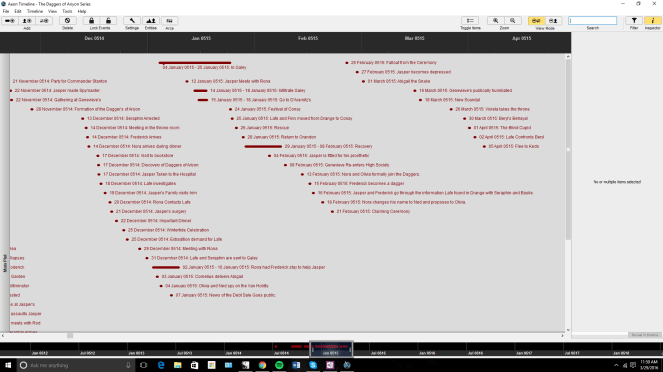
I’ve been working on the synopsis and outline for the Daggers of Ariyon since min-January. I finished inputting all the major plot points into Aeon Timeline the other day. It looks like this right now:

2016-03-29

Er … don’t squint too hard you might spoil yourself. The nice thing about Aeon is that you can export it into Scrivener as an opml and all your notes will transfer over too. This comes in really handy if you forget things like I do.

2016-03-29 (1)

It’s all there, nice and neat, with dates, times, and characters and this level of organization is starting tofreakmeout.

I’m a pantser at heart … I swear. But when your plots require multi-level planning organization is a must. I’m a masochist, I love complicated plots with multiple layers and characters but holy shit can it be migraine inducing if you don’t keep good notes.

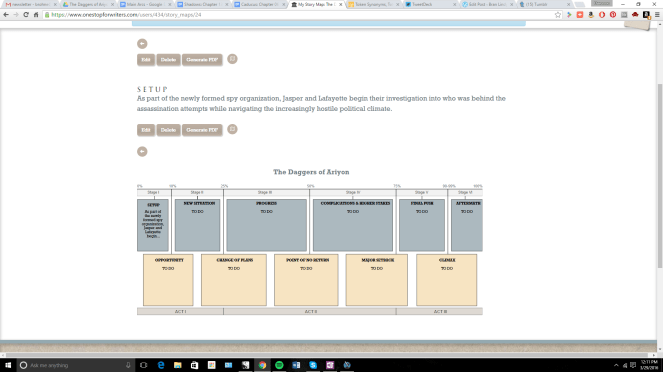
Even as great as the tools are sometimes it helps to have a little more concise representation of the storyline. That’s why I’m in love with One Stop For Writer’s new Story Map Feature. I’m not finished filling out my map yet but this is what the initial set up looks like:

2016-03-29 (2)

Refreshingly uncomplicated and incredibly helpful, I can see at a glance where I am in the plot and if my timeline isn’t helpful then knowing what plot point needs to come next can get me writing again.

2016-03-29 (3)

If you haven’t subscribed to OneStopForWriters.com  I highly recommend it. They are adding amazing new features and I know I personally rarely ever close its tab.

I do hope you’ll join me in April fpr CampNaNo if you can. I look forward to hearing about everyone’s stories and how you each approach planning and writing.

asexual · gay romance · Going Over the Rainbow · lgbt · mogai · writing

Going Over the Rainbow: Hot for You

GoingOver theRainbow (1)

This past week there has been a lot going on in both the LGBT community and the gay romance writers community. If you follow me on Twitter, you probably saw some of my reactions to the ongoing discussion. It revolved around one topic in particular: the ‘gay for you’ trope.

An incredibly popular trope in the m/m romance/erotica genre, it has been staunchly defended by those who enjoy writing and reading it while at the same time much of the queer community has expressed concern over it as being multi-queerphobic.

It’s been debated far and wide on the internet and I’m not going to get into it here. I will say that I personally loathe the trope for a long list of reasons, but instead of getting into that I am going to show you how to make the trope work.

That’s right. It can work. I promise you. Though the ‘gay’ part might need rewording.

First let’s take a look at the trope itself. What does ‘gay for you’ mean? Straight cis male falls in love/lust with another gay/straight cis male.

Hmm, okay. Well if you are straight and then suddenly find this one specific person who is your same gender attractive *surprise* you aren’t straight and you never were! Welcome to queerdom!

But-but, yes they are! You exclaim pointing to all the straightness of your character.

Shh, it’s okay. There are many people out there who thought they were straight and ended up being queer. Sexual exploration can be on ongoing and fluid thing. Shoot, I thought for years I was a lesbian (mostly because people said I was), then ace, then learned about demisexuality.  However, most gay men I’ve met, talk to, read about, knew they were gay since they were young. I’m talking like from their teens and sometimes even younger. You learn pretty early on who you find sexually attractive. Well, most of us.

What do I mean by that? Well, not everyone who is queer is gay or lesbian. Some of us don’t find anyone sexually attractive. (gasp)

Let me use myself as an example. I am 37, soon to be 38 years old. My entire life I have found only two people sexually attractive who happened to be different genders. And no—I am not bisexual. I am demisexual. I cannot and do not feel sexual attraction unless I have a deep emotional bond with a person and this doesn’t mean I’m hot for all my friends. Doesn’t work that way.

But that’s just me. There are some bisexual people who have only found one or two people of their same gender sexually attractive. They are still bisexual.

So what does this have to do with the trope.

Everything. There is a big issue in the entertainment industry with never looking beyond the G & L and basically erasing every other orientation out there, not to mention trans persons. Which is incredibly frustrating and very sad because the variety brings you so, so many opportunities for incredible stories.

This trope wouldn’t even be an issue if the character came out as bisexual, demisexual, pansexual or gray-asexual. All of these orientations would neatly explain why a character is attracted to someone of their same gender when they never have been before. One or two sentences is all it takes. Please allow me to demonstrate:

Reilly sat down next to Timothy in the booth. His best friend wriggled over to give him more room.

“What’s up Rei? You look a bit worried.”

Reilly shrugged and slid down in the seat. “You remember Quintin?”

“Yeah, he works at the cafe on the square. I almost asked him out. Why?”

“I don’t think I’m as straight as I thought.”

Timothy chuckled but quickly sobered. “Wait … really?”

“I don’t get it Tim … I’ve never … I’ve always thought I liked girls. I know I’m not gay.”

Timothy leaned over and bumped Reilly’s shoulder, “So maybe you’re not, maybe you are bi.”

It really is seriously that easy. In fact there really are no excuses beyond ignorance and laziness. And I know you are not like that.

So instead of ‘gay for you’ maybe ‘hot for you’ or another choice of wording might help us to be more inclusive. Just in case you need help here is a link to my worksheet and so helpful links.

Character Sexuality Worksheet

Going Over the Rainbow: The Trope Trap

Going Over the Rainbow: Moving Beyond the LG in LGBT.

Going Over the Rainbow: Show and Tell

For You

The Mythical Unicorn of LGBTQIA Novels (Or, the A doesn’t stand for Ally.)

Why Labels Matter


Do you have any questions for me regarding asexuality/demisexuality or the ‘gay for you’ trope? Which orientation would you like me to feature next month?


If you enjoyed this post and would like access to exclusive content please consider supporting me on Patreon.


Characters · Going Over the Rainbow · lgbt · mogai · writing · Writing FUNdamentals

Going Over the Rainbow: There is No Fast Lane

GoingOver theRainbow (1)

After last week’s post I had some people asking me to explain the concept of aromanticism further. If after reading the post and the included links you are still feeling a bit confused or unsure, don’t worry there isn’t anything wrong with you. Unfortunately, it is a subject much like gender; you only truly ‘get it’ if you experience it. Which is why I’m writing this week’s post on a slightly different subject; knowing when a story is not yours to write.

warning-general-2

This post is going to frankly discuss sensitive subjects that some might find triggering. Please read with caution.

I’ve discussed many personal things on this blog in the hopes of helping others gain insight to how some of us interact with the world around us. It is my sincere hope that these posts are not only informative and entertaining, but that they help you gain a greater understanding of your characters and more importantly; people who you might meet in your life.

However, there will sometimes be things that simply cannot be explained, they must be experienced to be understood. Even as a queer individual, I know that my experience is different than others. There are some orientations and gender identities I cannot comprehend because my brain is not wired that way (I don’t understand gender itself on my best days which is why I’m nonbinary). What I’m encouraging you to do is; be willing to learn about others but if something doesn’t click, don’t get frustrated. We can still try to be understanding and open-minded. But how do we know if we are straying into someone else’s lane?

Staying in Your Lane

Writers love to learn, but some things cannot be learned they must be experienced. I could tell you about my experiences growing up as a queer and gender confused child but unless you have experienced the dissociation, frustration, loneliness, and heartbreak of feeling othered by family and friends alike, there is little I can do to fully impart the knowledge. You might be able to empathize but true comprehension isn’t something I’d actually wish on anyone. This could make writing a character with a background like mine challenging for you. We all get lonely, frustrated and heartbroken but my cause for those feelings might be something incomprehensible for you. And that’s okay.

What’s not okay is writers who assume they understand and proceed to write characters who they think I should be like. Characters ‘triumphing’ over their queerness or being miraculously cured of their mental illness when Mx. Right comes along.

Jami Gold mentioned this last year in her post Shining a Light on Diversity and also in her post One Step to Better Writing and More Diversity. In both articles she mentions not defaulting to stock characters to fill perceived quotas to make our stories seem more diverse. Though as she says in Shining a Light on Diversity; even doing our research and having diverse beta readers and other help might not be enough.

In short it might not be our story to tell at all.w20_7b_be_prepared_to_stop

But how can we know if the story we want to tell is something we can do with good indepth research and interviews or if it would be best left to an author of that particular background?  There are plenty of blogs out there telling you how to write with diversity. The push for diversity is very much needed and should be actively sought and encouraged. However unlike some other bloggers I am going to tell you right now: Not every story is yours to tell. I’m sorry for being blunt but it is the truth. We must learn to check our priviledge and to stay in our lane to avoid traffic.

What does ‘check your priviledge’ mean?

Simply put, this means that we may, unknowingly, have certain advantages over others. And this is only because there are aspects of our identity that society values over others.

When someone asks you to ‘check your priviledge,’ what they’re really asking you to do is reflect on the ways that your social status might have given you an advantage—even if you didn’t ask for it or earn it—while their social status might have given them a disadvantage. (http://everydayfeminism.com/2015/07/what-checking-privilege-means)

So how do we know if we are in the correct lane? Let’s look at a few questions we can ask ourselves.

NOTE: For this I’ll be focusing on the gender and sexual identity portion. As a white person it is not my place to comment on racial issues faced by minorities. For help with racial diversity I highly recommend Writing With Color which is maintained by several people of diverse racial backgrounds.

  • Do I have a personal understanding of what this character might be facing? Can I truly sympathize with them or do I find it difficult to understand where they are coming from.
  • Do I find myself defaulting to stereotypical actions becasue I don’t fully undersand or comprehend how they might act/react in certain situations?
  • Am I struggling with the basic definition of their orientation or gender identity? Do I find it difficult to understand their viewpoint or do I find myself making excuses to write them the way I feel their orientation/gender identity should be represented?
  • Is the major part of their character arc about their race, gender identity, sexuality or mental helath? If so, do I share their experiences or can my experiences contribute to my characterization of them? If not, will research and interviews be adequate for their chararcterization?
  • Will my writing this character ‘talk over’ a writer from a diverse background? If I am not sure, have I asked someone of that background?
  • Am I being honest with myself about why I am writing this character and have I truly put aside any preconcieved notions or assumptions?
  • Is the story’s focus on their struggle with their race, gender identity, sexual orientation or mental health? If it is, do I identify as part of that diverse group? If I don’t, why do I feel the need to write about it? Do I feel as though I need to write this character to make a point? What point am I trying to make and why?
  • Have I read similar characters written by a writer from a diverse background? If not why do I feel qualified to write this character? Has a minority writer already written a similar story? Would I better serve my readers by promoting that author?

If we go through and candidly answer these questions we might find ourselves a little uncomfortable with the answers. It’s alright. This is your conscience telling you that you might be straying out of your lane.

There is nothing wrong with wanting to write someone different from ourselves, I wholeheartedly encourage it, the caution comes when we realize we cannot fully grasp the character’s situation or that our motivations for writing the character might be misplaced.

There is nothing to be ashamed of if this is the case. It just means that we should look for other ways to write this particular character or show our writerly humility and not write the character at all. This is why I rarely write traditional heterosexual romance and erotica. I don’t understand it.

I’ll be quite honest, when I read a romance that has the heroine gladly jumping in bed with the hero a short time after meeting him, I’m very put off. I cannot comprehend being able to have sex with someone within minutes of meeting them. I find the thought repulsive, but that is for me personally and I understand other people think very differently. They might find my lack of romantic and sexual attraction equally confusing and disturbing.

The wonderful thing about writing is that we all have stories to tell. No one can write like you or from your viewpoint and world experience. Don’t feel limited by that though. Please do read, research, explore, learn, and write with diversity. Just please also remember that even though your lane might not be wide, it’s just as long as you want to make it and don’t be afraid to let it intersect with other lanes. Just make certain you stop to check your priviledge first.

Going Over the Rainbow: Crush Those Stereotypes

Characters · Going Over the Rainbow · lgbt · mogai · writing · Writing FUNdamentals

Going Over the Rainbow: Aromantic

When Romance is Not an Option

I was having a hard time deciding where to start, so I thought I’d just do this alphabetically. ^^ I personally am between pan and aro when it comes to romantic orientation. I don’t claim to understand everything about either, and my experiences will vary widely from other aromantics.

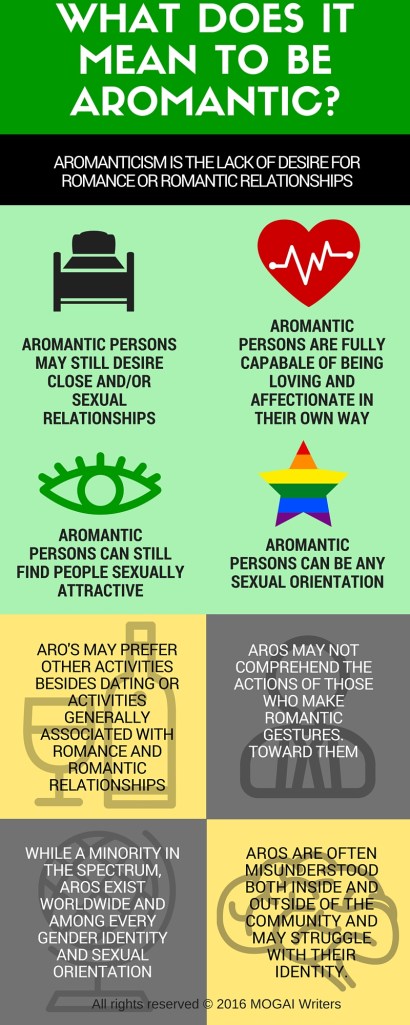
Aromanticism is:

not experiencing romantic attraction.

Aromanticism is not:  

a personal choice or lack of emotional connection.

Definition (From AVEN Wiki): An aromantic is a person who experiences lAromanticittle or no romantic attraction to others. Where romantic people have an emotional need to be with another person in a romantic relationship, aromantics are often satisfied with friendships and other non-romantic relationships. What distinguishes romantic relationships from a non-romantic relationships can vary diversely, but often includes physical connection (holding hands, cuddling, etc.) (Italics mine).The aromantic attribute is usually considered to be innate and not a personal choice, just as the lack of sexual attraction is innate to asexuals. It is important to note that aromantics do not lack emotional/personal connection, but simply have no instinctual need to develop connections of a romantic nature. Aromantics can have needs for just as much empathetic support as romantics, but these needs can be fulfilled in a platonic way.

It is possible for an aromantic individual to be involved in, and enjoy, a devoted relationship with another person, but these relations are often closer friendships, naturally reflecting the closeness of the two individuals and not a purposely initiated monogamous separation as is often found in romantic couples. Aromantics may experience squishes which are the aromantic or platonic equivalent of a romantic crush. When an aromatic get’s into a relationship that’s more than friends – but less than romantic – that is known as a queerplatonic relationship.

Like all romantic identities aromatics can be of any sexual orientation.

Writing the Aromantic Character

The first thing to remember when writing an aromantic character is that being aromantic does not mean incapable of love, affection or sexual intimacy. It simply means they do not experience romantic attraction. They have friends and other relationships but not with a goal of a romance. (http://www.buzzfeed.com/mcrosswell/5-myths-about-aromanticism-tysc#.lvwnEXPxq)

Romantic Orientation – Describes an individual’s pattern of romantic attraction based on a person’s gender(s) regardless of one’s sexual orientation. For individuals who experience sexual attraction, their sexual orientation and romantic orientation are often in alignment (i.e. they experience sexual attraction toward individuals of the same gender(s) as the individuals they are interested in forming romantic relationships with). (AVEN Wiki).

As when writing any character, you need to ask yourself several questions:

  • Have I given them other meaningful, close relationships?
  • Have I fallen into the stereotype of the aromantic asexual as an unfeeling, friendless, virginal robot who hates everyone? Not all aromantic people are asexual.
  • Do I fully understand what it means to be aromantic? Is this my story to tell?
  • Have I tried to ‘fix’ the character’s or tried to show them suddenly being romantic when they find the ‘right’ person?
  • What are my reasons for having this character be aromantic? Have I made them a whole person or is their orientation their primary characteristic? Am I trying to fill a perceived quota?
  • Have I made the character aromantic due to mental illness, trauma, personal failing or some outside factor? If so, why and how does it serve the plot?
  • Have I made this character’s orientation the comedic relief?

Now some questions for your aromantic character:

  • Do they realize they are aromantic? How do they feel about this? Do they wish they were ‘normal’ or are they content with their orientation? Do they try to force themselves into romantic relationships? What are the consequences?
  • When did they discover their orientation? Was it a gradual understanding that took years. Are they still a teen and trying to come to grips with how different they might seem from all their peers?
  • Who else knows about their orientation or have they told anyone? If so, who and why or why not? How did those they told react? How did they handle this reaction?
  • How has their orientation affected their other relationships?
  • Do they want a close platonic or even sexual relationship?
  • Does their orientation intersect with other things such as gender identity, race, physical disability, mental illness, or other factors? How do they handle this intersectionality?

Once you’ve addressed these questions, it is important to remember that you are writing a person. A whole person not just an orientation. While a person’s orientation is integral to who they are and defines them up to a point it shouldn’t be the sole basis for their personality. This can lead to falling into the trope trap. While tropes themselves are not bad some can perpetuate harmful stereotypes. Aromantics are seldom, if ever, seen in media so there are very few tropes about them, though many of the asexual tropes can apply as well.

Don’t shy away from writing them just because they are rare. They are part of the spectrum and need to be favorably represented so that other aromantics can read their stories and see that they are not broken, ‘messed up,’ or ‘weird.’ They are normal people who just happen to not be interested in romance. This might feel like a challenge at first and if you are romantically inclined it might be difficult to comprehend. It’s okay. Their story might not be yours to write and that’s fine. But don’t let that scare you off from including their orientation in your stories. If anything the research can help you, as it has me, come to a better understanding of others and to have greater empathy.

Here are some more references I found helpful that I’d like to share with you:

Aromantic – AVENwiki

5 Myths About Aromanticism – BuzzFeed

ASK AN AROMANTIC (if asking questions please remember to be courteous and not assume things)

Anagnori : You might be aromantic if…

Resources for Aromantic Sexual People | The Thinking Aro

Asexual Romances Are Necessary

Going Over the Rainbow: Like a Moth to a Flame

Going Over the Rainbow: The Trope Trap

Going Over the Rainbow: Crush Those Stereotypes

Please share your thoughts with me. Were you aware of the aromantic orientation? Have you met an aromantic person? Would you consider including one in a story? What challenges do you think aromantics face in our society? How might this affect their portrayal in media? Do you know of any canon aromantic characters in a book, movie or game? 

If you enjoyed this post and would like access to exclusive content please consider supporting me on Patreon.
asexual · Characters · Going Over the Rainbow · lgbt · mogai · writing · Writing FUNdamentals

Going Over the Rainbow: Like a Moth to a Flame


GoingOver theRainbow (1)

This week has been chaotic at best and I apologize for the lateness of this article.

As writers who write living beings at some point our characters will probably experience attraction to another being and desire a relationship. But what kind?

Romantic relationships often seem to be the default in books and movies. Hero A must get with their OoD (object of desire) by the end of Act 3 or your story is a flop. The default romance has become such a staple of mainstream media that to not have it can make it feel as though your story is missing something. So is it?

No not really. Ever watched a show with a really great partnership/friendship. Those are relation(ship)s too. Just with a different kind of attraction. Mad Max: Fury Road was a great example of this. Max and Furiosa’s relationship is not one of sexual attraction at all. Even Capable and Nux don’t have a blatantly romantic relationship. Theirs is based more on shared comfort in a society that sees both of them as disposable objects.

So what kind of relationship did they have if it wasn’t a romantic one?

Yes, you’re on the right track. There are several different forms of attraction (and love but that’s for later). Don’t forget though, romantic attraction does not equal sexual attraction for everyone. Your character can be romantically attracted to someone without wanting to engage in sex.

Let’s look at what this means.

Sexual attraction is what people feel when they look at someone and their first thought is something along the lines of “I want to jump their bones” or “How do I get in those pants.” It’s a response to finding someone physically appealing. Think lust.


Marketing companies bank (literally) on our being sexually titillated to sell things. Sex sells, right?

Not always.herehaveanothersexyburgerpic_4f15384461b9daf422986fc8509e164c

(Personally, I have no idea what is appealing about this picture but it came up when I looked up sex in advertising.)

So if there are other kinds of attraction, like my attraction to that burger, what are they? Why do we as writers need to be aware of them and how can we be more diverse by writing characters with different attraction orientations?

Just as there are different sexual orientations, there are different romantic orientations. Just as there are asexual persons, there are aromantic persons. I consider myself panromantic with heavy aromantic leanings. Meaning: while my romantic attraction is not defined by gender I am less likely to engage in anything traditionally romantic or be romantically attracted to anyone regardless of gender. It does not mean that I don’t—or am not capable—of love. Remember earlier? Love and romance are not the same thing. It is entirely possible to love people without being romantically attracted to them.

There are many different types of attraction, including:

Sexual attraction: attraction that makes people desire sexual contact or shows sexual interest in another person(s).


Romantic attraction: attraction that makes people desire romantic contact or interaction with another person or persons.


Aesthetic attraction: occurs when someone appreciates the appearance or beauty of another person(s), disconnected from sexual or romantic attraction.


Sensual attraction: the desire to interact with others in a tactile, non-sexual way, such as through hugging or cuddling.


Emotional attraction: the desire to get to know someone, often as a result of their personality instead of their physicality. This type of attraction is present in most relationships from platonic friendships to romantic and sexual relationships.


Intellectual attraction: the desire to engage with another in an intellectual manner, such as engaging in conversation with them, “picking their brain,” and it has more to do with what or how a person thinks instead of the person themselves.

(https://lgbtq.unc.edu/asexuality-attraction-and-romantic-orientation)

maleficent-auroraMaleficent (2014) is an excellent example of True Love™. In the movie it was not the Prince’s kiss that could break the spell. Only Maleficent herself could do that. It was the fact that Maleficent was the only person who Aurora truly loved that allowed her to break the spell. This is platonic love.

This is the kind of attraction between characters who are very close friends. I’m pretty certain you don’t have any problems writing friendships.

Sensual and sexual attraction are much more common than aesthetic attraction in books and movies. Women in close, non-sexual, relationships are often shown as being sensually attracted to each other since cuddling, snuggling, hugging and holding hands are seen as more feminine type behaviors. Don’t be afraid to break stereotypes or expectations. Men can initiate cuddling, hand holding and other forms of non-sexual intimacies.

Knowing these various types of attraction can help us as writers be more diverse with our characters and their relationships. Hero A might not find the Hero B sexually attractive, but could be aesthetically attracted to them. Or Hero B might find Sidekick C sensually attractive and want to cuddle and watch Netflix with them.

Don’t be afraid to allow your characters other close relationships even if a romance is the primary focus of the plot. This will help round out all of your characters.

Next time we’ll dive into the various types of romantic orientations and how to write them.

If you enjoyed this post and would like access to exclusive content please consider supporting me on Patreon.