Characters · gay romance · lgbt · mogai · writing · Writing FUNdamentals

Going Over the Rainbow: Crush Those Stereotypes

Get rid of stereotypical characters as easily as Dorothy got rid of the Wicked Witch of the East.

There is a lot of great advice out there when it comes to creating our characters. From Nancy Kress’ Dynamic Characters to The Positive and Negative Trait Thesaurus by Angela Ackerman and Becca Puglisi there are many excellent resources for writers looking to create truly unique and realistic characters.  Even as comprehensive as these helps are, there is one area many writers neglect.

A character’s sexuality and sexual orientation.

‘But I don’t write romance!’ I hear you saying. Romance isn’t always about sex and sex isn’t always about romance.  A character’s sexual orientation can have a huge impact on how they are treated by society, their family, how they interact with others around them and how they perceive themselves. It can be a source of both internal and external conflict.

‘But I only write straight characters!’ You say.  Okay, nothing wrong with that, but why? Why only write straight characters?  It’s almost guaranteed that you personally know, at the very least, one person of a different orientation and the likelihood is that the number is much higher. Our lives are filled with diversity and it stands to reason that our stories should be as well.

Diversity is a huge buzz word right now in the entertainment industry and while there is a great focus on it, the actual results have been marginal at best. Unfortunately some well-meaning writers have perpetuated harmful stereotypes, misrepresented an orientation or been less than accurate in their portrayals of queer* persons.

So how can you add diversity and be inclusive without stumbling into the stereotype trap?

Click your heels and we’re on our way.

The first step is to realize writing diversity is not hard. Writing a queer character is no harder than writing any other character because, first and foremost, you are writing people; not an orientation.  A lesbian is not just a lesbian, she might also be a sister, mother, accountant, scientist, police officer, volunteer firefighter or any number of things that make up someone’s identity. Her orientation is just one aspect of who she is, but it is something that helps define her, just as core traits help define personality.

Fearless Defenders #12

The second step is to decide if the character’s story is one for you to tell. As I stated last week, some stories need to be told by writers from that particular background. We should recognize when a character’s story might not be ours to tell, especially if the story centers on experiences or hardships related to their race, orientation, physical ability or mental health.  As the term goes, stay in your lane. In other words know when to check your privilege and don’t assume any amount of research is going to give you true insight into their struggles. Instead, support authors who are part of those diverse backgrounds.

Kaidan Alenko is a romanceable option for Commander Shepard in Mass Effect 3

With that being said, there is nothing wrong with including diverse characters. You absolutely should.

The final step in writing with diversity is actually creating a character that is a fair representation. Everyone’s experiences are going to be different and there is no one right way to write a queer character. However, there are most definitely wrong ways to write them.

Over the next several months I will be going through both the sexual orientation spectrum and the gender identity spectrum and helping you to avoid stereotypes and harmful misinformation. My goal is to help you not only understand your characters better but to feel more comfortable writing with diversity. I myself am a queer person. I identify as an agender/nonbinary panromantic demisexual. That’s probably is a bunch of gibberish right now, but I promise, if you stick with me I’ll show you what those labels mean and what they can mean for your character.

The first place we are going to start with is the Character Sexuality Worksheet. I designed this worksheet to help you answer orientation specific questions about your character. This should give you a launching point for your research. I’ve also included two handy flowcharts to help in case you are not sure where on the spectrum your character might fall.

Character Sexuality Worksheet

Please feel free to download and print the worksheet for your private use.

Over the next several months I will be exploring each of the various sexual orientations and gender identities in an effort to help my fellow authors write with more diversity. I will be inviting people of other orientations and gender identities to offer their advice and experiences as well. I sincerely hope you find this of value and please feel free to ask questions.

If you enjoyed this and would like access to additional content, please consider supporting me on Patreon

What orientation you are most curious about? What else would you like know about sexuality, sexual orientation, and gender identity? Have you written a character from the sexual orientation spectrum?  What challenges have you encountered in your effort to add diversity to your writing? Do you have any suggestions or comments for the worksheet or upcoming topics? I look forward to hearing from you.

*As someone who identifies as nonbinary and panromantic demisxual, I am comfortable using the term queer when describing myself or my characters. I am aware that many in the community still feel this is an insult. If you do not identify as part of the spectrum, please refrain from using the term.

Characters · gay romance · lgbt · mogai · writing · Writing FUNdamentals

Going Over the Rainbow: Moving Beyond the LG in LGBT.

Growing up in small towns in the middle of the Midwest, I didn’t get much exposure to people of other races.  There was not a single African American at the school I went to and only one person of mixed race.  I also had no exposure to people who identified as different sexual orientations or gender identities. This meant I felt horribly out of place growing up. I was just weird. It’s taken twenty years, but I’ve finally found where I fit and understand myself. I’ve also learned a lot about others along the way.

Last month Jami Gold brought up the subject of diversity on her blog.  Diversity is a huge topic right now, and it should be. We need more diversity in every genre.  And by diversity I don’t just mean racially, but sexual orientation, gender identity, neurodivergence, physical ability, all of it. However, we need to when and how to add it so it fits and doesn’t feel tacked on. There is no quota, only authenticity.

This is a good thing when it comes to our characters, especially for characters with diverse elements, as there’s no definitive black, gay, disabled, whatever experience, and therefore there’s no “one right way” to portray those characters. There are, however, wrong ways to portray diversity.—Jami Gold, Writing Diversity: How Can We Avoid Issues?

In a follow up post, Jami also touched on research and being aware of the source of our information. There are plenty of resources on the internet but we need to be aware of who is supplying them and if they are actually part of the segment of the population they are writing about. This can make all the difference in whether or not our portrayal is authentic or othering.

Some stories simply are not ours to write.

Obviously, the most helpful thing we can do to support diversity within the publishing industry is to buy and help promote books from diverse authors. As I mentioned last time, there might be some stories that aren’t ours to tell, so we also need to encourage the success of those authors who can tell those stories.—Jami Gold, Digging into Research: Consider the Source

I write stories with queer* characters and yes many of them are not white, but their race and queerness is part of who they are and the stories are not about either. As a white person it is not my place to write a story about race or racism. It might happen in my stories, but it won’t be the focus because I have never had to deal with it the way so many others do. I cannot and will not write something when I know it is a subject that does not belong to me. No amount of creativity can replace experience with something like this.

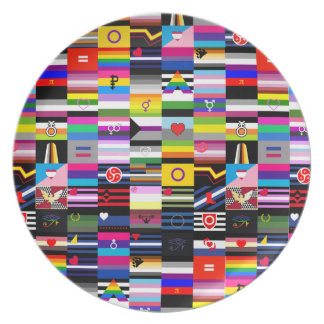
And that leads me to the point of this post.  As a queer person I have noticed a lot of authors struggling to write authentically queer characters. The gay romance genre is stuck in the m/m cis white male, coming out trope (not that there is anything wrong with the trope, but … diversity would be nice ^^). That is only one small part of the entire spectrum. The rainbow flag is not the only flag out there. Whether you write romance or not, adding other orientations can only enrich your writing. When done properly.

Pride Flag Collage

Over the next several months I will be exploring each of the various sexual orientations and gender identities in an effort to help my fellow authors write with more diversity. I will be inviting people of other orientations and gender identities to offer their advice and experiences as well. I sincerely hope you find this of value and please feel free to ask questions.

If you enjoyed this and would like access to additional content, please consider supporting me on Patreon

As always your comments and questions are welcomed below. 

*As someone who identifies as nonbinary and panromantic demisxual, I am comfortable using the term queer when describing myself or my characters. I am aware that many in the community still feel this is an insult. If you do not identify as part of the spectrum, please refrain from using the term.

Characters · Writing FUNdamentals

Non-Traditional Hero Part 3: Character Flaws and One Stop for Writers

Eeesh, it’s been awhile since I’ve been able to write a post. Sorry about that. Having a chronic illness and being a single parent can really flatten you sometimes.  So, on with the post!

Last time we talked about developing a non-traditional hero.  We discussed how archetypes are useful as a basis for creating a character and how to add traits and goals to make them truly unique and non-stereotypical. We looked at the waif archetype and discussed how to make them atypical including switching the gender typically associated with waifs.

I promised to show you how to fill out the lovely Character Pyramid available on Writers Helping Writers.  So we will focus on that today. If you have the Negative Trait Thesaurus by Angela Ackerman & Becca Puglisi you can find the pyramid in Appendix B, if not please click through to the link above where you can print out one for yourself. I like to do this so I can fill them out.

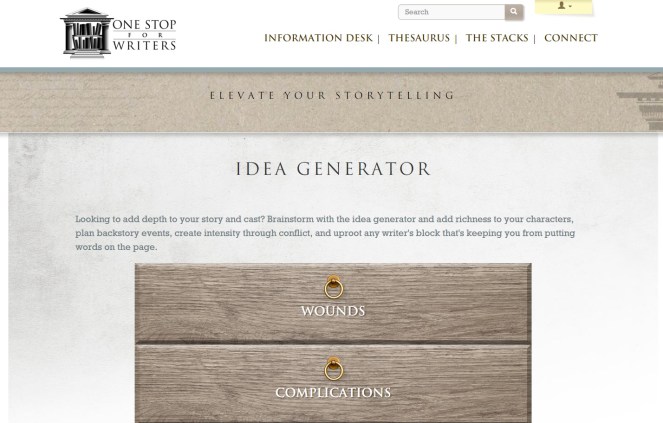
As a bonus I’m going to introduce you to One Stop for Writers. If you have followed my blog for long you’ll know I don’t really endorse writing software, but One Stop for Writers is completely different. Instead of just writing a review I thought I’d show you why I am so completely thrilled with this website and how incredibly helpful it is. So, we are going to use it to help us fill out the pyramid. You can access a lot of helpful information for free, but a subscription is only $9 a month.

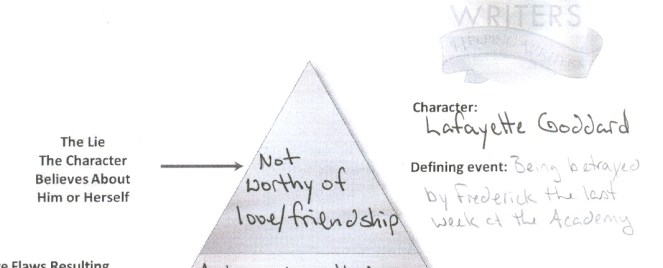
So first, the pyramid. I’ve decided to use one of the characters from my upcoming novel to fill this out since I know him best. You’ll see on the page a place to put the character name and under that, a defining event. This is their backstory wound that results in the lie they believe about themselves.

But what if you don’t know what your character’s defining event was?  One Stop for Writers has an idea generator and no it’s not random phrases strung together. At the top of the page you’ll see a drawer marked Wounds. Open and close it until something sparks an idea. That can be your defining event (just beware of getting sidetracked with all the other amazing generators as I tend to do, seriously it’s very tempting).Onestop1

Now, we are ready for the pyramid itself. So depending on your character’s defining event what lie do they believe about themselves? Lafayette believes he is not worthy of love or close relationships because of being betrayed by someone he was in love with and trusted.

pyramid lie

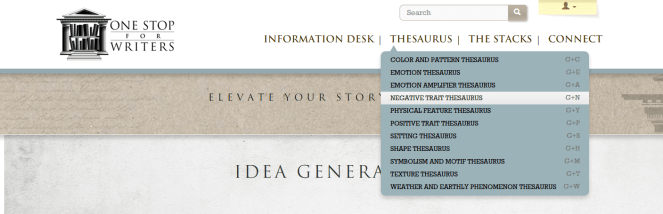
So what core flaws might result from that lie? Let’s head over to the Negative Trait Thesaurus and find some.Onestop2

One Stop for Writers makes it easy as they have the entire Negative Trait Thesaurus readily available.onestop3

So looking at our pyramid what core flaws might arise from our character’s wound and lie? To illustrate let’s look at Lafayette’s wound and lie and see what traits he could display. Having been the victim of a cruel betrayal he’s become antisocial, withdrawn, cynical, and uncooperative.

pyramid core flaws

If you are on the website you’ll find that clicking each trait gives you the entire thesaurus entry for that trait.  This should give you some ideas on how to fill the next step of the pyramid with their lesser flaws that grow from the core flaws.

Pyramid lesser flaws

For Lafayette I’ve gone with; disrespectful, jealous, suspicious, hostile and ungrateful. He’s starting to sound like a bit of a jerk. Well he is. These are your character’s bad traits, the grounding for their flaws and where they came from.

The last tier of the pyramid are the ways you will actually show these traits in your narrative. By how they think, what they think about, how they behave and act and what quirks they have, you’ll be able to show your reader your character’s flaws. So how are you going to fill this tier out?

Go through each entry and find associated behaviors that you feel fit your character. No one has all the associated behaviors and some traits might only have one main behavior to contend with. You might find that there is some overlap within the behaviors, this is just fine. This is mostly to give you a basis for ideas of how your character behaves because of their backstory wound.

Pyramid behaviors

Lafayette avoids intimacy and pushes people away. He is brutally sarcastic and will play pranks to get back at people he feels slighted by. He hordes pillows.

So now you have, or hopefully have, a completed pyramid. It should look something like this (with your character’s detail of course):

pyramid completed lafe

Now you have something to refer back to when you’re not certain how your character might react to a situation and you’ve given them new depth and realism. This will help take your hero from a nice cake with pretty icing to something truly worthy of a place at your table and something your readers will devour.

I also hope you’ve enjoyed this very short tour of One Stop for Writers and can see why I think it is an incredible tool. I’ve barely even skimmed the surface of all the wonderful features they’ve included. I am very grateful to Becca Puglisi and Angela Ackerman, authors of The Emotion Thesaurus, and Lee Powell, creator of Scrivener for Windows for putting so much thought and effort into this resource.

I hope this helps you build your wonderfully non-traditional hero! If you enjoyed this, please consider supporting me on Patreon

As always your comments and questions are welcomed below. Do you find it difficult to incorporate a character’s flaws, especially if they are the hero? Do you find yourself worried the character might come across as unlikeable or unsympathetic? How do you handle this? Please let me know your thoughts in the comments.


Uncategorized

One Stop for Writers

Every once in a while, something comes along that changes things for the better.

And in the world of writers, this can mean the difference between finishing that manuscript or letting it languish, because we all know just how much sweat, courage and persistence it takes to write a book and then release it into the world.

Today, I’ve got a treat for you. It’s a new website which I hope will help my fellow writers brainstorm stronger characters, craft deeper, more compelling plots, and teach us how to be more effective with our description so we draw readers in. It’s already become an invaluable tool for me and I think you’ll find it’s the same for you.

One Stop For Writers is a collaboration between Becca Puglisi and Angela Ackerman, authors of The Emotion Thesaurus, and Lee Powell, creator of Scrivener for Windows. This powerhouse online library is filled with one-of-a-kind descriptive thesaurus collections, tools, tutorials and much more, all geared to provide the resources you need to strengthen your prose and write more efficiently.

Want to check One Stop For Writers out?

Hop on over to Writers Helping Writers for their Launch Week festivities (October 7-14th)! If you know Angela, Lee and Becca already, you probably can guess there will be some great prizes, and probably a bit of paying-it-forward too.

Next week look for my complete review of the site and what it offers.

Uncategorized

Not just one way to be transgender…

Diversity, in all things.

Kaje Harper's avatarkajeharper

I had an interesting conversation with a trans guy who is a friend of mine. He was talking about how he’s both pleased, and yet feeling a bit invisible, with recent increases in trans stories out in the public eye.

The easiest narrative to understand, about being trans, is the one where the little trans girl at the tender age of two and three and four rejects all the boy stuff – the work-boots and football jerseys and toy trucks. She insists on wearing skirts and growing her hair out and wants to play with dolls. And as she grows up, she never wavers from this stance. Eventually, she takes hormones, has surgery, and becomes the feminine dress-wearing, nailpolished girl she always wanted to be. And the little trans boy cuts his own hair short, won’t wear a skirt, and wants a football helmet for his birthday.

GirlFootballHelmet

And that is…

View original post 455 more words

archetypes · Characters · Writing FUNdamentals

Non-Traditional Hero Part 2: Whipping Up an Atypical Hero in Five Easy Steps

Building a character is a lot like making a cake. Except you don’t want just a basic yellow cake, you want layers and frosting and all the fun stuff that makes cake great. Or maybe it’s sushi you like, you aren’t just going to eat rice and be satisfied when you want sushi. Archetypes are like your basic yellow cake batter. They form the basis to start from, but it’s up to you to add all the stuff that will make an epic cake. What kinds of things do you like in a layer cake? Fruit, nuts, chocolate something a bit more exotic? Then we need the icing, or maybe you like frosting or fondant and lots of it. Good.

The point is we start with a base, but we don’t stay there. That’s boring. Spice it up. Experiment, see what flavors work well together and which ones don’t.

So, let’s get cooking.

Step 1: Start with an Archetype.

The ones I listed a couple of weeks ago are just one set of archetypes. Schmidt’s book A Writer’s Guide to Creating Characters contains more lists. I’m going to stick with my list and pick the Waif because it’s so well known. Plus I have a fun idea to play with.

Step 2: Determine the Flavor

So who is the Waif?

Tami Cowden defines the Waif:

This is the original damsel in distress. She was the star of many a Grimm’s fairy tales. Cinderella and Sleeping Beauty and Rapunzel, all required rescue, and so does she. Her child-like innocence evokes a protective urge in the beastliest of heroes.

But don’t be fooled, because the Waif has tremendous strength of will. She won’t fight back; she’ll endure. Audrey Hepburn often played this heroine – think of Sabrina. Marilyn Monroe in The Misfits was a classic waif. And an updated version is found in Peta Wilson’s La Femme Nikita. A classic Waif is Jane Eyre by Charlotte Bronte. She overcame mistreatment, and her innocence and purity won her Mr. Rochester. Another good example – Kathleen E. Woodiwiss’s heroine in The Flame & the Flower.

These women are pure at heart, at times a little too trusting, and also insecure. They seem to be untouched by the world, patient and adaptable to any situation. They carry on, looking for the day when they are free of their travails, but taking little action to bring that day closer.

In a bar fight, the Waif is most likely to turn to the hero to get her out of this situation. If that fails, she’ll be found pressed against a wall, well out of the fray. But let an unwary fighter venture too close to her little island of safety, and he’s likely to have a bottle smashed over his head. When cornered, the Waif will take desperate measures, but only when she has no other option.

(http://www.likesbooks.com/78.html )

This is when you decide just what kind of cake you want to work with; is it chocolate, red velvet, angel food, or lemon? This is what we will build on so pick something that feels right for your character.

What core moral value do we see that might fit the Waif? Looking at The Positive Trait Thesaurus by Angela Ackerman & Becca Puglisi in Appendix C on page 236 there is a list of moral traits. A couple that jump out at me as potentially fitting the Waif archetype are Innocent and Patient. I can hear you wondering why I’m not trying to stay as far away as possible from the whole definition of the Waif archetype. We still need a basis, a starting point. So let’s look at these two moral values.

http://cdn.writershelpingwriters.net/wp-content/uploads/2013/10/Target-Tool.pdf

Innocent is defined at being of pure intent and motive with possible causes being a sheltered upbringing or seeing only the good in people. Some associated behaviors I’m going to pick for my Waif are:

  • honesty
  • curiosity
  • being exceptionally trusting
  • friendliness
  • seeing things in a practical light
  • being willing to help others
  • being excitable

Patient is defined as exhibiting self-control and composure under trial or strain with possible causes being believing everything will work out, maturity, or being focused on others rather than self.  Some associated behaviors could include:

  • calmly waiting
  • not complaining when things take too long
  • enjoying the moment rather than always thinking about what’s coming next
  • bouncing back quickly from setbacks
  • not being surprised by the unexpected
  • managing one’s time wisely
  • delaying gratification

Personally I think patient fits my vision for my Waif a little better than innocent so I’m going with that. We have the core trait, the thing that gives them their sense of right and wrong. Now lets look at the next set of traits.

Step 3: Add the Extras and Bake

So I have my batter and am ready to add some fun flavors. This is the what the Positive Trait Thesaurus describes in Appendix B on page 233 as the achievement tier and while being aligned with their morals, is focused on what traits they’ve developed to help them achieve their life goals.

What might fit the Patient Waif? When creating my characters I like to pick at least three complementary achievement traits. For my Waif I’m going to pick adaptable, cooperative and persuasive. I generally like to pick a fourth that doesn’t seem to quite fit with the others. I’ve decided on meticulous. So to go along with the analogy I’ve got a few complimentary flavors and then something to add a little texture like fresh fruit or nuts. Now we bake and assemble the tiers.

Step 4: Frosting

Now, I’m going to move from personality traits to external elements because the interactive and identity traits deal more with how the Patient Waif reacts to their surroundings. They need a goal, motivation and conflict for me to understand them better and flesh them out a bit more. We have our cake tiers ready to go, and now we need to layer on the frosting and decorations. But to do that I have to understand their environment, the frosting needs to compliment the cake itself.

I know that my Patient Waif has endured something that gave them that core trait. So now I brainstorm. You’ll probably come up with something entirely different given your interests and life experiences, and that’s perfect. Every character needs a sliver of yourself within them to make them feel alive and real to the reader.

So what goals, motivations and conflicts might my Patient Waif have? That depends on the story, the setting, their history and such. As an example I’m going to pick a character from a current WIP of mine. It’s just now in the planning stages so this will be a good exercise. It’s a high fantasy setting but more technologically advanced, think pre-industrial revolution instead of medieval. Magic is a science all to itself.

The interactive traits are described in The Positive Trait Thesaurus Appendix B page 233: “Strengths form through interaction with people and the environment. These traits help the character work with others, handle conflict, convey ideas and forge healthy relationships.” This layer is our frosting, icing or fondant before you start adding any other decorations.

For my Waif I’ve picked; Diplomatic, Observant, Perceptive and Tolerant. These are things they’ve learned from their life experiences and reflect how they interact with other people. These traits compliment their core morality of being patient while enhancing the overall flavor.

Step 5: Decorate

Now for the decoration, the identity traits. These are the traits that the thesaurus describes as being tied to a personal sense of identity. This is what makes your character, your cake, stand out as unique. It’s the surface qualities that draw the reader in so they are tempted to take that first bite.

For my Waif I picked some fun things; Intelligent, Philosophical, Sensual,  and Witty.  Typically now I would get a notebook and start going through the thesaurus jotting down the various attributes of each trait I feel fit the character and getting an idea of who they are.

It’s helpful to go through the Positive Trait Thesaurus, Appendix A on page 229 at this point and start going through the topics. I also like to fill out character profile sheets so I have the information in one spot to refer back to. Just remember that this is your test kitchen. Once you start writing you might discover whole new things about your character and who they really are. Be willing to listen to them and see how the new direction fits.

The main thing to remember when creating a character, give them foibles, faults and quirks. Pick one trait and take it to its extreme and see what happens.  This is when you pick up the Negative Trait Thesaurus by Angela Ackerman & Becca Puglisi and go to Appendix B. This pyramid is very helpful: http://cdn.writershelpingwriters.net/wp-content/uploads/2013/10/Character-Pyramid.pdf

We need to understand what their goal is, why they are striving for it, and what is keeping them from it.

Sometimes I actually find it more helpful to figure out the goal and then work backwards figuring out who this person is. I’ll go more indepth about this next week and we’ll fill out the pyramid together.

So who is my Waif and what makes them an atypical hero? Let’s find out.

Cirbus is tall even for his race, the Daoine Sith. As a knight of the Unseelie he is supposed to be working for the Winter Queen in her never ending struggled against the Summer Queen. Except after several hundred years he’s a bit fed up. Maintaining the gates between the realms he’s had to witness much cruelty and heartbreak and nothing bothers him more than seeing intelligent beings suffering.

One day he witnesses the capture and vivisection of a young mage who is then left to die on the side of the road once the butchers are done. Leaving his post he heals the now normal young woman and sends her on her way. The incident leaves him questioning his duty but he remains until word is sent that his actions have not gone unnoticed and he’s subsequently banished.

For the first time in his life he’s alone. He has no idea about human culture or how anything works. He’s never been out of the glade where his portal lay.  He doesn’t wander far, only making it as far as the crossroads where he runs into a group of magic hunters. Daoine Sith aren’t just rare, they are a myth and the hunters are prepared for the vicious evil creatures the myth calls them. Cirbus is understandably unprepared for their assault and is captured and taken to the nearest principality to be sold. Instead of trying to escape he waits patiently for the next several decades until the principality is no more.

What happens after that? That’s a spoiler. Point is I have my cake—er my atypical hero. Cirbus eschews the stereotype by being a male waif for starters and also by choosing not to react and to instead be patient.  We’ve taken the archetype and built something entirely new in just a few steps. It does take some work and experimenting but in the end you’ll have an awesome cake that readers will devour.

If you enjoyed this and would like to see more, please consider supporting me on Patreon.  

As always your comments and questions are welcomed below. Do you have a favorite ‘flavor’ you like to write? How do you go about creating your characters? Do you like to start from a different approach? If so what is it?

archetypes · Characters · writing · Writing FUNdamentals

The Non-Traditional Hero: Part One

Art by Drew Melton

Last week I discussed the alpha character role and the trap of stereotypical heroes. So what is a traditional hero? Often in fiction, especially romance, the hero is what is termed an alpha male, which I discussed in last week’s post. The often hypermasculine and overly sexualized characters (male and female) in media, while popular, are becoming cliche.

So what makes a non-traditional hero?

First let’s break down what a hero is and what makes them a hero.

hero

[heer-oh]

noun, plural heroes;

  1. a man of distinguished courage or ability, admired for his brave deeds and noble qualities.
  2. a person who, in the opinion of others, has heroic qualities or has performed a heroic act and is regarded as a model or ideal: He was a local hero when he saved the drowning child.
  3. the principal male character in a story, play, film, etc.
  4. Classical Mythology.
  1. a being of godlike prowess and beneficence who often came to be honored as a divinity.
  2. (in the Homeric period) a warrior-chieftain of special strength,courage, or ability.
  3. (in later antiquity) an immortal being; demigod.


hero. Dictionary.com. Dictionary.com Unabridged. Random House, Inc.http://dictionary.reference.com/browse/hero (accessed: May 29, 2015).


One who acts in consciiousness of heart and soul. modern: one who acts on what he/she was tought to do or perform. as in Doctors, astronauts, firefighters, paramedics, etc.. the modern kind of takes away from the true meaning of the word “HERO”.Answer A traditional hero plays by the book, he doesn’t bend or break the law, doesn’t smoke, drink or cuss, will not lie and helps little old ladies across the street. Like Atticus Finch, Roy Rogers, The Lone Ranger, Superman etc… A modern hero may be on either side of the law, will bend or break the rules to his benefit, he may steal, will certainly lie, smokes, drinks, cusses and helps little old ladies across the street. Like Dirty Harry, Lazarus Long, and others. Of course this is only the general differences, both types of heros have the same focal point, the common good of the people.

A hero is a man that is admired for his achievments; that has strength and shows courage to others.

http://www.answers.com/Q/What_are_the_differences_between_a_traditional_hero_and_a_modern_hero

Last week I covered the various character archetypes and how Mad Max doesn’t fit the typical alpha male role. What I want to do this week is discuss the typical hero. The definition of a traditional hero is someone who follows the rules and is courteous and polite. A gentleman, basically. The modern idea of a hero is an anti-hero who only follows rules when it suits them and is more coarse and crude, but still a ‘good’ person. Both the traditional and modern types of hero work for the common good of the people. The alpha male is simply a hyper-masculinized version of either a traditional or a modern hero. This is something that I find unfortunate, because it does a disservice to both men and women in the portrayal of that kind of behavior being the norm. There is nothing wrong with having an alpha male character, provided they’re not the only kind of hero we get to see.

There is more than one way to be a hero, and anyone with enough guts can be a hero if the moment calls for it. Some characters never even think of themselves as acting heroically; they just act. To quote my character Jasper Stanton from The Jeweled Dagger, ‘Heroes act. They don’t wait for things to happen.’

Even a so-called coward can become a hero given the right set of circumstances. Even if they act out of cowardice or self-interest, if the action benefits others it can be deemed heroic. The character’s actual motivation for the act is immaterial because it’s the results that matter.

This is where the concepts of the anti-villain and the anti-hero come in. The anti-hero is almost always motivated primarily by selfishness. An anti-villain is a villain with a conscience: they know they must make the hard decisions and aren’t afraid to make the necessary sacrifice in order to fulfill their goal as long as they themselves are not the sacrifice. It is that difference which makes them a villain. Villains and heroes are just two sides of the same coin. A character who believes themselves to be the hero is really the villain if the results of their actions are harmful, though they are often considered to be a hero by some.

An example of this is Rozzen Barbeaux, an original character in my Thief fan fiction series which can be found on Archive of Our Own. She is powerful, driven, in control and incredibly intelligent. She is publically working to better the City, to bring order to the chaos created by the events of the game. She was previously an altruistic corsair who toppled tyrants and oppressive regimes. Many of the wealthy citizens of the City see her as a hero, and their last hope to stem the chaos and bring order. To Garrett and the common people of the City she has become another oppressive tyrant like those she used to fight, and is the main villain of the series.

There are always two stories in every conflict, and which side is which is often a matter of perspective. The same would still apply even if the harmful results were accidental instead of deliberate.

Each archetype I listed last week possesses a core moral value, that inner decency that drives all their choices and decisions. These archetypes are a good starting point for creating a character but, like a core moral value, they must be expanded upon to fully develop a character that is not a stereotype.

Mad Max from the movie Mad Max: Fury Road is a good example of a non-traditional hero, as is his counterpart Furiosa. Neither fits the commonly defined hero role. Stevesbootyshorts on Tumblr made an excellent observation:

Hardy’s Max is traumatized, he is twitchy, non-verbal, and is haunted by hallucinations/flashbacks. Despite this, he listens to the other characters; when the women decide to trust Nux, he trusts their judgement. He’s very obviously afraid. He is far more viscerally traumatized than anything you typically see out of male action stars.

The film completely undermines the male action hero, both by having the women be the true propelling force behind the film’s action, and by having a traumatized action hero who is actually traumatized. http://stevesbootyshorts.tumblr.com/post/119879908308/i-think-one-of-the-things-i-loved-the-most-about

When I began planning The Jeweled Dagger I knew I didn’t want either of my main characters to be stereotypical or to even fit neatly into an archetype. I knew it was going to be a non-traditional romance as well, featuring characters from the orientation and gender identity spectrum who you don’t see often in fiction.

Jasper Stanton at first glance might seem like your typical dashing hero and he strives to be what he thinks of as the ideal. It’s actually one of his flaws. He’s distinctly uncomfortable in a leadership role and when he’s promoted to Captain he thinks it’s a prank. He’s out of place at the Royal Court and is desperate to fit in and gain the approval of those around him. He’s a flirt but doesn’t actively pursue a sexual relationship and even rebuffs those who seek one with him. He asks for help when he knows he’s in over his head. He is terrible with a sword and pukes if he has to deal with bloody wounds. He endures abuse because he thinks he deserves it.

Not exactly your typical hero.

Then we have Lafayette Goddard, who is more of an anti-hero, but still not typical. Living a dual life at Court, they are highly skilled as both a spy and an assassin. As Genevieve they are just as assertive and capable of violence as when they are Lafayette. They are also very focused on maintaining appearances at Court, especially as Genevieve, and they will go to great lengths to protect their reputation. As Lafayette they work to remain in the background but they don’t mince words or insults. They prefer to work alone and refuse help even when it’s offered and needed. Relationships are merely tools to them and they actively use others’ interest in Genevieve to acquire information.

Also not your typical hero, anti or otherwise.

For comparison there is Adrian Barbeaux, from the Thief fan fiction I mentioned previously. He is a Warrior. Literally. Adrian is a Captain of the City Watch and the quintessential hero. He’s courageous, protective, patient and kind to a fault. He risks everything to save Garrett, at first simply because he feels Garrett’s treatment is unjust, even for a known thief. Later he stays with Garrett because he’s come to respect and admire him. Even when events ultimately lead him to a horrifying decision he decides against putting his tormenter to death.

What saves him from being a stereotype is the way he goes beyond the archetype. Here is it defined according to Tami Cowden at All About Romance:

The Warrior

This man is the reluctant rescuer or the knight in shining armor. He’s noble, tenacious, relentless, and he always sticks up for the underdog. If you need a protector, he’s your guy. He doesn’t buckle under to rules, or and he doesn’t go along just to get along.

Examples of Warriors? Dirty Harry, and most any Steven Seagal character. Check the Die Hard movies too. For a lighter version, try TV’s Hercules. Most superheroes are Warriors .

In romance, Suzanne Brockmann and Linda Howard write Warriors. Rosemary Rogers favors this type, too. Trap this man in a basement and his reaction is going to be pure outrage.

He’s a protector, so his focus will be getting her out. But once they’re out, the villain better start running. The Warrior will hunt him to the ends of the earth.

Forget about rescue. This man is the cavalry.


So how did I make sure Adrian didn’t fall into the stereotypical hero trap? I gave him flaws and quirks that help round him out. He takes charge when he needs to but always considers Garrett’s best interest first, including not trying to take Garrett out of his comfort zone or trying to change him. Though this has led to him assuming he knows what is in Garrett’s best interest even when Garrett disagrees. I even took some of his ‘good’ qualities and amped them up until they became flaws. Like his kindness. How can kindness ever be a flaw? When it gets to the point Adrian allows himself to be manipulated and/or abused because he’s too nice. Even his protective instincts can be taken to the point they become not just overprotective but obsessive.

As I mentioned earlier, every hero has the potential to become a villain if any one trait is taken too far. We can use this duality and potential for mistakes to make our heroes more relatable and less stereotypical. Archetypes are a great starting place to build characters, but can become limiting if our characters never go beyond their original archetypes.

These are some examples of both typical and atypical heroes, but how do you go about creating an non-traditional hero? I’ll take you step by step through the process next week.

Have questions or comments about the examples? Please let me know in the comments. Is your character creation process different? Do you like to mix and match archetypes? Do you have a favorite go-to archetype you prefer writing? Have you recognized some archetypes among your favorite characters? Who are they?

Writing FUNdamentals

The Alpha Character Role and Mad Max

The Alpha Character Archetype gets a lot of hype. Especially in romance, er well in most genres. I personally find it very cliche and it is something I avoid. But why, you ask? Let me explain.

The Alpha Character Archetype

Most of the time when you mention an alpha male people immediately think of wolves. This is both unfortunate and scientifically incorrect. Wolves do not have a pack dynamic that includes the concept of an alpha. (http://io9.com/why-everything-you-know-about-wolf-packs-is-wrong-502754629)

The quintessential alpha male is often portrayed as the ultimate hero, the man every male should strive to be (http://princesswithapen.hubpages.com/hub/How-to-be-an-alpha-male-Typical-characteristics-personality-traits-and-behavior-of-an-alpha-male). Tami Cowden broke down the eight types of heroes aka alpha males in her post  We Need a Hero: A Look at the Eight Hero Archetypes (http://www.likesbooks.com/eight.html).

  • The Chief
  • The Bad Boy
  • The Best Friend
  • The Charmer
  • The Lost Soul
  • The Professor
  • The Swashbuckler
  • The Warrior

But what about the women? What types of character roles to women generally get?

Again Tami Cowden breaks down the most popular types for us in her post The Women We Want to Be: The Eight Female Archetypes (http://www.likesbooks.com/78.html)

  • The Boss
  • The Survivor
  • The Spunky Kid
  • The Free Spirit
  • The Waif
  • The Librarian
  • The Crusader
  • The Nurturer

Most of these types share certain traits that make them an alpha character (The Best Friend and Waif excluded). Jami Gold in a recent post (http://jamigold.com/2015/05/what-is-an-alpha-heroine/) outlined these traits as follows:

  • Won’t Fight just to Fight
  • Doesn’t Wait to Be Led
  • Has Strong Communication Skills
  • Has a Strong Presence
  • Makes Decisions
  • Is Less Emotional
  • Looks Out for Others and Solves Problems
  • Commands Respect
  • Doesn’t Panic
  • Is Focused
  • Isn’t a Doormat
  • Might Struggle with Asking for Help
  • Is Less Inhibited in Her Sexuality
  • Doesn’t Need the Approval of Others
  • Isn’t a Slave to Fashion
  • Isn’t a Social Butterfly
  • Has a Good Sense of Humor
  • Takes Care of Herself


Reading through those lists, do you see an issue? Yes, these are all stereotypes. Which is basically what archetypes are: stereotypes we can use as starting points to creating whole characters. However, some of these are so overused they are becoming cliche. Like the Waif or the Chief, we’ve seen them so often as soon as we realize that’s what a particular character is we already know what’s going to happen. While the traits are desirable in and of themselves no character is going to have all of them and it’s not even necessary to have any of them to have a heroic character.

The Archetypal Rut

So what can we do to break out of the archetypal rut? Let’s look at the recently released Mad Max: Fury Road for some good examples of how to mix it up. Both Max and Imperator Furiosa at first seem to be alpha characters, gender aside.

At two points in the movie Mad Max: Fury Road both Max and Imperator Furiosa claim to be seeking redemption. They are both haunted by their past, Max is being driven insane with guilt and suffers from what appears to be PTSD, flashbacks and hallucinations. Furiosa’s past is left to our imagination but her drive to return to the Green Place and recover what she lost is all we need to know.

They neither one find their redemption by the end of the movie. Not redemption as we might think of it. Their character arcs are static in that they remain who they are from start to finish. It’s the world that changes around them. They both transform everything they touch for better or for worse. As expected sparks fly when these two encounter each other. And not the sexy kind.

Max and Furiosa at first glance seem to fit the alpha character archetype. Strong, determined, unapologetic, take charge and unswayed by emotion. Then we quickly see the archetype for both males and females subverted in a number of ways.

‘Mad’ Max is mentally ill. Furiosa is disabled. Max is routinely beaten to a pulp and is never at any point in charge of the situation. Furiosa is the de facto leader as the driver of the war rig and makes the decisions but when it becomes apparent that things are not going well she lets the others have a say. She’s not afraid to seek help from those she knows she can trust. Max seeks help, at first by trying to demand it and then accepting it when it’s offered. Max spends the first third of the movie muzzled and mostly speechless. Furiosa’s words are few and carefully chosen. They both have moments of panic driven by fear and the chaotic situation happening around them. Through it all they both react to each other as two people who have found kindred spirits, hardened by what the world has made them and determined to survive at all costs. There is no male/female dichotomy here. Simply people struggling to exist in a world ruined by greed and save what matters to them.

In short they are wholly human and utterly believable in a situation that seems unbelievable.

The one character who gets a redemption arc that isn’t being talked about is Nux. He starts out as a sickly war boy, dying and reliant on a blood transfusion from his ‘blood bag’ to keep functioning. I won’t spoil his arc but it’s beautiful and very poignant.

Even Immortan Joe is given humanity when we get to see him grieving the loss of a child and how he keeps a piano and other ‘unnecessary’ items locked in a vault. For his depravity he knows what makes us human.

Archetypes, like tropes exist for a reason, but like tropes they can fall into cliche and should never be used solely on their own to create a character. When looking at the traits for a hero don’t be afraid to go against the grain and let them have their flaws, lots of them. Let them show their suffering but not be conquered by it. Let them be humble and relinquish leadership but never relent on doing what is right. Don’t be afraid to make them human and don’t be afraid to go against the archetype.

Next week I’ll discuss the issues with the alpha male/female dynamic and why I think it’s something to be avoided especially in romance.

Uncategorized

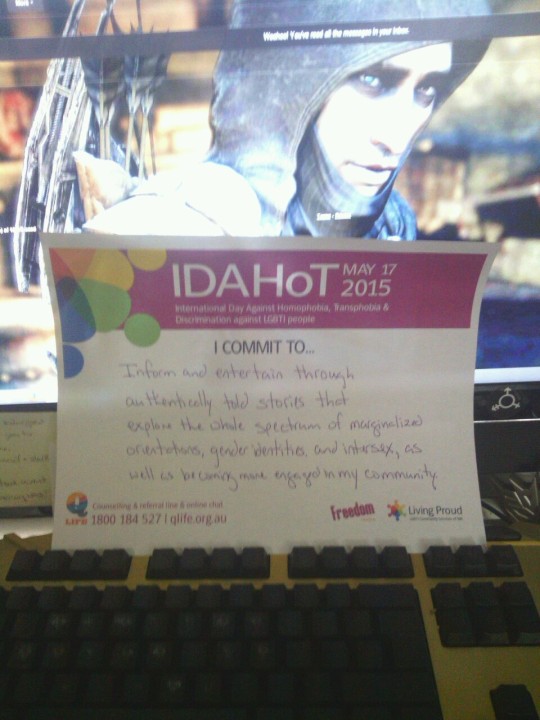
International Day Against Homophobia, Transphobia & Discrimination against LGBTI People

Above is my commitment for this year and I thought I’d expand on it a bit because I find the choice of wording isn’t as inclusive as it should be. You might notice the I used the MOGAI definition in my statement. I feel this is much more inclusive and less cumbersome than the LGBT+ acronym. So it will also be my goal to make MOGAI more visible and to promote its use so that asexuals and others not included in LGBT will feel a part of the community.

If you have suggestions on ways I can be more inclusive in my writing, I welcome your comments.

poetry

The Keeper and the Kept

Can you handle the blood?
Is it something you hate?
Does the violence excite you?
Am I too twisted and broken for you?
Or is that why you keep coming back to riffle through the pages where I live?
Returning to see if I will change,
if the villain can become the hero?
You see all my flaws,
all my hidden thoughts,
yet you keep returning.
You have fingers as soft as the paper they caresses,
eyes deeper than the black
beyond the edge of the universe.
You twist your hair as you read of my trials and tribulations.
You bite your lip as I am wounded and left to bleed.
You call my name in your sleep.
You love me,
you hate me,
you want me,
you rape me.
I suffer gladly through it all.
Just hoping you will return to do it all again.