asexual · Characters · Going Over the Rainbow · lgbt · mogai · writing · Writing FUNdamentals

Going Over the Rainbow: The Asexuality Spectrum

GoingOver theRainbow (1)

For this month’s Going Over the Rainbow post we are going to look at one of the more misunderstood orientations—asexuality. I’ve broken this post up across two weeks because there are a lot of misconceptions as to what being asexual is and I want to address those before getting into actually writing an asexual character.

So what does it mean to be asexual? It varies by person but the simplest definition is a lack of sexual attraction. It is not the same as abstinence nor it is a mental illness. Asexual persons may not experience the desire to have sex with someone who they might otherwise find attractive or appealing, but that doesn’t always hold true either. Mostly because asexuality is, itself, a spectrum.
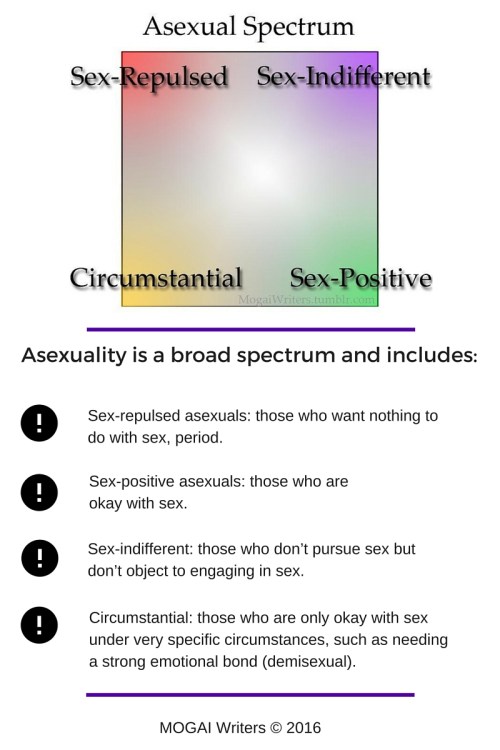
Asexual Spectrum

The asexual spectrum includes people who are completely repulsed by the thought of sex all the way to sex-positive individuals who may even enjoy sex with their partner. It’s a very personal thing for each asexual person and no one but them can tell you where they fall on the spectrum.

Many asexual persons will refer to a romantic orientation such as illustrated in the chart:

Romantic Attraction

Looking at the two charts combined you’ll see that there is a vast number of possible combinations. I personally identify as panromantic demisexual. What that means to me might not mean the exact same thing to someone else with the same chosen labels. For me personally, I am romantically attracted to people regardless of gender while I have only ever experienced sexual attraction twice in my entire life. To those who don’t know me I might appear to be a monogamous heterosexual. This is a misconception. Monogamy is a choice. My being sexually active with my partner doesn’t make me heterosexual, I am still asexual. I do not look at other people and find them sexually attractive. In fact trying to imagine sex with someone results in feelings of revulsion and panic. I quite literally cannot fathom it.

This doesn’t mean that asexuals can’t get turned on or don’t have a libido. Sexual attraction and libido are two separate things. You can experience sexual attraction yet have a low libido and there are people with a desire for sex that doesn’t relate to their orientation. There are asexuals who do engage in sex or who masturbate for a variety of reasons including but not limited to: pleasing a partner, releasing tension, to get to sleep or because they enjoy it. They are still asexual.

Asexuals also face unique issues within the community and recently there has been a call by some for them to be dropped from the LGBT community. Some asexuals feel that they would be better served by having their own separate community since the majority of the LGBT community is highly sex focused. This is an ongoing debate and will probably never be fully resolved.

It’s also good to keep in mind the kinds of challenges asexual face in our society. Sex is seen as normal, healthy and something that is integral to being human. Its even listed as a basic human need along with eating and breathing in Maslow’s theory of the hierarchy of needsmaslows_hierarchy_of_needs. Which any asexual will tell you is preposterous. No one has ever died because of a lack of sex. Lack of love, yes. But love is not sex. Sex can be an expression of love and intimacy but the act itself can be done for reasons outside of love. But, because of this view of sex and sexuality many asexuals report feeling broken or being seen as not wholly human by many, even being referred to as robots or plants or just being flat denied as existing. Acephobia is very common and often goes unrecognized and unchallenged.

Asexuals face being infantilized, fetishized as virginal, excluded by the LGBT community, labeled as mentally ill, and generally dismissed by society at large. These are all things your character might face as well. Don’t shy away from addressing these issues if your plot allows for it.

Next week we will delve deeper into how to actually go about writing an asexual character.

Asexual Orientation

The Thinking Asexual

Privileges Sexual People Have

Asexual Erasure and Mental Health

No Sex Please, I’m Asexual

If you enjoyed this post and would like access to exclusive content please consider supporting me on Patreon.


asexual · gay romance · Going Over the Rainbow · lgbt · mogai · writing

Going Over the Rainbow: Hot for You

GoingOver theRainbow (1)

This past week there has been a lot going on in both the LGBT community and the gay romance writers community. If you follow me on Twitter, you probably saw some of my reactions to the ongoing discussion. It revolved around one topic in particular: the ‘gay for you’ trope.

An incredibly popular trope in the m/m romance/erotica genre, it has been staunchly defended by those who enjoy writing and reading it while at the same time much of the queer community has expressed concern over it as being multi-queerphobic.

It’s been debated far and wide on the internet and I’m not going to get into it here. I will say that I personally loathe the trope for a long list of reasons, but instead of getting into that I am going to show you how to make the trope work.

That’s right. It can work. I promise you. Though the ‘gay’ part might need rewording.

First let’s take a look at the trope itself. What does ‘gay for you’ mean? Straight cis male falls in love/lust with another gay/straight cis male.

Hmm, okay. Well if you are straight and then suddenly find this one specific person who is your same gender attractive *surprise* you aren’t straight and you never were! Welcome to queerdom!

But-but, yes they are! You exclaim pointing to all the straightness of your character.

Shh, it’s okay. There are many people out there who thought they were straight and ended up being queer. Sexual exploration can be on ongoing and fluid thing. Shoot, I thought for years I was a lesbian (mostly because people said I was), then ace, then learned about demisexuality.  However, most gay men I’ve met, talk to, read about, knew they were gay since they were young. I’m talking like from their teens and sometimes even younger. You learn pretty early on who you find sexually attractive. Well, most of us.

What do I mean by that? Well, not everyone who is queer is gay or lesbian. Some of us don’t find anyone sexually attractive. (gasp)

Let me use myself as an example. I am 37, soon to be 38 years old. My entire life I have found only two people sexually attractive who happened to be different genders. And no—I am not bisexual. I am demisexual. I cannot and do not feel sexual attraction unless I have a deep emotional bond with a person and this doesn’t mean I’m hot for all my friends. Doesn’t work that way.

But that’s just me. There are some bisexual people who have only found one or two people of their same gender sexually attractive. They are still bisexual.

So what does this have to do with the trope.

Everything. There is a big issue in the entertainment industry with never looking beyond the G & L and basically erasing every other orientation out there, not to mention trans persons. Which is incredibly frustrating and very sad because the variety brings you so, so many opportunities for incredible stories.

This trope wouldn’t even be an issue if the character came out as bisexual, demisexual, pansexual or gray-asexual. All of these orientations would neatly explain why a character is attracted to someone of their same gender when they never have been before. One or two sentences is all it takes. Please allow me to demonstrate:

Reilly sat down next to Timothy in the booth. His best friend wriggled over to give him more room.

“What’s up Rei? You look a bit worried.”

Reilly shrugged and slid down in the seat. “You remember Quintin?”

“Yeah, he works at the cafe on the square. I almost asked him out. Why?”

“I don’t think I’m as straight as I thought.”

Timothy chuckled but quickly sobered. “Wait … really?”

“I don’t get it Tim … I’ve never … I’ve always thought I liked girls. I know I’m not gay.”

Timothy leaned over and bumped Reilly’s shoulder, “So maybe you’re not, maybe you are bi.”

It really is seriously that easy. In fact there really are no excuses beyond ignorance and laziness. And I know you are not like that.

So instead of ‘gay for you’ maybe ‘hot for you’ or another choice of wording might help us to be more inclusive. Just in case you need help here is a link to my worksheet and so helpful links.

Character Sexuality Worksheet

Going Over the Rainbow: The Trope Trap

Going Over the Rainbow: Moving Beyond the LG in LGBT.

Going Over the Rainbow: Show and Tell

For You

The Mythical Unicorn of LGBTQIA Novels (Or, the A doesn’t stand for Ally.)

Why Labels Matter


Do you have any questions for me regarding asexuality/demisexuality or the ‘gay for you’ trope? Which orientation would you like me to feature next month?


If you enjoyed this post and would like access to exclusive content please consider supporting me on Patreon.
 

Characters · Going Over the Rainbow · lgbt · mogai · writing · Writing FUNdamentals

Going Over the Rainbow: There is No Fast Lane

GoingOver theRainbow (1)

After last week’s post I had some people asking me to explain the concept of aromanticism further. If after reading the post and the included links you are still feeling a bit confused or unsure, don’t worry there isn’t anything wrong with you. Unfortunately, it is a subject much like gender; you only truly ‘get it’ if you experience it. Which is why I’m writing this week’s post on a slightly different subject; knowing when a story is not yours to write.

warning-general-2

This post is going to frankly discuss sensitive subjects that some might find triggering. Please read with caution.

I’ve discussed many personal things on this blog in the hopes of helping others gain insight to how some of us interact with the world around us. It is my sincere hope that these posts are not only informative and entertaining, but that they help you gain a greater understanding of your characters and more importantly; people who you might meet in your life.

However, there will sometimes be things that simply cannot be explained, they must be experienced to be understood. Even as a queer individual, I know that my experience is different than others. There are some orientations and gender identities I cannot comprehend because my brain is not wired that way (I don’t understand gender itself on my best days which is why I’m nonbinary). What I’m encouraging you to do is; be willing to learn about others but if something doesn’t click, don’t get frustrated. We can still try to be understanding and open-minded. But how do we know if we are straying into someone else’s lane?

Staying in Your Lane

Writers love to learn, but some things cannot be learned they must be experienced. I could tell you about my experiences growing up as a queer and gender confused child but unless you have experienced the dissociation, frustration, loneliness, and heartbreak of feeling othered by family and friends alike, there is little I can do to fully impart the knowledge. You might be able to empathize but true comprehension isn’t something I’d actually wish on anyone. This could make writing a character with a background like mine challenging for you. We all get lonely, frustrated and heartbroken but my cause for those feelings might be something incomprehensible for you. And that’s okay.

What’s not okay is writers who assume they understand and proceed to write characters who they think I should be like. Characters ‘triumphing’ over their queerness or being miraculously cured of their mental illness when Mx. Right comes along.

Jami Gold mentioned this last year in her post Shining a Light on Diversity and also in her post One Step to Better Writing and More Diversity. In both articles she mentions not defaulting to stock characters to fill perceived quotas to make our stories seem more diverse. Though as she says in Shining a Light on Diversity; even doing our research and having diverse beta readers and other help might not be enough.

In short it might not be our story to tell at all.w20_7b_be_prepared_to_stop

But how can we know if the story we want to tell is something we can do with good indepth research and interviews or if it would be best left to an author of that particular background?  There are plenty of blogs out there telling you how to write with diversity. The push for diversity is very much needed and should be actively sought and encouraged. However unlike some other bloggers I am going to tell you right now: Not every story is yours to tell. I’m sorry for being blunt but it is the truth. We must learn to check our priviledge and to stay in our lane to avoid traffic.

What does ‘check your priviledge’ mean?

Simply put, this means that we may, unknowingly, have certain advantages over others. And this is only because there are aspects of our identity that society values over others.

When someone asks you to ‘check your priviledge,’ what they’re really asking you to do is reflect on the ways that your social status might have given you an advantage—even if you didn’t ask for it or earn it—while their social status might have given them a disadvantage. (http://everydayfeminism.com/2015/07/what-checking-privilege-means)

So how do we know if we are in the correct lane? Let’s look at a few questions we can ask ourselves.

NOTE: For this I’ll be focusing on the gender and sexual identity portion. As a white person it is not my place to comment on racial issues faced by minorities. For help with racial diversity I highly recommend Writing With Color which is maintained by several people of diverse racial backgrounds.

  • Do I have a personal understanding of what this character might be facing? Can I truly sympathize with them or do I find it difficult to understand where they are coming from.
  • Do I find myself defaulting to stereotypical actions becasue I don’t fully undersand or comprehend how they might act/react in certain situations?
  • Am I struggling with the basic definition of their orientation or gender identity? Do I find it difficult to understand their viewpoint or do I find myself making excuses to write them the way I feel their orientation/gender identity should be represented?
  • Is the major part of their character arc about their race, gender identity, sexuality or mental helath? If so, do I share their experiences or can my experiences contribute to my characterization of them? If not, will research and interviews be adequate for their chararcterization?
  • Will my writing this character ‘talk over’ a writer from a diverse background? If I am not sure, have I asked someone of that background?
  • Am I being honest with myself about why I am writing this character and have I truly put aside any preconcieved notions or assumptions?
  • Is the story’s focus on their struggle with their race, gender identity, sexual orientation or mental health? If it is, do I identify as part of that diverse group? If I don’t, why do I feel the need to write about it? Do I feel as though I need to write this character to make a point? What point am I trying to make and why?
  • Have I read similar characters written by a writer from a diverse background? If not why do I feel qualified to write this character? Has a minority writer already written a similar story? Would I better serve my readers by promoting that author?

If we go through and candidly answer these questions we might find ourselves a little uncomfortable with the answers. It’s alright. This is your conscience telling you that you might be straying out of your lane.

There is nothing wrong with wanting to write someone different from ourselves, I wholeheartedly encourage it, the caution comes when we realize we cannot fully grasp the character’s situation or that our motivations for writing the character might be misplaced.

There is nothing to be ashamed of if this is the case. It just means that we should look for other ways to write this particular character or show our writerly humility and not write the character at all. This is why I rarely write traditional heterosexual romance and erotica. I don’t understand it.

I’ll be quite honest, when I read a romance that has the heroine gladly jumping in bed with the hero a short time after meeting him, I’m very put off. I cannot comprehend being able to have sex with someone within minutes of meeting them. I find the thought repulsive, but that is for me personally and I understand other people think very differently. They might find my lack of romantic and sexual attraction equally confusing and disturbing.

The wonderful thing about writing is that we all have stories to tell. No one can write like you or from your viewpoint and world experience. Don’t feel limited by that though. Please do read, research, explore, learn, and write with diversity. Just please also remember that even though your lane might not be wide, it’s just as long as you want to make it and don’t be afraid to let it intersect with other lanes. Just make certain you stop to check your priviledge first.

Going Over the Rainbow: Crush Those Stereotypes

Characters · Going Over the Rainbow · lgbt · mogai · writing · Writing FUNdamentals

Going Over the Rainbow: Aromantic

When Romance is Not an Option

I was having a hard time deciding where to start, so I thought I’d just do this alphabetically. ^^ I personally am between pan and aro when it comes to romantic orientation. I don’t claim to understand everything about either, and my experiences will vary widely from other aromantics.

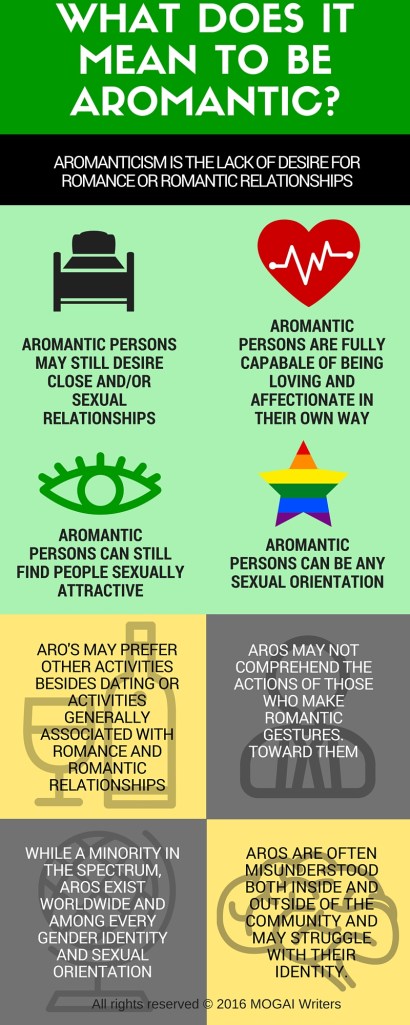
Aromanticism is:

not experiencing romantic attraction.

Aromanticism is not:  

a personal choice or lack of emotional connection.

Definition (From AVEN Wiki): An aromantic is a person who experiences lAromanticittle or no romantic attraction to others. Where romantic people have an emotional need to be with another person in a romantic relationship, aromantics are often satisfied with friendships and other non-romantic relationships. What distinguishes romantic relationships from a non-romantic relationships can vary diversely, but often includes physical connection (holding hands, cuddling, etc.) (Italics mine).The aromantic attribute is usually considered to be innate and not a personal choice, just as the lack of sexual attraction is innate to asexuals. It is important to note that aromantics do not lack emotional/personal connection, but simply have no instinctual need to develop connections of a romantic nature. Aromantics can have needs for just as much empathetic support as romantics, but these needs can be fulfilled in a platonic way.

It is possible for an aromantic individual to be involved in, and enjoy, a devoted relationship with another person, but these relations are often closer friendships, naturally reflecting the closeness of the two individuals and not a purposely initiated monogamous separation as is often found in romantic couples. Aromantics may experience squishes which are the aromantic or platonic equivalent of a romantic crush. When an aromatic get’s into a relationship that’s more than friends – but less than romantic – that is known as a queerplatonic relationship.

Like all romantic identities aromatics can be of any sexual orientation.

Writing the Aromantic Character

The first thing to remember when writing an aromantic character is that being aromantic does not mean incapable of love, affection or sexual intimacy. It simply means they do not experience romantic attraction. They have friends and other relationships but not with a goal of a romance. (http://www.buzzfeed.com/mcrosswell/5-myths-about-aromanticism-tysc#.lvwnEXPxq)

Romantic Orientation – Describes an individual’s pattern of romantic attraction based on a person’s gender(s) regardless of one’s sexual orientation. For individuals who experience sexual attraction, their sexual orientation and romantic orientation are often in alignment (i.e. they experience sexual attraction toward individuals of the same gender(s) as the individuals they are interested in forming romantic relationships with). (AVEN Wiki).

As when writing any character, you need to ask yourself several questions:

  • Have I given them other meaningful, close relationships?
  • Have I fallen into the stereotype of the aromantic asexual as an unfeeling, friendless, virginal robot who hates everyone? Not all aromantic people are asexual.
  • Do I fully understand what it means to be aromantic? Is this my story to tell?
  • Have I tried to ‘fix’ the character’s or tried to show them suddenly being romantic when they find the ‘right’ person?
  • What are my reasons for having this character be aromantic? Have I made them a whole person or is their orientation their primary characteristic? Am I trying to fill a perceived quota?
  • Have I made the character aromantic due to mental illness, trauma, personal failing or some outside factor? If so, why and how does it serve the plot?
  • Have I made this character’s orientation the comedic relief?

Now some questions for your aromantic character:

  • Do they realize they are aromantic? How do they feel about this? Do they wish they were ‘normal’ or are they content with their orientation? Do they try to force themselves into romantic relationships? What are the consequences?
  • When did they discover their orientation? Was it a gradual understanding that took years. Are they still a teen and trying to come to grips with how different they might seem from all their peers?
  • Who else knows about their orientation or have they told anyone? If so, who and why or why not? How did those they told react? How did they handle this reaction?
  • How has their orientation affected their other relationships?
  • Do they want a close platonic or even sexual relationship?
  • Does their orientation intersect with other things such as gender identity, race, physical disability, mental illness, or other factors? How do they handle this intersectionality?

Once you’ve addressed these questions, it is important to remember that you are writing a person. A whole person not just an orientation. While a person’s orientation is integral to who they are and defines them up to a point it shouldn’t be the sole basis for their personality. This can lead to falling into the trope trap. While tropes themselves are not bad some can perpetuate harmful stereotypes. Aromantics are seldom, if ever, seen in media so there are very few tropes about them, though many of the asexual tropes can apply as well.

Don’t shy away from writing them just because they are rare. They are part of the spectrum and need to be favorably represented so that other aromantics can read their stories and see that they are not broken, ‘messed up,’ or ‘weird.’ They are normal people who just happen to not be interested in romance. This might feel like a challenge at first and if you are romantically inclined it might be difficult to comprehend. It’s okay. Their story might not be yours to write and that’s fine. But don’t let that scare you off from including their orientation in your stories. If anything the research can help you, as it has me, come to a better understanding of others and to have greater empathy.

Here are some more references I found helpful that I’d like to share with you:

Aromantic – AVENwiki

5 Myths About Aromanticism – BuzzFeed

ASK AN AROMANTIC (if asking questions please remember to be courteous and not assume things)

Anagnori : You might be aromantic if…

Resources for Aromantic Sexual People | The Thinking Aro

Asexual Romances Are Necessary

Going Over the Rainbow: Like a Moth to a Flame

Going Over the Rainbow: The Trope Trap

Going Over the Rainbow: Crush Those Stereotypes

Please share your thoughts with me. Were you aware of the aromantic orientation? Have you met an aromantic person? Would you consider including one in a story? What challenges do you think aromantics face in our society? How might this affect their portrayal in media? Do you know of any canon aromantic characters in a book, movie or game? 

If you enjoyed this post and would like access to exclusive content please consider supporting me on Patreon.

asexual · Characters · Going Over the Rainbow · lgbt · mogai · writing · Writing FUNdamentals

Going Over the Rainbow: Like a Moth to a Flame


GoingOver theRainbow (1)

This week has been chaotic at best and I apologize for the lateness of this article.

As writers who write living beings at some point our characters will probably experience attraction to another being and desire a relationship. But what kind?

Romantic relationships often seem to be the default in books and movies. Hero A must get with their OoD (object of desire) by the end of Act 3 or your story is a flop. The default romance has become such a staple of mainstream media that to not have it can make it feel as though your story is missing something. So is it?

No not really. Ever watched a show with a really great partnership/friendship. Those are relation(ship)s too. Just with a different kind of attraction. Mad Max: Fury Road was a great example of this. Max and Furiosa’s relationship is not one of sexual attraction at all. Even Capable and Nux don’t have a blatantly romantic relationship. Theirs is based more on shared comfort in a society that sees both of them as disposable objects.

So what kind of relationship did they have if it wasn’t a romantic one?

Yes, you’re on the right track. There are several different forms of attraction (and love but that’s for later). Don’t forget though, romantic attraction does not equal sexual attraction for everyone. Your character can be romantically attracted to someone without wanting to engage in sex.

Let’s look at what this means.

Sexual attraction is what people feel when they look at someone and their first thought is something along the lines of “I want to jump their bones” or “How do I get in those pants.” It’s a response to finding someone physically appealing. Think lust.


Marketing companies bank (literally) on our being sexually titillated to sell things. Sex sells, right?

Not always.herehaveanothersexyburgerpic_4f15384461b9daf422986fc8509e164c

(Personally, I have no idea what is appealing about this picture but it came up when I looked up sex in advertising.)

So if there are other kinds of attraction, like my attraction to that burger, what are they? Why do we as writers need to be aware of them and how can we be more diverse by writing characters with different attraction orientations?

Just as there are different sexual orientations, there are different romantic orientations. Just as there are asexual persons, there are aromantic persons. I consider myself panromantic with heavy aromantic leanings. Meaning: while my romantic attraction is not defined by gender I am less likely to engage in anything traditionally romantic or be romantically attracted to anyone regardless of gender. It does not mean that I don’t—or am not capable—of love. Remember earlier? Love and romance are not the same thing. It is entirely possible to love people without being romantically attracted to them.

There are many different types of attraction, including:

Sexual attraction: attraction that makes people desire sexual contact or shows sexual interest in another person(s).


Romantic attraction: attraction that makes people desire romantic contact or interaction with another person or persons.


Aesthetic attraction: occurs when someone appreciates the appearance or beauty of another person(s), disconnected from sexual or romantic attraction.


Sensual attraction: the desire to interact with others in a tactile, non-sexual way, such as through hugging or cuddling.


Emotional attraction: the desire to get to know someone, often as a result of their personality instead of their physicality. This type of attraction is present in most relationships from platonic friendships to romantic and sexual relationships.


Intellectual attraction: the desire to engage with another in an intellectual manner, such as engaging in conversation with them, “picking their brain,” and it has more to do with what or how a person thinks instead of the person themselves.

(https://lgbtq.unc.edu/asexuality-attraction-and-romantic-orientation)

maleficent-auroraMaleficent (2014) is an excellent example of True Love™. In the movie it was not the Prince’s kiss that could break the spell. Only Maleficent herself could do that. It was the fact that Maleficent was the only person who Aurora truly loved that allowed her to break the spell. This is platonic love.

This is the kind of attraction between characters who are very close friends. I’m pretty certain you don’t have any problems writing friendships.

Sensual and sexual attraction are much more common than aesthetic attraction in books and movies. Women in close, non-sexual, relationships are often shown as being sensually attracted to each other since cuddling, snuggling, hugging and holding hands are seen as more feminine type behaviors. Don’t be afraid to break stereotypes or expectations. Men can initiate cuddling, hand holding and other forms of non-sexual intimacies.

Knowing these various types of attraction can help us as writers be more diverse with our characters and their relationships. Hero A might not find the Hero B sexually attractive, but could be aesthetically attracted to them. Or Hero B might find Sidekick C sensually attractive and want to cuddle and watch Netflix with them.

Don’t be afraid to allow your characters other close relationships even if a romance is the primary focus of the plot. This will help round out all of your characters.

Next time we’ll dive into the various types of romantic orientations and how to write them.

If you enjoyed this post and would like access to exclusive content please consider supporting me on Patreon.


Books · Characters · gay romance · Going Over the Rainbow · lgbt · mogai · Movies · writing · Writing FUNdamentals

Going Over the Rainbow: The Trope Trap

tumblr_o1a4is0yup1upq7vno1_1280


All joking aside, accountability is something that professionals of any discipline face. Even us writers.

Yes, you read that right. You, my dear writer, are accountable to your reader. Well yes, you say, I should give them the best story I can write.

Yes you should, but it goes beyond that too. If you’ve written for long you’ve probably ended up having to do some research into an unfamiliar topic. We often joke about hoping the government isn’t keeping too close an eye on our internet research history. There are many resources available online to help us flesh out our characters and our setting. One Stop For Writers is a great example. However, while we might research settings, the job our character has and where they live; sometimes we forget that other things need research too.

Jami Gold had several excellent articles about writing with diversity and the research that goes along with it.

Ask if the Story Is Ours to Tell: If we don’t have direct experience with the diverse element, a story that centers on the diverse aspect might suffer from disrespectful negative stereotypes or breathless, isn’t-it-inspirational-how-they-overcame-those-obstacles “positive” stereotypes. (Note that treating a character’s diverse element as a problem to overcome isn’t actually positive.) — Jami Gold

Sometimes when we are writing a character, even when we’ve done research, we might find ourselves slipping into stereotypes or tropes. They are like clichés. They are comfortable and familiar. Unlike clichés they can be damaging and perpetuate some very harmful thinking.

We can usually spot harmful racial stereotypes. I wrote about avoiding stereotypes in a previous post. I still recommend WritingWithColor, DiversityCrossCheck and betas to help with racial/cultural sensitivity. But tropes aren’t always stereotypes, so how do we know if we are falling into the trope trap?

Trumping the Tropes

There are a LOT of tropes out there. And they are not all bad, most exist for a reason and like popular themes don’t have to be eschewed completely and can even be used to good effect. Over the course of this series I will be addressing various tropes and how they relate to the identity or orientation I’m discussing. In case you are curious as to how many there are TV Tropes Queer as Tropes page is a good place to start.

One of the most prevalent tropes is Bury Your Gays. Queer persons never get happy endings. Ever. Often they die.

Or, more recently, they are the villain.

This doesn’t mean that your queer character has to survive and not be evil. However, it does mean that you need to be very careful about how you approach each of those circumstances. Just as careful as you’d be about casting a black man as a street thug.

Tropes at their most basic are indeed stereotypes and thus need to be very carefully considered. Many common romance themes are tropes in disguise.

  • Stereotypes: Not literary. We avoid using this term to talk about classifying characters, settings, plot points, etc..
  • Archetypes: The broad, all-encompassing norms of the stories humanity tells. The same archetypes can be found in all or nearly all cultures.
  • Tropes: Culturally-specific norms in storytelling. Tropes are cultural classifications of archetypes. There can be many tropes found under the umbrella of one archetype. Literary devices are not tropes (i.e. narrators, foreshadowing, flashbacks, etc.).
  • Clichés: Overused and hackneyed phrases, characters, settings, plot points, etc.. Archetypes do not become clichéd. Tropes can become clichés if they are used too often and readers get bored of them. Clichés are defined by a loss of the meaning or as a distraction from the story.

Definition list from WriteWorld.org.

If we find ourselves falling back on common tropes a lot in our writing5 Questions to Ask Yourself (1), we might need to ask ourselves why. There is absolutely nothing wrong with using tropes but we need to make sure we are giving them our own special treatment. This is easily done by combining two or more tropes or even subverting or flipping them.

Let’s look at some examples:

All Gays Are Promiscuous trope is the stereotype that a gay man is completely driven by lust and must therefore have sex all the time.

Game of Thrones: Downplayed by Ser Loras Tyrell; he is rather easily seduced by an attractive male prostitute, and exchanges significant glances with the openly bisexual Oberyn Martell not long after his lover Renly Baratheon is killed. He mostly comes across as this in comparison to his literary incarnation, who falls into a deep depression after Renly’s death, is apparently celibate, and shows signs of being a Death Seeker.

Wallace Wells, Scott Pilgrim‘s cool gay roommate, is characterized with this trope, even going so far as to hang a lampshade it when chastising Scott for infidelity.

Scott: Double standard!
Wallace: Hey, I didn’t make the gay rules. If you don’t like it, take it up with Liberace’s ghost!
Are there gay men who like to sleep around? Yes, or course, just as there are lesbians, bi-sexuals, pansexuals and straight people who do the same. But the issue comes when we perpetuate it as a defining trait of being gay. This trope is very easily subverted by letting our gay character be in a committed relationship that is not centered on sexual gratification. After all that’s the kind of relationships many of us have and enjoy.
So, do you see how a trope can be trouble? But why should you care?

Jumping the Shark

movie-poster-jaws

The blockbuster movie Jaws launched a national campaign against the ‘man eaters’ and contributed to the drastic decline in the shark population. To this day, the stereotype against sharks persists.

The film’s key mistake was portraying great white sharks as vengeful predators that could remember specific human beings and go after them to settle a grudge. — How ‘Jaws’ Forever Changed Our View of Great White Sharks by Charles Q. Choi

This is just one example of how harmful a negative portrayal in our work can be on others. This is why I wanted to address the issue of accountability with you and how it relates to using tropes.

As authors we enjoy the privilege of having readers accept our words at face value (for the most part). People trust us. What we show them in our fiction, no matter what we write— paranormal, romance, thriller, mystery, literary, et cetera—has an impact on their thinking and their perception of the world around them. This is why we have to be so careful about stereotypical or negatively portrayed characters from marginalized identities/orientations/races/cultures.

This is why I say we are accountable. Our words have power. The power to create understanding and empathy or further the divide. This is why research from valid sources is so important and why we must recognize our own tendency toward common tropes and stereotypes when writing.


Now that I’ve got most of the preliminary issues out of the way, it’s time to start delving into the various gender identities and sexual orientations. As we move forward, I’d like to encourage you to refer back to these posts and keep these things in mind.

What are your thoughts on author accountability? Have you ever come across a negative portrayal that affected you personally? Have you read any books where certain characters were walking stereotypes? Do you have any other comments or questions for me?

If you enjoyed this post and would like access to exclusive content please consider supporting me on Patreon.

Characters · Going Over the Rainbow · lgbt · mogai · writing · Writing FUNdamentals

Going Over the Rainbow: Show and Tell

I recently ran across a post on Tumblr where the OP was rather distraught. They’d been told that using the word asexual to describe their character’s orientation was historically inaccurate for their setting.

This brought up the issue of explicitly stating a character’s orientation within the prose and when and how this should be done. Some writers might feel that they’d rather not label their characters and let their readers decide the character’s orientation. However, I caution against this.

El at Just Love Romance recently brought out how many romance novels feature asexual and demisexual characters yet this is rarely explicitly stated for the reader. Often in movies and television a character’s sexuality is left vague and for the viewer to guess. This can lead to what is called queer-baiting and is a huge source of frustration within the community.

I’m here to help you avoid this problem no matter what genre you write.

Transparency in Prose

The best way to let your reader know a character’s orientation is to tell them. Let your character state their identity. Be explicit. If your character is questioning or unsure, let them talk about it to other (hopefully queer) characters. Don’t be afraid to show them being unsure or looking for answers. You don’t have to be writing a coming-out story to allow a character to realize who they are.

Okay … don’t look at me like that. I know what you are thinking. It doesn’t fit in the narrative, they are a secondary character, the terms are too modern for my setting, I’m afraid of reader backlash, I don’t even know how they identify, blah, blah, blah.  Sorry, I’m not letting you off the hook on this one. No excuses.

Subtext is not enough. Readers want context. Which means you, my dear writer, have to be transparent when it comes to your character’s sexuality. It must be stated and shown for the reader.

But how?

Please allow me to show you.

Show and Tell

This is one of those times you can throw aside the advice to ‘show don’t tell.’ However, there are ways to show your character’s orientation. The graphic below lists the main ways to do this. As with any other characterization details there are a number of ways to get the information across to your reader.

Dialog

This is one of the easier ways to show the reader a character’s orientation. It doesn’t have to be a pages of discussion, it can be just a line or two of dialog. As long as it is clearly stated by someone. Here is an example:

Maggie stared at the curvy young woman behind the counter. A bump to her hip jolted her to the side. She glanced over to see her friend grinning at her.

“Come on Maggie, either ask her out or stop leering.”Ways to Show and Tell A character's Orientation

“I … uh,” Maggie blinked rapidly as her brain went on autopilot. “She’s probably not even interested in women.”

Okay let’s stop right there. ‘Interested in women’ could mean lesbian, bisexual, or pansexual. So let’s try this:

“I … uh,” Maggie blinked rapidly as her brain went on autopilot. “She’s probably not even a lesbian.”

“Actually I’m pan,” The woman smiled showing two cute dimples.

Simple, right?

Action

Another way to show it is by your character’s actions around those they find attractive. This works nicely if it’s difficult to work the terms into dialog or you want to add extra reassurance for the reader. This is like any other scene that shows characterization, it just deals with your character’s sexual orientation. Again there is no reason to spend multiple paragraphs, get the information out there and let the reader do the rest. If you’re unsure how to show attraction check out One Stop For Writers Emotion Thesaurus. There are several entries to help you show emotional attachment. And don’t forget there are plenty of non-sexual intimacies that can show your character being attracted to or in love with someone.

Internal Dialog

This is an often under-utilized tool for characterization. You are allowed to let your character think about things, dwell on them, process them. This helps your reader too. If you feel dialog or action isn’t appropriate for your character to express their orientation then this might be a good alternative. Of course balance is needed as with all plot and characterization tools.

External Circumstances

What I mean by external circumstances is that it is not the character in question who tells/shows the reader what their orientation is. It could be anther character discussing them or something that happens in the larger world around them. Something as simple as another character stating “X is asexual, they might be uncomfortable watching this movie” or you can even tell your reader as the following paragraph demostrates.

Alice talked to Bert about her feelings for Charlie. Bert informed her that Charlie’s asexual, so whilst he might be open to a romantic relationship, he’d not be likely to respond to sexual flirting. Maybe she should try another tactic to get Charlie’s attention.

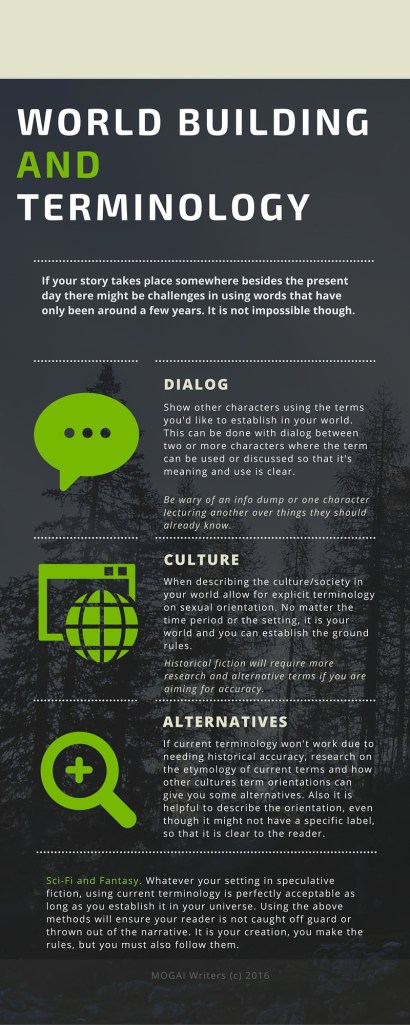
Not fantastic but you get the idea. But what if you write historical fiction, fantasy or science fiction? Can you still use the modern terms?

Absolutely.

Here are a few quick, easy ways to do so.

Bran Lindy Ayres (1)


What are your thoughts on this? How would you approach revealing a character’s orientation? Have you read any books where you weren’t sure of a character’s orientation? 

If you enjoyed this post and would like access to exclusive content please consider supporting me on Patreon.


Books · lgbt · mogai

The Jeweled Dagger Pre-Order News and Book Release Party

It’s been just over a year since I started working on The Jeweled Dagger. It all started from a NaNoWriMo boot camp in 2013 and a little righteous indignation at an editor over being told to take out Lafayette’s ‘cross dressing.’ I quit the boot camp when it became obvious I wasn’t going to get any support writing a non-traditional romance. I’ve never once regretted my decision.

Over the past year I’ve had amazing support from my friends, both online and off, and the lovely staff at my local comic book store who let me come haunt their premises.

This book would not have been possible without the help of the exceptional Jean Mabbs and the amazing Eleonore Eder and my lovely sprinting partner Joana Maia. You all are invaluable and this book would not exist without you.

The Jeweled Dagger Cover

Genderfluid spy Lafayette Goddard knows better than to trust anyone in their line of work. Now they sit in prison with information that could save the Queen yet they cannot bring themselves to trust the new Captain of the Royal Guard. Even if it means losing everything they’ve worked so hard for.

All Captain Jasper Stanton ever wanted was a chance to prove himself. Mistakenly imprisoning Lafayette isn’t how he planned on distinguishing himself. Now he must try to win the former spy’s respect if he wants cooperation investigating the conspiracy.

The secret to finding out who is plotting to kill the Queen lies with Lafayette’s mysterious informant known only as the Jeweled Dagger. The closer Jasper gets to Lafayette, the more he wonders just how much is being hidden from him.

The Jeweled Dagger is currently available for pre-order  and will be available Feb 1st.

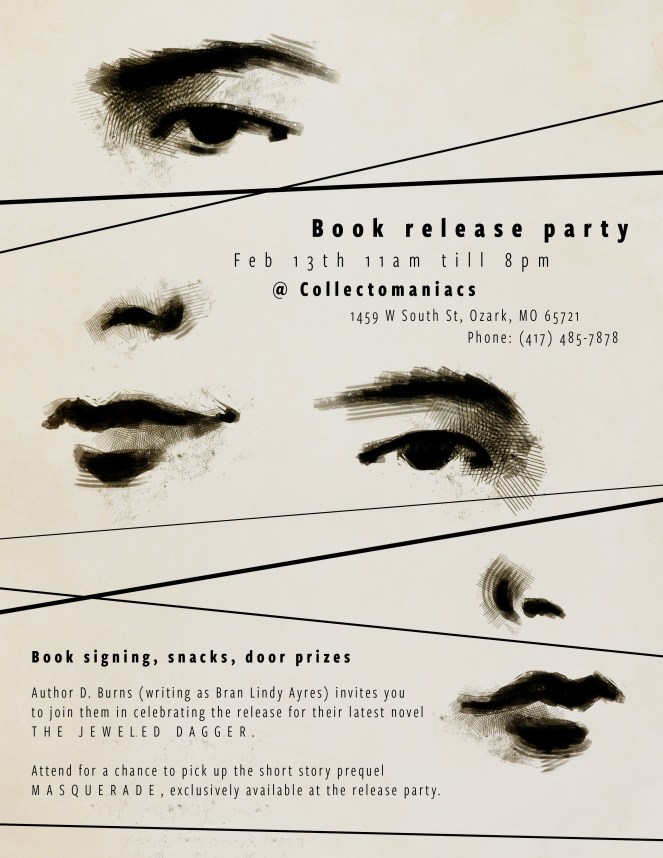
I’m inviting anyone who can attend, to the book release party on Feb 13th from 11am till 8pm at Collectomaniacs here in Ozark. If you cannot make it in person, don’t worry I’ll be hosting an online party as well (I’ll post details once they are finalized). You will find your personal invitation here. I look forward to seeing or hearing from you and hope you’ll join me in celebrating this unique novel.

Book Release Party Flyer

Characters · gay romance · lgbt · mogai · writing

Going Over the Rainbow: Getting the Kinks Out

warning-general-2Disclaimer: This post frankly discusses some aspects of sex and sexuality that some might find triggering including sexual kinks, fetishes and paraphilias. Please do not read further if you find any of these subjects triggering.


If you’ve been around romance writing for long you’ve undoubtedly ran across a number of characters with kinks and fetishes or even paraphilias (and no I will not discuss a certain well known book that shall remain nameless).

But what do these have to do with gender identity and sexual orientations?

Let’s take a look.

Continue reading “Going Over the Rainbow: Getting the Kinks Out”

Characters · lgbt · mogai · Uncategorized · writing

Going Over the Rainbow: The Gender Divide

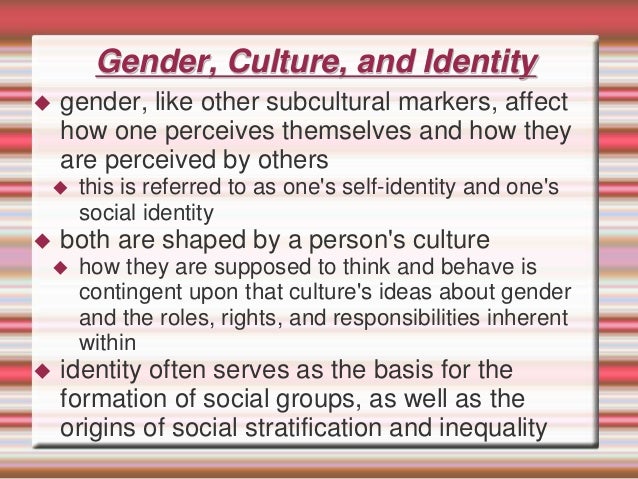
Most of us go through life never thinking much about our gender or how we express it. We might feel it is something we were born with, something absolute and  immutable. We might think there are only two genders and that we are one or the other.

‘But aren’t there only two genders?’ I hear you asking.

Nope. Male and female are only two ends of a vast spectrum. Also it helps not to confuse gender with sex. Sex is biology/physiology and even then there are intersex persons whose bodies are not clearly one or the other.

“When we think of gender, we often think of male or female; that’s only half of understanding gender. The denotations of male and female actually refer to biological and physiological sex. Gender is a sociological construct of values, ideals, and behaviors about what it means to be either male or female, and are often regarded in terms of masculine or feminine, respectively. Many people use sex and gender interchangeably, but one does not have to be male to identify as masculine, and vice versa.”

-Boundless. “Context of Culture and Gender.” Boundless Communications. Boundless, 21 Jul. 2015. 

In addition to exploring the sexual orientations in the coming months we’ll be looking at different gender identities . We’ll discuss gender identity and expression and how you can use these to make your characters more diverse.

‘Why? Can’t I just have my character be male or female?’ You ask.

Of course you can but you’re here so you’re obviously interested in being more diverse in your writing.

The Culture of Gender

Ripley, the main character in Alien originally was to be male.

Have you ever thought about how your favorite book or movie might have been different if the main character had been a different gender? What would have made it different? Why?

In our society (I’m speaking as someone who lives in the US) identifying as male or female comes with a host of gender specific expectations: men are macho, women are feminine, men don’t cry, women are emotionally compromised, men like cars, women like shoes, ad nauseam.  These gender stereotypes are social constructs and have little basis in biology or psychology.

“Gender theorists point to the variations in gender roles observed among different cultures in arguing that gender – our masculinity or femininity – is a social construct rather than an innate biological characteristic. Because there is no universal “right” way to be a man or a woman, they argue that our ways of “doing gender” are shaped by social cues and influences.”

Dr. Abby Palko

This is why we as writers need to be more cognizant of the variety around us.  Challenging these stereotypes can help us broaden our social consciousness and that of our readers.

‘But why should I worry about gender when I only write men or women?’ You wonder.

Because even cisgendered persons, or persons whose gender identity aligns with their gender assigned at birth, are impacted by society’s gender culture and expected to conform to certain norms. It’s not enough to  throw a bunch of ‘masculine’ traits into a character’s personality and call her a ‘strong’ female. And conversely taking a female character and switching to masculine pronouns won’t give you the sensitive male you are looking for. They each will have skin-deep traits and no real depth to them.

Sex and Gender: A Cross Cultural Perspective

It’s my hope that you’ll find the following articles interesting and maybe a little enlightening as we study the wide variation of genders and sexualities and how we can accurately write these identities.

If you enjoyed this and would like access to additional content, please consider supporting me on Patreon

Do you struggle writing a certain gender? Why do you feel that is the case? Have you ever written a character and then decided to change their gender? What prompted the change and how do you feel it turned out?