Characters · Writing FUNdamentals

Beginnings Always End Something

Or why character backstory is vital to your story.

“History, despite its wrenching pain, cannot be unlived, but if faced with courage, need not be lived again.”
Maya Angelou

In preparation for NaNoWriMo, I read numerous blogs about plot and structure and how to do both.  What I’ve not seen many writers mention is the need for well thought out characters.  Plot is after all character driven.  Without meaningful characters there will be no plot.

So how do you go about creating a character that is compelling?

My advice; start at the beginning.  No wait, let me explain.  Start with where you see your character now.  Their beginning in your story.  Now go back.  What lead them up to this point?  What decisions did they make?  What people influenced them?  What outside actions took their toll?  How does their upbringing influence their current thinking and actions?

That’s a lot to think about.

Maybe you aren’t sure how your character’s history has influenced them, or maybe you aren’t convinced it matters.   Let’s explore a couple of examples to see how this could work.  (A note before we continue:  writing a character’s backstory is for your information, when writing the actual story you want to keep as much of it as possible hidden from the reader, only revealing what is absolutely necessary.  We’ll discuss why later in the post.)

Once Upon a Time . . .

There was a young gladiator.  He risked his life for the amusement of others on a regular basis.  He trained, he grew and became mighty, fearless and feared.  His ambitions did not stop at the arena walls.  He wanted to foment change, to start a revolution.

There was a young scholar.  He read, cataloged and reported on the goings on of the empire.  He learned and within him grew a sense of what is just, what is right and respect for the sanctity of life.  He dreamed of a world without corruption, without oppression of the weak and less fortunate.

And one day they met.

“From the greatest love comes the most vicious hate.”

This meeting took place quietly, no grand fanfare, no one really took much notice till later when events started to happen and the revolution was well under way.  They fought for the same ideals yet their methods were as different as night and day.  Understandably the gladiator turned to force, using his great charisma to sway the masses to his side, and using his sword when words failed.  The scholar knowing little to nothing of fighting opened the debate with their ruling council, using his intellect and many years of study to try and persuade them.  The gladiator was impatient and took matters into his own hands much to the horror of the scholar.  Their friendship shattered as the council bestowed the scholar with the most important title their civilization had to offer.  The gladiator, frustrated and feeling impotent now turned his attention from overthrowing the caste system to destroying his onetime friend.

In their current iteration we rarely hear anything about how these two met or why.  We only know that they were once friends and are now bitter enemies.  Yet their back story is critical to where they are now.

Some of you may recognize the characters I’m speaking of here.  I have not named them because I want the focus to be on their back story, not on who they are.

In my novel Sorrow’s Fall little is said of my protagonist’s upbringing outside of a few comments on his training and a random memory or two that is relevant to what is currently happening.  He does not dwell on it, yet is shapes his actions, defines him.  Without his past he would be a radically different person.

There are many times when a character seems to just appear out of a fog with no back history or explanation of why or how they came to where they are.  Sometimes the reader is willing to put aside this in favor of learning about the character.  Wolverine comes to mind.  He himself did not know his past and it haunted him.  His lack of a past drove him forward, dictated his actions and even his friendships and alliances.  He was unwilling to trust anyone.

Then there are characters who we are introduced to just as they reach a defining moment in their lives.  Peter Parker/Spider Man for example.

In each of these examples, the writer knows exactly where these characters are coming from.  Or should.  Knowing where your character has been makes determining where they are going much easier.  Why is that so?

We are the sum of our experiences.  Your character should be too.  This might take some in depth research and hard soul searching.  But, that is what writing is about, finding those hidden truths about ourselves that others can relate to, those hidden gems are what make outstanding characters.

Happily Ever After . . .

So even though pretty much 98% of your character’s back story won’t end up in your actual prose, it is still a huge part of the story.  Without it the characters have nowhere to go and no drive to get there.

Lets look back at my first example of the gladiator and the scholar.  Without their past they would have no reason to fight each other now.  There would be no sense of betrayal on either side.  No one but the two of them truly know the depth of their emotion over what happened, except their writer.  You should know these types of details about your character as well.  Knowing when to use them in your story is a different beast altogether.

The Battle is Joined

If you would like more help with creating a character check out these helpful books:

Uncategorized

Guest Post: Going Pro with Your Writing

This week I am super excited to have Pauline Jones as a guest poster.


Going Pro with your Writing

by Pauline Baird Jones


Writing is easy:  All you do is sit staring at a blank sheet of paper until drops of blood form on your forehead

~Gene Fowler


This is an exciting time to be a writer. It is hard to miss the Fifty Shades of Grey phenomenon, or not feel why not me? Digital publishing has forever changed the landscape for writers, opening up a direct conduit from author to reader. Now fan fiction authors have been talking direct to their readers for years, so they have an important edge—as evidenced by Fifty Shades—when taking their writing from fun hobby to professional business.

But there are some important differences that can trip the unwary and turn going pro into an exercise in miserable.


I love being a writer.  What I can’t stand is the paperwork

~Peter De Vries


Because there are so many options, it has become even more important for the savvy writer to understand the various options, the upside and downside of each, and what’s best for your work. That means you need a basic understanding of intellectual property rights before you sign anything. If you don’t know what IP is, then that’s a good place to start doing your research.


Here are a couple of good places to start:


The Business Rusch (Kristine Kathryn Rusch)

Dean Wesley Smith (her husband)

The Passive Voice (an intellectual property lawyer)

Joe Konrath (writer and voice for indie authors)


Most of these blogs will open you up to more resources and information. Information is power. Don’t fear knowledge. One of the biggest problems writers have is mixing fiction with their reality. They hear or believe what they want to hear, what feels comfortable, or what will let them continue in happy ignorance.

Happy ignorance will not last if you get published. Truth will slap you around. It can cost you time and sometimes control of your intellectual property.

Be in charge of your own business.

Yes, you are, or will become, a small business if you decide to begin selling your work. How much responsibility you take on will depend, in some part, on which form of publishing you choose to pursue. But even if you choose to use a publisher, you will sign legal contracts that will affect your rights to control your work.

And no matter who publishes your work, ultimately you will be responsible for your author brand. Your author brand is your name, or the name that will be on the cover of your published work.

Your published work is your product. Each book is a package that you hope to sell to readers. When you are writing for friends and/or family, story telling is king. And friends and family tend to love you, so they love what you write. They read it without a critical eye. They can overlook typos and badly constructed sentences and meandering plots.

When you are asking readers to pay money for your writing, storytelling is still king—but craft is the queen. If you don’t believe me, just peruse some reader reviews on Amazon, paying particular attention to the 1-2 star reviews.

Whenever I see comments like, “This could have been so much better with the help of a good editor,” you know the author didn’t respect their story or their reader enough to do the hard work of learning the craft. Authors who know they are running a business will hire the best people for their business, so that they protect their brand.

The first law of protecting your brand is to make sure your story is the best it can be before money changes hands.


When something can be read without effort, great effort has gone into its writing

~Enrique Jardiel Poncela


Let me repeat that: when you are asking readers to exchange money for your story, you need to deliver the best story possible.

Once a reader pays for your product, they have a right to comment on their experience with it. Reviews are hard. Rejection is really hard. But understand that readers who aren’t related to us, or who aren’t our friends, aren’t going to love us unless we do our job.

One of the hardest lessons for me to learn, as a beginning-going-professional writer, was how important it was to be patient, to take the time to get the story right. For many readers, you only get one shot at making a good impression. You fail with them, they are gone.


Doing it right the first time is part of protecting your brand.

~Almost Every Successful Author


Our job is to deliver a well-written, satisfying story. There is too much competition to drive off readers who wanted to like your book. Because there will be readers who don’t engage with your story no matter what you do. “This just didn’t work for me” is very different from “needs a better editor,” or “an editor.”

When you collect reviews like that you ready to face the second rule of protecting your brand: don’t go bat crap crazy on people who don’t like what you write. Even if they are wrong, don’t engage. Take the long view, drive the high road, bite your tongue, step away from the computer—whatever it takes. There are people out there who like to see authors melt down, lose control, whatever. It’s reality Internet for them. Don’t let them play you.

Who you are, what you did, what you wrote, what you didn’t do, will follow you around like a whining dog/child/reader. If you can’t handle bad reviews, don’t read them. For some authors, bad reviews don’t just hit their ego. They stomp on their Muse. Which brings me back to: protect your brand. Yes, your Muse is part of your brand. Writing more books is the most important part of your business.

Let me repeat that: writing books is the most important part of your business. It is the reason you have a business. If readers love your books, the first thing they will do after “the end,” is to go looking for more.

I promise you there will be times when it is harder to write for money than it was to write for nothing. If that seems counterintuitive, welcome to the publishing business.


So, to recap: 


  1. Quantity of words does not equal quality. Writing is rewriting and rewriting some more.
  2. If you want to be a professional writer, find where professional writers hang out and talk to them, learn from them, pick their brains, read their blogs, learn.
  3. Protect your brand. Put your best writing foot forward in your books and your best self forward when you promote. Learn from others how to do this. (See a pattern emerging here?)
  4. Be nice. (I don’t have to explain this, do I?)
  5. Learn the business of writing. Craft, contracts, rights management, promotion and publicity–all of it. If you don’t manage it, it will manage you. If you’re not savvy, you risk losing time, money and control of your intellectual property.
  6. Grow a thick skin. You’ll need it when the first rejections and/or reviews start coming in. Realize that not everyone likes chocolate and not everyone will like what you write. When you go pro, that means putting on the big girl/boy pants.
  7. Keep writing. If you write a book that readers like, they will look for the next one and the next one and the one after that.
  8. Don’t take your readers for granted.  Don’t disappoint them or yourself by being less than your best.
  9. Love the process, love the writing, love the story telling.


Many books require no thought from those who read them, and for a very simple reason; they made no demand on those who wrote them.

~Charles Caleb Colton


Every business, from widgets to frozen waffles, is in it for the money, but they start with a passion to provide a service or product that people are willing to pay for. People who make widgets love making them. I know, seems crazy, but to people who don’t write, we’re the crazies and widgets are normal.

If you are only in it for the money, it will show in your writing and readers will know. Books aren’t widgets. They are a deeply personal experience to readers. You know when a book isn’t quite right, don’t you? And your job is to convince a reader to pick your story over the millions and millions of books out there.

We all know the stories of the overnight success, the authors who cut corners and struck gold their first time out of the gate. It happens. Lightning strikes sometimes. And if you don’t get out there, it sure won’t strike.

But the authors who endure, who build a readership that comes back for more, are the authors who respect themselves and those readers. They are in it for the long haul. They are in it because they love telling stories. They are the ones who bring their passion for great storytelling to the process and not just a longing to strike it rich. These writers create fans, not cash cows.

I’ve been in this business a long time. I delighted over my first sale and I still get a thrill when I release a new novel. But the deep satisfaction, and the will to keep going, does not come from the money. I am amazed and delighted when a reader takes the time to write to me, or to write a review about how much they liked something I wrote. When I realize they get what I was trying to do with the story, knowing they took the journey into my imaginary world and had a great time—well, there’s nothing quite like that glow. It feeds my Muse and keeps me going through recalcitrant characters, tricky plots and even the not-so-nice reviews.

Is it hard? Absolutely.

Is it worth it? In my humble opinion, without a doubt.

But then, I don’t want to make widgets. I want to write books.


Pauline Baird Jones had a tough time with reality from the get-go. After “schooling” from four, yes FOUR brothers, she knew that some people needed love and others needed killing. Pauline figured she could do both. Romantic suspense was the logical starting point, but there were more worlds to explore, more rules to break and minds to bend. She grabbed her pocket watch and time travel device and dove through the wormhole into the world of science fiction and even some Steampunk.

Now she wanders among the genres, trying a little of this and a lot of that, rampaging through her characters’ lives like Godzilla because she does love her peril (when it’s not happening to her). Never fear, she gives her characters happy endings. Well, the good characters. The bad ones get justice. 

She is currently at work on her fourteenth novel and has twelve audio books in production. Her publisher will release three collections of her short stories in the upcoming months: Project Enterprise: The short stories, The Romances and The Mysteries. For more information about Pauline, her books and to check out her blog, visit: www.paulinebjones.com


Books · Characters · Loki

Writing. For real.

I love to read.  Almost as much as I like to write.  I read everything that comes within eyesight. This is not always a good thing, but meh, can’t help it.

As someone who loves to read, I read a lot of fan fiction.  Don’t judge me.  I’m impatient.

Over the last couple of months I’ve been putting together a writer’s conference just for fan fiction writers.  I knew fanficcers where considered fringe writers at best and social pariahs at worst.  I was not prepared for the amount of vitrol directed at these amatuer writers.  They are not just social outcasts of the writing world, they are viewed as the demon hellspawn of the internet by many a pro-writer and avid reader alike.

And along came Fifty Shades of Grey, the oh-so-famous porn version of Twilight-er no wait, that version is an ‘original’ work.  Now fan fiction is in the public eye like never before and the debate continues.  Is it legal?  No.  Is it fun?  Often.  Is it terribly written?  Mostly.  Should authors sue and demand their works be banned from fanfic.net?  Their call.  George R. R. Martin of Game of Thrones fame wrote in his Not A Blog on Livejournal about his views on the phenomenon.  You can read his post here:  http://grrm.livejournal.com/151914.html

The issue has been debated to death and will rise as a zombie issue to be debated over and over.  I’m not here to debate the legality or the ethics of fan fiction.  Others have and much more eloquently than I ever could.

For the record, I never planned on writing fan fiction.  I don’t like messing with someone else’s characters.  My characters are as dear and real to me as my flesh and blood children.  So I completely understand other author’s stance on fan fiction.  Have I written fan fiction?  Yes.  I am currently writing an Avengers peice all from Loki‘s pov.  Why?  For one Loki is fascintating to me.  (In case you hadn’t read any of my other posts, I adore the manipulative bastard.)  He’s very hard for me to write.  He’s a huge challenge, which I relish.  He’s an incredibly complex character with an rich back story and that’s just Marvel’s version.

But, I digress.

I’m of the opinion that young writers need somewhere to start.  They need mentors, someone who will offer them sound advice and helpful critiques.  They get this, and more, by writing and posting their fan fiction to the various sites available for it.  Of course this means there is a ton and I mean a ton, of horrible writing out there to sift through.  Yet, often these amateurs feel they are not  ‘creative’ enough to spawn their own universe and characters, so they decide to use someone elses.  Or they find a certain character in  fandom that they identify so closely with that they just have to write about them.  Or there are the ones who insist they can do better than the original creator.  And then you have the people who only care about writing por-er smut about their favorite pairing.

Writing is writing is writing.  Whatever you want to call it.  Fan fiction.  Dirivitive works.  Copyright infringement.

The point is, these young writers want to write and do so with a verbosity and passion that I’m sure a lot of us more experienced writers wish we could muster at times.  They love their characters just as fiercely as we love ours.  Yet, I know deep down the majority of them want to be original they just don’t know how.  I cite the plethora of original characters (OCs) in any fandom as proof of that.

Of course it has been pointed out that one of the major failings of fanfic, legality aside, is the quality.  We are all learning the hard way that digital publishing has it’s downside-quality control.  This is something that any regular to fanfic.net or other fanfic site could have told you years ago.  The number of barely readable works far outnumbers the truly well written ones.  Trying to find a well written fic in a fandom can be worse than trying to find a normie at ComicCon.  They are there, but they can be hard to spot.

Cathy Young speaks about this in her post at reason.com.  (http://reason.com/archives/2007/01/30/the-fan-fiction-phenomena)  “The good news about the Internet is that, in a world without gatekeepers, anyone can get published. The bad news, of course, is the same. Much fanfic is hosted on sites such as fanfiction.net, where authors can get their work online in minutes—which means that professional-quality stories coexist with barely literate fluff, and reader reviews will sometimes congratulate an author on good grammar and spelling. Even sites that prescreen fanfic and encourage authors to use beta readers and a spell checker tend to be quite lax with quality control, and only a few fan fiction archives are genuinely selective.”

This is only more true today five years later and not only about fan fiction.  So with the new public eye on fan fiction what’s a writer to do?  Where can the amatuer turn to for advice and education on the craft when all they’ve ever written is fan fiction?  Some are too intimidated to even admit to their writing addiction.  Others would never take a writing class because they don’t consider themselves ‘real’ writers.

The sites on writing that welcome or even encourage fan fiction writers are few and far between outside of fanfic.net forums.  FanFic101.com is the preeminent site for writers of the genre offering writing advice and encouragement specifically for fan fiction writers.  That’s why I decided to have a writer’s conference just for fan fiction writers. (fansoffiction.com) These authors write out of love, as we all do.  Love for the character, love of writing, love of recognition and acclaim for our works.   When it comes right down to it, the amateur and the so-called professional aren’t so different.  We both love to write and should be more interested in helping each other learn the craft.

We are all writers after all.

Characters

Enemy Mine

For the first time in my life I completed a video game.  As in roll the credits we are outta here.  Don’t snicker.  It’s true, I’ve never played a game where no matter how many times I died or how complicated things seem to get I couldn’t get enough of it.  Well played High Moon Studio’s, well played.  I hope Deadpool‘s take over won’t affect the quality of the games.  Though I doubt he gives much input.   Oh . . . you didn’t know he took over?  He announced it in person at ComicCon 2012.  No seriously.

Anyway, this isn’t about Deadpool.  Really.  No.  It’s about Transformers.  Specifically this game:

Wow.

I can count on one hand the times I’ve paid full price for a game.  I paid full price for this game and it was worth every sandwich I slapped together at Subway.  The game play was nearly seamless, the graphics incredible even on my ancient CRT TV.  Technical things aside, what made this game so much fun was the fact that you sometimes played as an Autobot and sometimes as a Decepticon.  I enjoyed both honestly.  But what struck me the most was the dicotomy between Megatron and Optimus.  Oh sure I’d always known it existed but usually it was just:  Autobots=GOOD, Decepticons=BAD.

Yet the lines, while clearly drawn, were sometimes a bit fuzzy and grayer than I’d remembered.  At one point Megatron taunts Optimus saying that he was the reason Cybertron was uninhabitable because he’d drug out the war by not surrendering.  That Optimus was at fault for allowing the war to continue when he could have ended it and the suffering and ultimate decimation of their home world.

Optimus counters that freedom is worth the price.  Freedom from Megatron’s tyranny is worth the sacrifice.  And it’s a huge sacrifice.  Their home planet is incapable of supporting life any longer.  Optimus makes the difficult and not uncontested decision to leave their planet behind.  The war is a stalemate.  Both sides have lost.  There isn’t enough energon to fuel the planet and even the Well of Allsparks has gone dry.  There are no new transformers.  Their world is dead.

Was it worth it?

Their civilization is gone and with it nearly all their advancements in culture, art, science and technology.   Was Optimus right to make that decision for the whole race?  Was he right to fight Megatron until literally every last resource had been depleted?  Should he have tried to find another way to end the war and save their planet?  Should he have conceded defeat to Megatron to save their world from destruction?

Sometimes, waiting for a tyranny to erode from the inside only brings more pain and suffering and you still end up in the same place you would have if you had opposed it.

So what was Megatron’s impetus for continuing the war?  Obviously he believed himself and his ideals to be right.  Right enough to fight for hundreds of years to ensure they were implemented.  Megatron wanted to end the caste system that had been in place for millenia on Cybertron.  He wanted freedom to determine his own status as a Cybertronian.  So where did things go so wrong?

His methods.  He was impatient, ruthless, driven and unwilling to negotiate.  While his ideals might have been lofty and well intended.  His means of getting there decried any possibility of his rule being a just one.  He became obsessed with power which lead to his use of the Dark Energon and his exposure to its corruptive influence.   He refused the advice of his lieutenants to leave Dark Energon alone and went ahead with his plan.  This was extreme hubris on his part.

His background as a gladiator did him no favors when it came time to lead.  He was too accustomed to crushing anything that stood in his way.  This just one area where he and Optimus differed.

Before he became a Prime, Optimus had been Orion Pax, a data clerk.  His approach to things was academic, with careful research and weighing of all sides.  Sometimes, during the civil war his close friends and advisers felt he was too cautious, too reserved and unwilling to take necessary risks.  Where Megatron would rush in headlong guns blazing, Optimus was more likely to observe and debate the necessity of action.

They are polar opposites and yet they are both passionate about their ideals.  Both of them have lofty aims that are not in themselves wrong.  At one time they agreed and were even friends, but their difference of opinion in the method to reach those goals lead to their current animosity.

Their story is a tragedy of epic proportions that spanned eons and millions of light years.  There are lessons to be learned from it.  Both from a societal viewpoint and a personal one.

Yup, all that from a  video game.

Books · Characters · Movies · Uncategorized · Writing FUNdamentals

Kill Me Softly


This is how I remember first meeting Boba Fett.  He was mysterious, dangerous and didn’t back down from one of the meanest villains in any genre.  It was love at first sight.  Then came the prequels.  The utter horror and dismay on my part as one of my all time favorite characters was reduced to a mere clone has stuck with me for years now.  I used to collect anything and everything Fett.  No longer.  His image and his very essence had been tainted.  By the  man who created him.  And why?  To satisfy fans.

I’m a fan and I did not ask for this travesty.  Yet over and over I see characters get slaughtered by their own writers.   The comic book industry is rife with examples.  (Deadpool being one of the foremost, more on that in a few.) Literature doesn’t escape it either.  I recently finished the Hunger Games series.  I was severely disappointed by how Katniss changed over the three books.  She went from being a total badass to basically reinstating the very regime she’d fought to take down.  How is that character progression?  Is it meant to be an ironic statement by the author?

Then there is the Anita Blake series by Laurell K. Hamilton.  I loved the first book.  Anita was a total kick ass woman who knew who she was and who she didn’t want to be.  I was appalled and disgusted by the end of the series.   Anita was no longer kick ass and amazing, she was a whore.  She had gone from untouchable to just another bimbo sleeping with vampires.  Is it no wonder I rarely read books with a female protagonist?

So what happened?  Fans.  Fans happened.  Fans are awesome.  I wish I had fans.  But just like the electric kind they can be refreshing or they can blow shit all over the place.  Letting your character get caught by fans reduces them to a bloody splatter on the wall, unrecognizable as the person you brought into existence.  I’m a fan myself.  I’m a huge fan of certain series and characters as you’ve probably noticed.  I’m also a writer.  (Another fact that I hope hasn’t escaped your notice.)  As a writer watching another writer as they let fans dictate how a character evolves puzzles me.

I’m all for fan input, commentary, discussion and whathaveyou, but when it starts to affect how I view my own character it’s time to step back.  I know my characters more intimately than I probably know myself.  Does that mean I need to let you, my dear, dear reader know all those facts?  No.  Does that mean I don’t listen when people remark on certain attributes of my characters?  No.  Does that mean I write to please my readers?  No.  I write to please myself.  If you like it awesome, great, fantastic we’ve got something in common.  If not, no big.

So why do some writers get caught up in trying to please fans?  Maybe they are afraid of what people will say if they don’t.  Maybe they think that appealing to the lowest common denominator will gain them more sales.  Which, while sometimes true, I think betrays the core reason for writing.  Writers write to entertain, to educate and illuminate.  Few single works do all three.  Some can barely manage one.

It is my firm belief that writers have a duty to their story and their characters first, readers second.  If the story and characters are sound, well crafted and compelling the readers will come.  Being consistent when writing a character is paramount.  And that point brings me to Deadpool.

Sure there are other comic book characters who have been rewritten by various writers.  Each writer for a run has their own take on the character and the universe.  A lot like fanfiction really.  Look at Batman or Spider-Man.  Though they essentially stay the same type of character, their core personalities don’t change.  Deadpool aka Wade Wilson has no such luck.  In his first appearance nothing is known about him, his actions and his verbage speak for themselves.  We didn’t need to know his background at that point.  We got it.  He was a killer who enjoyed his job very much and also loved to talk.  He was quite menacing and very obviously a bad guy.

Deadpool’s first appearance in New Mutants #98 published Feb 1991.

After his first appearance he cropped up a few months later in X-Force #1 but only as a character profile.  Slowly but surely he built a fandom and starting getting more appearances.   Finally in 1993 he got to be a headliner in his own one-shot series Deadpool: The Circle Chase.   That series ended and he was back to making short appearances until 1997 when he got his own title.  This started off the Joe Kelly era of Deadpool which is considered by most fans to be the definitive version of the character.  Then we come down to 2008 and a new writer by the name of Daniel Way.  He’d worked on Wolverine: Origins and Ghost Rider, he’s legit.  So why has his take on Deadpool has seen the most virulent derision from the loyal fans who have followed Deadpool from the early 90’s?

Deadpool began as a wise cracking mercenary who shot first and never thought to ask questions and acted as if the fourth wall was merely a suggestion.  By the end of the Secret Invasion arc things are very clearly leaning in a different direction.   Then came Dark Reign and Monkey Business.  The wise cracking is still there but the wise is slipping.  Instead of real humor there are inane refrences to (then) current entertainment news/gossip.  And Deadpool has lost a whole bucket full of IQ points.  He seems to have traded in his quirky talent for being painfully obvious yet obscure for being painfully dimwitted and trite.  He’s still mouthy, but instead of being funny it comes across more as though a fourteen year old sat in his room dreaming up one liners and who then creates situations in which to use them.

The progression of Wade as a character has stalled.  There is no internal conflict that was present in the earlier series and all the external conflict feels contrived.  There is a fixation on being  a ‘hero,’ but no real motive for this fixation other than wanting to be liked and this isn’t even explored or exploited as well as it could be.  He tries to join the X-Men, of course that fails miserably, he’s not a ‘true’ mutant.  So he tries to follow Spider-Man around to learn how to be a hero.  He’s been a hero, multiple times in earlier incarnations, albeit never acknowledged by the Mavel Universe as one.  Current issues are episodic and have more of a sitcom feel to them with little or no character development.

Sure some issues are funny, most are juvenile and not suited to the more mature audience that Deadpool has garnered over the years.  While I am not a Way-nah-sayer, I do find his run to have been more puerile and much less fun than anticipated.

My main issue with him as the writer of Deadpool is that while he did introduce some interesting elements they were not used to their full advantage.  He chose flash over bang.  It looks like something happened but when the smoke clears, its just that.  Smoke.  Nothing really happened.

So what can we take from this example?  When writing a character, any character you have to fully understand where they come from and their motivations.  Once the action really gets going it can be easy to lose those motivations.  That’s why it helps to step back every now and then and look objectively at what you’ve written.  Is it really working?  Is your character staying true to themselves or are you dictating things to make the story work?  Author intrusion is going to be noticed by the reader and even those fans who have been begging for something to happen will know that you faked it.  Don’t be afraid to write your character as they truly are and definitely don’t listen to fans who blow shit.

Yes, my boy.  You are good.

Characters

This Pool is a Little Crowded Part 2

Deadpool (by ReillyBrown on DeviantArt) never seems to take bodily injury or even death seriously.

So last time I was talking about why Deadpool is NOT a hero.  No where does he fit the description of a typical action hero.  So does this mean he’s an anti-hero.  Lets look at that definition.

antihero

an·ti·he·ro [an-tee-heer-oh] noun, plural an·ti·he·roes.

a protagonist who lacks the attributes that make a heroic figure,as nobility of mind and spirit, a life or attitude marked by action or purpose, and the like.

Encyclopedia Britannica  Encyclopedia

antihero

a protagonist of a drama or narrative who is notably lacking in heroic qualities. This type of character has appeared in literature since the time of the Greek dramatists and can be found in the literary works of all nations. Examples include the title charactersof Miguel de Cervantes’s Don Quixote (Part I, 1605; Part II, 1615) and Henry Fielding’s Tom Jones (1749). Some examples of the modern, postwar antihero, as defined by the Angry Young Men,include Joe Lampton, in John Braine’s Room at the Top (1957),and Arthur Seaton, in Alan Sillitoe’s Saturday Night and Sunday Morning (1958).

From the beginning of his series, its been established that Deadpool’s first priority in anything is himself.  He joined the military, not out of a sense of duty or patriotism, but simply for the money.  He later volunteers for the Weapon X program simply to try and save himself from cancer.  (As he notes himself in one of the later issues of Cable & Deadpool all origin continuity depends on which writer you prefer, this is the version I think makes the most sense.)  Like a lot of us, he’s made bad decisions compounded by worse decisions.  He has a hard time figuring out what the ‘right’ thing is and then doing it.  Sometimes, his reactions to events are simply that, reactionary and while on the surface seem heroic, it was never his intention to be heroic.  Then other times he’s desperately trying to be what he thinks of as heroic, which rarely works out well for anyone involved.

Cable tries repeatedly to help him rise above his self-inflicted mediocrity.  It has rather mixed and questionable results. After a very public and very messy break up with Cable, Deadpool kidnaps Taskmaster who is a renowned mercenary in order to prove that he’s still a kick ass merc.  After their fight and the failure of Deadpool’s plan this is what Taskmaster says to him:

Excerpted from Deadpool & Cable #36 originally published Jan 17, 2007.
Deadpool can’t win for losing.

Ouch, buuuurn.  But therein lines the crux of the problem.  Deadpool has no idea what he’s doing.  He’s highly trained and extremely dangerous but completely unfocused.  He basically just does whatever strikes his fancy.  So . . . that leads us to the next topic.  Is he a villain?

Definition of VILLAIN

2: an uncouth person : boor
3: a deliberate scoundrel or criminal
4: a character in a story or play who opposes the hero
5: one blamed for a particular evil or difficulty <automation as the villain in job … displacement — M. H. Goldberg>

Examples of VILLAIN

  1. He plays the villain in most of his movies.
  2. She describes her first husband as a villain who treated her terribly.
  3. Don’t try to make me the villain. It’s your own fault that you’re having these problems.

Origin of VILLAIN

Middle English vilain, vilein, from Anglo-French, from Medieval Latin villanus, from Latin villa

First Known Use: 14th century

Related to VILLAIN

While most everyone who knows Deadpool say’s he’s an idiot most understand that he’s not a complete reprobate.  He doesn’t like killing innocents or causing undo mischief without reason(reason being money).  At one point he lost his hired gun job with King Pin because he chose to save innocent bystanders rather than taking the opportunity to kill Bullseye.  So does that mean he’s an anti-villain?
TVtropes.org has this to say about anti-villains.  “The Anti-Villain is a villain with heroic goals, personality traits, and virtues. Their desired ends are good, but their means of getting there are evil. Alternatively, their desired ends are evil, but they are far more ethical or moral than most villains and they thus use fairly benign means to achieve it, and can be downright heroic on occasion. They reach a kind of critical mass that makes them more good than normal villains but not quite heroes, blurring the line between hero and villain the same way an Anti-Hero does.

Anti-Villain is an attempt to humanize, to lighten up, a villain as opposed to Anti-Hero, which has a tendency to darken the hero. Side by side, it can become hard to tell them apart. The only reason some would even be considered evil at all is because they’re the Designated Villain. Despite this humanizing characterization, they are rarely less dangerous; heroes won’t know what to expect when their enemy offers cookies and then attacks their reputation, without giving them an excuse to rationalize killing them.

They are probably well aware that what they’re doing is “evil”, unlike the blinded Knight Templar, but strive to maintain a facade of good PR. They’ll see it as a viable means to a (possibly) good end.” (http://tvtropes.org/pmwiki/pmwiki.php/Main/AntiVillain)

So what do you think? Which camp does Deadpool fall into, if any?  Are there any other notable anti villains you can think of?

Characters

This Pool is a Little Crowded

So, by now most you understand my fandoms, n’est pas?  Well, along with revisiting my Tron love, I happened to find a box of my old comics.  (I’d boarded and bagged all of them prior to storage of course, I’m a true fangirl after all.)  I still miss my Spawn comics.  Cannot forget that #6 Todd McFarlane cover.  Relatives should never be allowed to go through your things when you move.  Ever.  Sigh.

But I did find my full series run of Dark Horse’s Boba Fett comics that came out before those dreaded prequels.  You know, back when Fett was bad ass and sounded it.

Gorgeous, isn’t it.  Mine is in near mint condition too.  I also have the entire run the Ultimate Spider-Man series.  I had a subscription as any good fan does.  What I realized I am missing though are my Deadpool comics.  I only had a few and none of his series, mostly just random times when he’d show up in other titles.

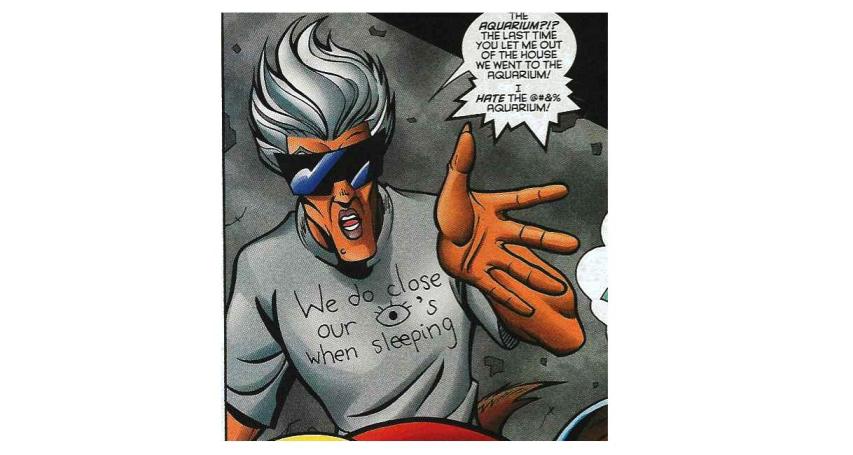
So, I decided to start re-reading them from #1, online since my local comic book store is woefully short of the titles.  The early runs starting in 1994 (The four book outing with the main series starting up again in ’97) are remarkably different from the ‘Pool we see in comics today.  Oh, don’t get me wrong he’s always been ‘the merc with a mouth.’   The earlier runs had him struggling to become a ‘hero’ and questioning if he could ever live up to that title then there were the times he vehemently denied even wanting to be one.  Good stuff.  He’s quite the poster boy for internal conflict and conflicting motivations.  He can be incredibly violent and nearly sadistic and then turn around and do something totally unexpected and borderline heroic and make you agree with Al that somewhere under all that filth there is a good soul.  By the way, Al or Alfred is the elderly woman Deadpool kept prisoner in his house.  Needless to say their relationship is ultra complicated.

I can hear you mumbling, yes I’m getting to the point okay.  I don’t ramble like Deadpool.  Usually.  Though I do talk to myself or rather to my other selves.  That’s a whole’nother blog though.  I’m getting distracted again.  I blame this yummy rotisserie chicken and The Fray.

So, can someone like Deadpool who has been a killer/murderer for hire for years, be a hero.  Short answer.  No.  Long answer forthcoming:

First, what is a hero?

Webster’s Free Online Dic says:

Definition of HERO

a : a mythological or legendary figure often of divine descentendowed with great strength or ability b : an illustrious warrior c : a man admired for his achievements and noble qualities d : one who shows great courage
a : the principal male character in a literary or dramatic work b : the central figure in an event, period, or movement
plural usually he·ros : submarine 2
4: an object of extreme admiration and devotion : idol
Examples of HERO
  1. He returned from the war a national hero.
  2. the hero of a rescue
  3. She was a hero for standing up to the government.
  4. His father has always been his hero.
  5. He has always been a hero to his son.
  6. A motto of his hero, Thomas Edison, is inscribed on a favorite sweatshirt : “To invent you need a good imagination and a pile of junk.” —Britt Robson, Mother Jones, May/June 2008
  7. [+]more
Origin of HERO
Latin heros, from Greek hērōs
First Known Use: 14th century
Related to HERO
Synonyms: godidolicon (also ikon)

[+]more

Other Mythology and Folklore Terms
Rhymes with HERO

Feel enlightened yet.  Yeah, me neither.  By definition #4 anyone can be a hero to someone.  So what makes someone a hero.  Selflessness?  Compassion?  Willingness to act when other’s won’t?  Standing up for what is right?  Sure those are all good things.  Maybe even heroic things.  But where is motivation?  If the motivation is wrong is the action still heroic?  What makes an action heroic?  It’s like the age old question.  Are you brave or stupid?

I’ve always been a bit against the classical archetype of the hero.  I like to see people get beaten down by life and struggle to find a way to rise above it.  I guess that’s why I like our dear old Deadpool so much.  He’s had the snot kicked out of him more times than most Marvel heroes and villains.  Yet, he’s only ever once really gotten to the point he wanted to end it all.  Not that he can all that easily.  Healing factor and all.  But still, you gotta like a guy who loses limbs, gets decapitated and suffers all kind of bodily harm yet never shut’s the hell up.  Well only when he gets ‘really serious’ then its game over. A quiet Deadpool is an oxymoron.

DP is also unique in a few other ways.  He’s not afraid to address his reader directly. Yup, he is notorious for breaking the fourth wall and spouting his own observations about what’s happening in the comic.  In fact, he’s so excited about the upcoming Deadpool video game that he wrote the press release himself.  It’s quite epic and I use it in my class about how to write press releases.  Yup, it’s that good.  Here is the link.  Link.

Another unique thing about our red spandex clad anti-hero, he’s crazy.  Certifiable.  As in hears voices and has full blown hallucinations.  Quite like myself, but that’s my other blog.  I have to admit I find it quite endearing.  He’s so cute when he’s talking to his selves.

The 'Pool is Full
Is it dissociate identity disorder or schizophrenia? My vote is on the later.

When you’ve been through all the stuff DP has then you’d get your sanity link severed too.  It’s really too bad that this character doesn’t get the attention he deserves.  In fact just yesterday/today the artists who’ve worked on DP over the years were called D-listers as in Marvel wouldn’t put A-list talent on a crappy title like Deadpool.  And this by DP’s creator to add insult to injury.

Helloooo . . . waitagoshdarnminute.  Crappy?  Deadpool?  As DP might exclaim: “Exsqueeze me?”   Oh wait, here’s the explanation and honestly, can’t argue with the man on this point.  Linkage.  Rob is right Deadpool is amazing even in spite of, or maybe  because of the fact that he never gets A-list talent.  A-listers have images to uphold.  They can’t be seen slogging through DP’s filthy mind.  D-listers on the other hand have no such inhibitions.  Anything goes as long as they get to work.  And I think that’s one of the reasons Deadpool works.  He’s crazy, violent, chaotic and not afraid to call the reader out on shit.  And that’s why I love him.


End of line.  (Crap wrong fandom.)  (Who cares just post it already.)

Anime

I’m Cosplaying a Responsible Adult

This past weekend I attended an anime convention in Tulsa called Tokyo in Tulsa.  Official stats are not out yet, be I’m guessing there were at least 4000+ attendees over the three day weekend.  For those of you not familiar with Japanese anime, I highly recommend you check it out.  There is literally something for everyone in every age group.

At Tokyo in Tulsa (TnT) I saw parents with infants and young children, grandparents dressed as superheroes following around their grandkids who were dressed as anime characters, children dressed as their favorite Pokemon, several Borg and a couple of zombies.  The list goes on and on.  There were people my age, college students, high school students, industry professionals and more.

Through out the con, the energy was very high.  Often I would hear someone randomly shout “Oh my god there is *insert favorite character*” and go running to meet someone cosplaying*.  There was lots of hugging.  Lots and lots of hugging.  Of old friends, new friends, acquaintances, and total strangers.  Everyone got hugged at some point.  Even me.  Actually I got hugged more this past weekend than I can ever remember being hugged in such a short span of time.  Pretty epic.  Especially considering that only three days ago I’d never met most of them.

Its amazing how having something as simple as a TV show in common with someone can spark a friendship and ignite a relationship that crosses state lines and every other boundary imaginable.  Anime and cosplaying is a wonderful subculture that is often mocked for being trivial and ‘weird’.  I’d rather spend a weekend with my wonderful geeks in costume than getting drunk at a bar or going to some seedy club.  At least at the con there is a focus on culture, being open to new things, applying one’s self to a craft and learning tolerance in all it’s forms.  I don’t see that at a nightclub.  At TnT  I met people from the video game industry, published writers, actors, musicians, costumers, make-up artists, radio personalities, graphic artists, photographers, directors, professional storytellers, and a samurai.  I think I might have glimpsed a couple of ninja but they are hard to spot.

It was also my great privilege to give two panels on writing this year.  It was wonderful to find other writers to connect and converse with.  On Friday I addressed the phenomenon that is fan fiction.  Then Saturday we discussed character design and avoiding the Mary Sue*.  Both of these panels are great fun to give and I work hard to make sure they are very informative.

For the first time I also gave what is known as a fan panel.  Yes, I might be in my mid-thirties but I love anime enough that I want to spend at least an hour discussing my particular fandom with other fans.  Honestly, I could spend much longer discussing it.  It was quite wonderful to have the opportunity to share my love of the characters and story line with other fans.

The ground breaking anime, Tiger & Bunny

One of my favorite things about anime, and something I stress to those unfamiliar, is that it places great importance on friendship and being selfless.  I had a wonderful conversation with a gentleman at the hotel bar Friday evening.  He asked me what the con was about and I was more than happy to explain it to him.  I do not encourage my children to watch American programming.  We watch anime.  Through anime, my children learn that helping others and being loyal to your friends and family are what is important.  I encourage you to click the above picture and read the blurb about the show.  Watch the first episode and you will see themes explored that most American shows rarely touch.  And this is something I can watch with my children.  Granted not all titles are for children, but that is fine too.  There are much darker themes also explored in anime and then there are titles that are just hilarious crazy fun.

Another thing that I enjoyed at the con was the live concert on Friday night.  The two opening bands were fun and got the crowd going.  However, when the headliner stepped on stage the atmosphere changed.  The instant the opening riff rang through the hall you felt the difference.  These were pros.  The next hour was intense and amazing.  I’ve been a fan of The Slants for several years now.  Yet I had not had the chance to catch a concert.  Boy have I been missing out.  Energetic, culturally relevant, technically superb, and amazing artists who truly love their fans, these guys are not to be dismissed just because they choose to remain independent.  I think that fact makes them even more relevant.  Their message is not watered down by corporate censorship.

And yes, the entire band is comprised of Asian-Americans.  They are an amazing group of guys and I feel very privileged to have finally met them in person.

Overall, it was an unforgettable weekend.  I can’t wait to do it again.  And I don’t have long.  I’ll be going to Glitch Con in Bentonville, AR the first weekend in August.  Kevin J Anderson is going to be there.

Characters · Movies

Lost Souls

So, this past week I have rekindled an old flame . . .-er fandom.  I don’t know how many of you ever watched the original Tron (1982) but as a teen in the 90s I fell in love with the Grid and everything associated with it.  Jeff Bridges,  Bruce Boxleitner and Tron himself.  I was stoked when Tron: Legacy came out in 2010.  Loved it too.  Tron is still my favorite, though I’ve discovered a new attraction as well.  Rinzler.

Rinzler from Tron: Legacy
Rinzler, the deadly and silent enforcer of the Grid.

Yes, yes I know what you are thinking.  He’s the bad guy.  Again.   I can hear you rolling your eyes, stop it.  I’m sorry, well no I’m not, but I like antagonists okay.  And Rinzler is everything a really good bad guy should be.  Powerful, deadly, mysterious, intimidating yet with sparks of humanity glimmering through at times, oh and sexy as hell.  Yes I know you cannot see his face but my dear sweet Loki look at that body.

I’m getting distracted.  Just so you know it’s not all ‘dat ass with Rinzler.  Nope.  Ahem, so on to what I was originally going to talk about.  Also if you have not seen Legacy please read no further for here there be spoilers.

Rinzler

Rinzler first appears in the movie not too long after Sam enters the Grid and is sentenced to the Disc Games for being a stray program.

It was during this that I noticed something odd with Rinzler.  First he recognizes Sam as a user because of the blood and second there is a disturbingly familiar ‘t’ shape on his chest.  My fears are confirmed later when Flynn Sr. recognizes the security program.

Tron wasn’t killed by Clu he was  reprogrammed.

Oh the implications.  Tron would never have willingly followed Clu.  Reprogramming a complex and powerful security program would have been difficult.  And violent.  Stripping away core protocols, changing logic engines, replacing nearly everything that had made Tron what he was; a hero, a champion for programs and users alike.  This is what draws me to Rinzler, this inherent juxtaposition.  The hero is now the villain.  All his skill and beautifully designed functions have been twisted to meet Clu’s needs and wants.

Why do I find this so fascinating?  I’m not entirely sure.  A lot of it has to do with wanting to see the broken restored and the powerful broken.  Rinzler is powerful and broken.  Yet he is able to overcome at the very end and remain true to his core programming.  “I fight for the users.”  This is what we really want out of our heroes.  For them to remain true to their core beliefs no matter what happens to them.  I think it’s something we all hope we would do if so challenged, remain true to ourselves and our beliefs.

Something else I find fascinating is that Rinzler is able to overcome centuries of being  under Clu’s control once he’s given the chance.  Confronted with his first real challenge since being rectified he rejects what he’s held for so long.   He rejects Clu’s teachings of their previous enslavement by the users and realizes that it wasn’t the users who enslaved the programs, but Clu.    Clu himself is exactly what Kevin Flynn created.  A program to keep the operating system at peak function.  However Kevin didn’t realize that perfection is not sameness.  Perfection is doing one’s function at the highest possible capacity.  This oversight on his part lead to Clu’s rebellion, Tron’s ‘death’ and subsequent purge of the isomorphic algorithms.

We have all made mistakes, though hopefully none with such grave consequences.  That’s also what I love about this movie.  There are consequences to the character’s actions, real ones.  I dislike it when everything is all wrapped up in a tidy little bow at the end of a movie.  Bows can unravel with just the right tug but some people seem to forget this.  That is why I’m not a fan of the so-called happy ending either.  It’s unrealistic.  Yes, I know what you are thinking, we are discussing an alternate reality set inside a computer and I’m talking about realistic life scenarios.  But the setting is not the issue, the content is.

So, what do you want see out of a character?  Especially ones like Rinzler or Loki?  Defeat or redemption?

Uncategorized

Some times we forget we are not alone. We trudge along, never lifting our heads to look around. Slogging through our daily lives we miss opportunities and chances to meet new friends.

I’m learning to look around and see all the others slogging right along with me. It’s refreshing and enlightening. It also makes me less self centered and more productive.

MyWANA is a superb tool and social site for those of us who might feel isolated by our creativity. Come join me and see just who and what you find.

http://www.wanatribe.com go be a part.

Lillian's avatarHuman In Recovery

Recently I posted about reconnecting to a part of myself that I thought I had lost.  One of the things that I had lost was my sense and ability, my sensability as it were, to really be involved in community with wonderfully witty, snarky, bright, and intelligent folk such as Le Clown from A Clown On Fire and Dotty Headbanger from Notes from a She-Hermit.  What happened next has been quite the roller coaster ride and through that one post, I have come to find many other wonderful and interesting bloggers from all over the world with varied interests and challenges.  The following contains just a few examples:

The Howler And Me

Running Naked With Scissors

Halfway Between the Gutter and the Stars

My Electronic Jukebox

Brother Jon

and so many, many others.  Look them up here, where Dear Dotty has created a space for us all to…

View original post 194 more words