If anything is guaranteed in life, it’s that nothing is guaranteed. You have to eek out time to write, and time for more mundane activities like cleaning and pretending to be a functioning adult. This week has been full of irritating mundane issues for me, which is why I’m having to put off my next Going Over the Rainbow article for a bit.
I won’t bore you with the details of my circumstances but I do hope to be back as soon as possible.
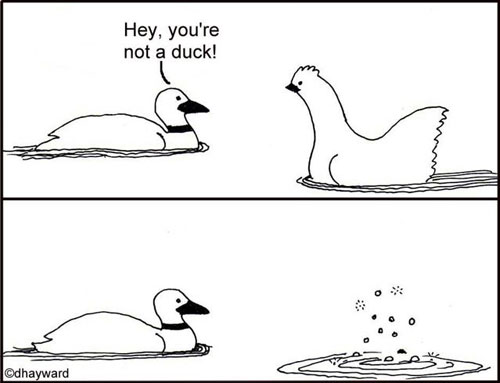
Here is a fun video that’s been helping me get through this week. ^_^
Spymaster Lafayette Goddard knows better than to trust anyone in their line of work. Now they sit in prison with information that could save the Queen yet they cannot bring themselves to trust the new Captain of the Royal Guard. Even if it means losing everything they’ve worked so hard for.
All Captain Jasper Stanton ever wanted was a chance to prove himself. Mistakenly imprisoning Lafayette isn’t how he planned on distinguishing himself. Now he must try to win the former spy’s respect if he wants cooperation investigating the conspiracy.
The secret to finding out who is plotting to kill the Queen lies with Lafayette’s mysterious informant known only as the Jeweled Dagger. The closer Jasper gets to Lafayette, the more he wonders just how much is being hidden from him.
How do you handle situations when finding time to write seems impossible? Do you have suggestions for allotting time for writing when you’re not at home and cannot follow your normal schedule?
If you enjoyed this post and would like access to exclusive content please consider supporting me on Patreon.
We’ll get straight to the good stuff! Just comment below with your email address to enter the giveaway. I’ll be choosing 2 Amazon gift card winners, 2 ebook winners and 2 signed print copy winners today using random.org. There is no purchase necessary to win.
You are also welcome to join me on Facebook for the online release party. I’ll also be on Skype all day and you are welcome to come chat with me there as well (my name is sorrows fall and I’m in MO, USA).
Genderfluid spy Lafayette Goddard knows better than to trust anyone in their line of work. Now they sit in prison with information that could save the Queen yet they cannot bring themselves to trust the new Captain. Even if it means losing everything they’ve worked so hard for.
All Captain Jasper Stanton ever wanted was a chance to prove himself. Mistakenly imprisoning Lafayette isn’t how he planned on distinguishing himself. Now he must try to win the former spy’s respect if he wants cooperation investigating the conspiracy.
The secret to finding out who is plotting to kill the Queen lies with Lafayette’s mysterious informant known only as the Jeweled Dagger. The closer Jasper gets to Lafayette, the more he wonders just how much is being hidden from him.
Get your copy now. Available in print and as an ebook on Amazon and on Smashwords.
If you read and enjoy (or not) please consider leaving a review! I’d love to know what I got right and what I need to work on!
All joking aside, accountability is something that professionals of any discipline face. Even us writers.
Yes, you read that right. You, my dear writer, are accountable to your reader. Well yes, you say, I should give them the best story I can write.
Yes you should, but it goes beyond that too. If you’ve written for long you’ve probably ended up having to do some research into an unfamiliar topic. We often joke about hoping the government isn’t keeping too close an eye on our internet research history. There are many resources available online to help us flesh out our characters and our setting. One Stop For Writers is a great example. However, while we might research settings, the job our character has and where they live; sometimes we forget that other things need research too.
Jami Gold had several excellent articles about writing with diversity and the research that goes along with it.
Ask if the Story Is Ours to Tell: If we don’t have direct experience with the diverse element, a story that centers on the diverse aspect might suffer from disrespectful negative stereotypes or breathless, isn’t-it-inspirational-how-they-overcame-those-obstacles “positive” stereotypes. (Note that treating a character’s diverse element as a problem to overcome isn’t actually positive.) — Jami Gold
Sometimes when we are writing a character, even when we’ve done research, we might find ourselves slipping into stereotypes or tropes. They are like clichés. They are comfortable and familiar. Unlike clichés they can be damaging and perpetuate some very harmful thinking.
We can usually spot harmful racial stereotypes. I wrote about avoiding stereotypes in a previous post. I still recommend WritingWithColor, DiversityCrossCheck and betas to help with racial/cultural sensitivity. But tropes aren’t always stereotypes, so how do we know if we are falling into the trope trap?
Trumping the Tropes
There are a LOT of tropes out there. And they are not all bad, most exist for a reason and like popular themes don’t have to be eschewed completely and can even be used to good effect. Over the course of this series I will be addressing various tropes and how they relate to the identity or orientation I’m discussing. In case you are curious as to how many there are TV Tropes Queer as Tropes page is a good place to start.
One of the most prevalent tropes is Bury Your Gays. Queer persons never get happy endings. Ever. Often they die.
Or, more recently, they are the villain.
This doesn’t mean that your queer character has to survive and not be evil. However, it does mean that you need to be very careful about how you approach each of those circumstances. Just as careful as you’d be about casting a black man as a street thug.
Tropes at their most basic are indeed stereotypes and thus need to be very carefully considered. Many common romance themes are tropes in disguise.
Stereotypes: Not literary. We avoid using this term to talk about classifying characters, settings, plot points, etc..
Archetypes: The broad, all-encompassing norms of the stories humanity tells. The same archetypes can be found in all or nearly all cultures.
Tropes: Culturally-specific norms in storytelling. Tropes are cultural classifications of archetypes. There can be many tropes found under the umbrella of one archetype. Literary devices are not tropes (i.e. narrators, foreshadowing, flashbacks, etc.).
Clichés: Overused and hackneyed phrases, characters, settings, plot points, etc.. Archetypes do not become clichéd. Tropes can become clichés if they are used too often and readers get bored of them. Clichés are defined by a loss of the meaning or as a distraction from the story.
If we find ourselves falling back on common tropes a lot in our writing, we might need to ask ourselves why. There is absolutely nothing wrong with using tropes but we need to make sure we are giving them our own special treatment. This is easily done by combining two or more tropes or even subverting or flipping them.
Let’s look at some examples:
All Gays Are Promiscuous trope is the stereotype that a gay man is completely driven by lust and must therefore have sex all the time.
Game of Thrones: Downplayed by Ser Loras Tyrell; he is rather easily seduced by an attractive male prostitute, and exchanges significant glances with the openly bisexual Oberyn Martell not long after his lover Renly Baratheon is killed. He mostly comes across as this in comparison to his literary incarnation, who falls into a deep depression after Renly’s death, is apparently celibate, and shows signs of being a Death Seeker.
Wallace Wells, Scott Pilgrim‘s cool gay roommate, is characterized with this trope, even going so far as to hang a lampshade it when chastising Scott for infidelity.
Scott: Double standard!
Wallace: Hey, I didn’t make the gay rules. If you don’t like it, take it up with Liberace’s ghost!
Are there gay men who like to sleep around? Yes, or course, just as there are lesbians, bi-sexuals, pansexuals and straight people who do the same. But the issue comes when we perpetuate it as a defining trait of being gay. This trope is very easily subverted by letting our gay character be in a committed relationship that is not centered on sexual gratification. After all that’s the kind of relationships many of us have and enjoy.
So, do you see how a trope can be trouble? But why should you care?
Jumping the Shark
The blockbuster movie Jaws launched a national campaign against the ‘man eaters’ and contributed to the drastic decline in the shark population. To this day, the stereotype against sharks persists.
The film’s key mistake was portraying great white sharks as vengeful predators that could remember specific human beings and go after them to settle a grudge. — How ‘Jaws’ Forever Changed Our View of Great White Sharks by Charles Q. Choi
This is just one example of how harmful a negative portrayal in our work can be on others. This is why I wanted to address the issue of accountability with you and how it relates to using tropes.
As authors we enjoy the privilege of having readers accept our words at face value (for the most part). People trust us. What we show them in our fiction, no matter what we write— paranormal, romance, thriller, mystery, literary, et cetera—has an impact on their thinking and their perception of the world around them. This is why we have to be so careful about stereotypical or negatively portrayed characters from marginalized identities/orientations/races/cultures.
This is why I say we are accountable. Our words have power. The power to create understanding and empathy or further the divide. This is why research from valid sources is so important and why we must recognize our own tendency toward common tropes and stereotypes when writing.
Now that I’ve got most of the preliminary issues out of the way, it’s time to start delving into the various gender identities and sexual orientations. As we move forward, I’d like to encourage you to refer back to these posts and keep these things in mind.
What are your thoughts on author accountability? Have you ever come across a negative portrayal that affected you personally? Have you read any books where certain characters were walking stereotypes? Do you have any other comments or questions for me?
If you enjoyed this post and would like access to exclusive content please consider supporting me on Patreon.
I recently ran across a post on Tumblr where the OP was rather distraught. They’d been told that using the word asexual to describe their character’s orientation was historically inaccurate for their setting.
This brought up the issue of explicitly stating a character’s orientation within the prose and when and how this should be done. Some writers might feel that they’d rather not label their characters and let their readers decide the character’s orientation. However, I caution against this.
El at Just Love Romance recently brought out how many romance novels feature asexual and demisexual characters yet this is rarely explicitly stated for the reader. Often in movies and television a character’s sexuality is left vague and for the viewer to guess. This can lead to what is called queer-baiting and is a huge source of frustration within the community.
I’m here to help you avoid this problem no matter what genre you write.
Transparency in Prose
The best way to let your reader know a character’s orientation is to tell them. Let your character state their identity. Be explicit. If your character is questioning or unsure, let them talk about it to other (hopefully queer) characters. Don’t be afraid to show them being unsure or looking for answers. You don’t have to be writing a coming-out story to allow a character to realize who they are.
Okay … don’t look at me like that. I know what you are thinking. It doesn’t fit in the narrative, they are a secondary character, the terms are too modern for my setting, I’m afraid of reader backlash, I don’t even know how they identify, blah, blah, blah. Sorry, I’m not letting you off the hook on this one. No excuses.
Subtext is not enough. Readers want context. Which means you, my dear writer, have to be transparent when it comes to your character’s sexuality. It must be stated and shown for the reader.
But how?
Please allow me to show you.
Show and Tell
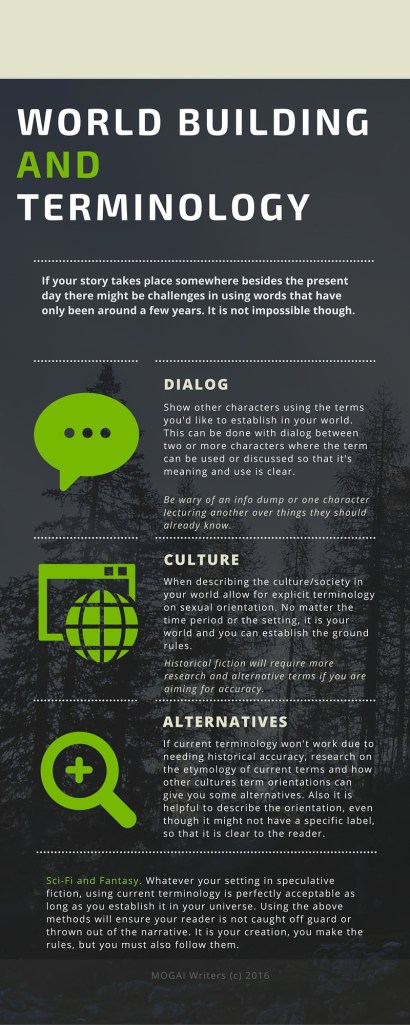
This is one of those times you can throw aside the advice to ‘show don’t tell.’ However, there are ways to show your character’s orientation. The graphic below lists the main ways to do this. As with any other characterization details there are a number of ways to get the information across to your reader.
Dialog
This is one of the easier ways to show the reader a character’s orientation. It doesn’t have to be a pages of discussion, it can be just a line or two of dialog. As long as it is clearly stated by someone. Here is an example:
Maggie stared at the curvy young woman behind the counter. A bump to her hip jolted her to the side. She glanced over to see her friend grinning at her.
“Come on Maggie, either ask her out or stop leering.”
“I … uh,” Maggie blinked rapidly as her brain went on autopilot. “She’s probably not even interested in women.”
Okay let’s stop right there. ‘Interested in women’ could mean lesbian, bisexual, or pansexual. So let’s try this:
“I … uh,” Maggie blinked rapidly as her brain went on autopilot. “She’s probably not even a lesbian.”
“Actually I’m pan,” The woman smiled showing two cute dimples.
Simple, right?
Action
Another way to show it is by your character’s actions around those they find attractive. This works nicely if it’s difficult to work the terms into dialog or you want to add extra reassurance for the reader. This is like any other scene that shows characterization, it just deals with your character’s sexual orientation. Again there is no reason to spend multiple paragraphs, get the information out there and let the reader do the rest. If you’re unsure how to show attraction check out One Stop For Writers Emotion Thesaurus. There are several entries to help you show emotional attachment. And don’t forget there are plenty of non-sexual intimacies that can show your character being attracted to or in love with someone.
Internal Dialog
This is an often under-utilized tool for characterization. You are allowed to let your character think about things, dwell on them, process them. This helps your reader too. If you feel dialog or action isn’t appropriate for your character to express their orientation then this might be a good alternative. Of course balance is needed as with all plot and characterization tools.
External Circumstances
What I mean by external circumstances is that it is not the character in question who tells/shows the reader what their orientation is. It could be anther character discussing them or something that happens in the larger world around them. Something as simple as another character stating “X is asexual, they might be uncomfortable watching this movie” or you can even tell your reader as the following paragraph demostrates.
Alice talked to Bert about her feelings for Charlie. Bert informed her that Charlie’s asexual, so whilst he might be open to a romantic relationship, he’d not be likely to respond to sexual flirting. Maybe she should try another tactic to get Charlie’s attention.
Not fantastic but you get the idea. But what if you write historical fiction, fantasy or science fiction? Can you still use the modern terms?
Absolutely.
Here are a few quick, easy ways to do so.
What are your thoughts on this? How would you approach revealing a character’s orientation? Have you read any books where you weren’t sure of a character’s orientation?
If you enjoyed this post and would like access to exclusive content please consider supporting me on Patreon.
On January 8, 2016 the American Dialect Society voted singular they as the word of the year.
The use of singular they builds on centuries of usage, appearing in the work of writers such as Chaucer, Shakespeare, and Jane Austen. In 2015, singular they was embraced by the Washington Post style guide. Bill Walsh, copy editor for the Post, described it as “the only sensible solution to English’s lack of a gender-neutral third-person singular personal pronoun.” – http://www.americandialect.org/2015-word-of-the-year-is-singular-they
This is a big deal. Especially for people like me who are not comfortable with gendered pronouns. It means that people cannot tell me that it is improper grammar to use they as my pronoun. It might take some time for people to get used to the idea of singular they, but it’s not the first time English as a language as changed and it most certainly won’t be the last.
Even the argument that it will be awkward to say things such as: “I saw Bran today, they were working on a new project.” doesn’t fly with me. It might sound off to an English major but for the general populace it won’t matter.
However, it will matter a great deal to non-binary, trans and genderfluid people who are not comfortable with gendered pronouns.
I understand this might be a hard concept for cis-gendered persons to grasp and truly there is no way for them to sympathize. They simply do not have the mental framework for it.
When someone calls me by female pronouns, it really unravels all the daily work (mentally, physically and emotionally) that I have done for years in order to find a gender that feels comfortable to me. I do not see anything wrong with being a woman or feminine (if anything, I often wish I could identify as this because it would be easier in some ways), but I simply do not feel like a female-bodied person. I can hardly remember a moment in my life when I did. -Janke Seltsam (http://www.huffingtonpost.com/james-nichols/misidentification-and-transphobia-one-musicians-experiences-touring-america_b_3362069.html)
With that being said, this does not mean that cis-gendered persons cannot and should not try to understand other genders. It involves being open and sensitive to the knowledge that not everyone goes by he or she.
Identity Crisis
I’m a big Transformers fan. The cool thing about them is they are robots. They do not have gender or gender binaries. Some choose to identify as male or female and use the appropriate pronouns. But what if you are writing a character who is trans, non-binary or gender-queer? What do you do then?
You, my dear writer, use their correct pronouns.
But, you say, what if they are a trans woman and the reader needs to know they are trans and were assigned male at birth?
A valid question; you want your readers to know how your character identifies but you also don’t want run the risk of turning your character into a walking stereotype, or make readers feel as though your character is wearing a sign that says ‘Hi I’m trans.’
That does not mean that the subject should not be addressed. It absolutely should. Below is a list of ways you can show, and tell, your readers which gender—if any—your character identifies with.
If a character’s gender is in question, have other characters comment on or think about it. This is perfectly alright. Here is an example from Masquerade, my upcoming short story prequel to The Jeweled Dagger:
He turned back to find Sivil staring at him with a strange expression. “I … apologize, from your dress and demeanor I thought you were a man. I should have realized, with the long hair and pretty face—”
“Sivil, does the Steward need a footman or a housemaid because I can do either.”
“A footman.” Sivil nodded, his gaze darting around the room, only settling briefly on Lafayette. “Is it true what they say about Kedonians then? That you don’t have genders?”
Lafayette stared at Sivil a strange cold knot tightening in his gut. He’d heard a lot of idiotic rumors about Kedonians but this one was new. He took a step closer to Sivil, “My gender is my own business. Not yours. If the Steward needs a footman, he will get a footman.”
If the character is a viewpoint character it is just fine to let them think about it, our gender identities and expression are a large part of how we socialize.
Let your character come right out and confirm their gender. This is best done in dialog with other characters, though depending on the story there are other ways to approach this as well.
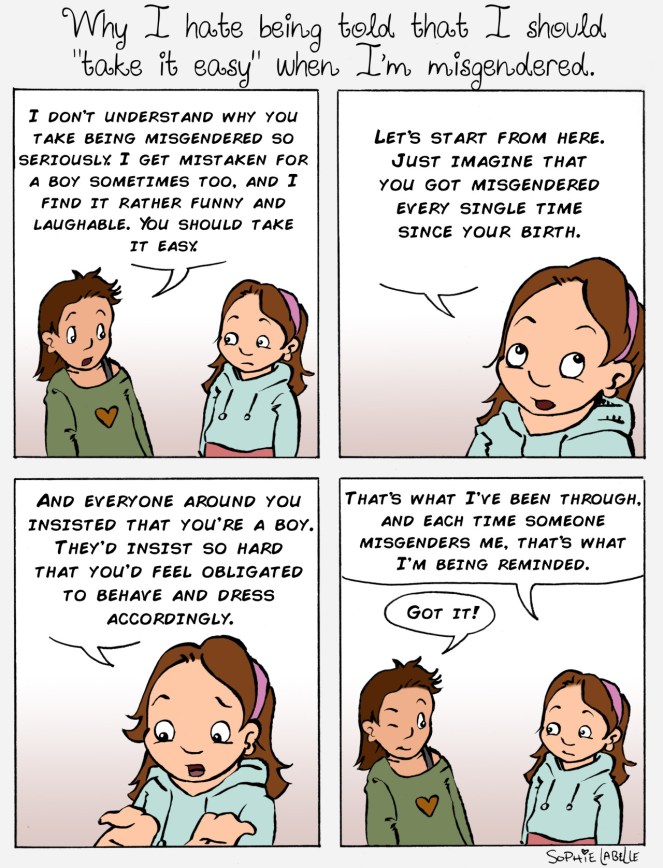
Have other characters comment on their gender expression. Non-binary, trans and gender queer persons are beset with misunderstanding and misgendering on a daily basis, so it’s likely they will encounter this in your narrative.*
They can ask to be called by their correct pronouns or inform other characters of their correct pronouns.
Use description to show their gender expression. This one is a bit trickier and can come off as being transphobic and othering. Here is a good example of how to handle it without going overboard:
I was living in Vancouver’s West End, still wet behind the ears, having just arrived from the Yukon in a Volkswagen van. It was only the second apartment I ever rented, and the first time I laid eyes on Rosie it was raining, and there she was, skinny, wiry, restless-eyed Rosie right behind me on the sidewalk that led to our building’s front door with bother her arms burdened down with grocery bags. So I held the door open for her, just like my gran had taught me to.
“Chivalry lives,” she snorted as she clunked in past me in her skin-tight Levi’s and low-cut blouse and kitten heels. Of course I did not know the words for kitten heels. Yet.
Except her voice was low, like an eighteen-wheeler gearing down with its engine brakes grinding on a long steep hill down from the summit, and her bare skin above her black bra was covered in five o’clock shadow and painted with now bleeding-edged and sailor-flash faded tattoos.
I had never met any other woman quite like Rosie before.
As the example shows, the description of Rosie is vivid but there is no mistaking that the narrator sees her as a woman. A little later in the story the narrator makes the mistake of calling her, he. Rosie is quick to correct them. Other than that, the fact that Rosie is trans is never really discussed. She is Rosie.
I see you squinting at the screen as you think … but the only pronouns I am aware of are he and she. Am I supposed to make up something?
Nope. As I mentioned above singular they is perfectly acceptable. My genderfluid character Lafayette, mentioned in the above excerpt, goes by he/she/they depending on the circumstances and who they are with. There are also several accepted gender-less pronouns. The only issue with the list below is that they are not very well known outside the genderqueer community and can draw your reader out of the story as they try to parse the new words. Personally, I like Spivak (ey,em, eir) as it is the least visually jarring but it is entirely up to you.
Please do not be afraid to let your character use these pronouns. They’ll never enter wider use if we don’t actually use them.
Image from the University of Wisconsin LGBT Resource Center
Contrary
You will likely get some irate readers asking why you decided to use ‘made-up’ pronouns. Be brave. Your desire to be inclusive of all genders is more important that their momentary discomfort.
Everyone deserves to be respected, even fictional characters. You cannot please everyone, but you could make a huge difference in someone’s life by showing them they have the right to be respected and treated as human no matter what gender they identify as.
As with all orientations and identities we must keep in mind that we are writing people. Which pronouns they prefer is a good clue to who they are and how they see themselves, but we must remember not to beat our reader over the head with this detail. It’s just another facet of who your character is as a person.
Ideally, your character’s gender should not be a major source of characterization. Relying on gender expression and society’s gender expectations to show character perpetuates and reinforces stereotypes. It is just fine to let gender be addressed, but a light hand usually works best. Treat it like backstory: leave it to a sentence or two here and there. The reader will do the rest.
*Sadly, in many instances (especially for non-white trans women) this situation is deadly. Please be careful how you approach this so that you’re not accidentally promoting transphobia. The only exception would be if you are writing a transphobic character.
Is there anything you feel I’ve left out? How would you handle writing a non-binary, trans or gender-queer character? Have you ever written one? If you haven’t, would you consider it?
If you enjoyed this post and would like access to exclusive content please consider supporting me on Patreon.
It’s been just over a year since I started working on The Jeweled Dagger. It all started from a NaNoWriMo boot camp in 2013 and a little righteous indignation at an editor over being told to take out Lafayette’s ‘cross dressing.’ I quit the boot camp when it became obvious I wasn’t going to get any support writing a non-traditional romance. I’ve never once regretted my decision.
Over the past year I’ve had amazing support from my friends, both online and off, and the lovely staff at my local comic book store who let me come haunt their premises.
This book would not have been possible without the help of the exceptional Jean Mabbs and the amazing Eleonore Eder and my lovely sprinting partner Joana Maia. You all are invaluable and this book would not exist without you.
Genderfluid spy Lafayette Goddard knows better than to trust anyone in their line of work. Now they sit in prison with information that could save the Queen yet they cannot bring themselves to trust the new Captain of the Royal Guard. Even if it means losing everything they’ve worked so hard for.
All Captain Jasper Stanton ever wanted was a chance to prove himself. Mistakenly imprisoning Lafayette isn’t how he planned on distinguishing himself. Now he must try to win the former spy’s respect if he wants cooperation investigating the conspiracy.
The secret to finding out who is plotting to kill the Queen lies with Lafayette’s mysterious informant known only as the Jeweled Dagger. The closer Jasper gets to Lafayette, the more he wonders just how much is being hidden from him.
The Jeweled Dagger is currently available for pre-order and will be available Feb 1st.
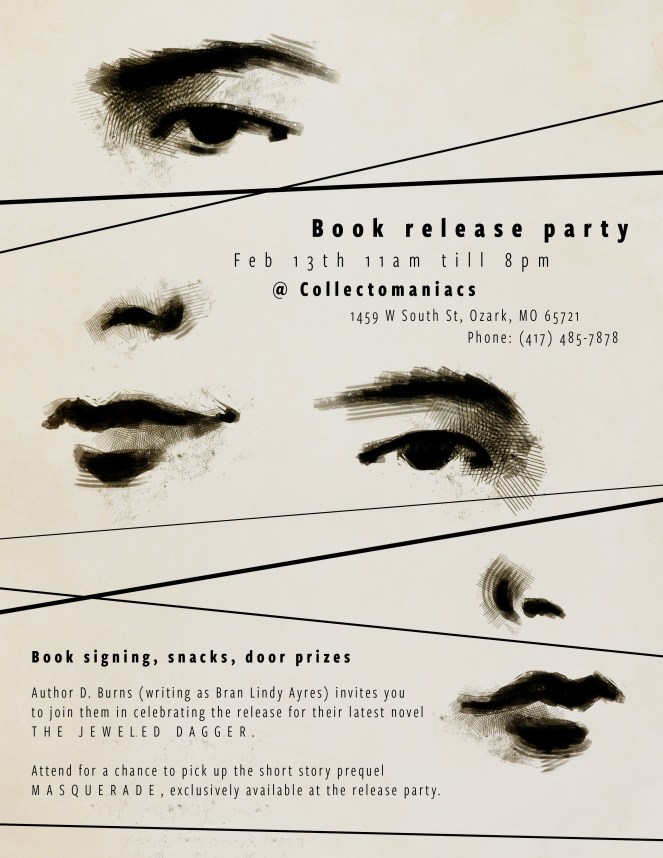
I’m inviting anyone who can attend, to the book release party on Feb 13th from 11am till 8pm at Collectomaniacs here in Ozark. If you cannot make it in person, don’t worry I’ll be hosting an online party as well (I’ll post details once they are finalized). You will find your personal invitation here. I look forward to seeing or hearing from you and hope you’ll join me in celebrating this unique novel.
I want to preface this by saying; I bear no ill will, animosity or hard feelings toward anyone. I am simply sad and disappointed. I had hoped we might learn from each other. Yet, I guess my hopes were naïve.
Writing can be so lonesome. You sit at your desk, hour after hour, day after day and stare at a screen or a piece of paper. Some days it feels as though no one could possibly understand the difficulties that come with writing. This is why I was relieved, and a bit apprehensive, about joining the group. I tried out the group write-in first and found it amazing to be surrounded by fellow writers. It was an epiphany. I did not have to do this alone. There were others locally I could get together with for coffee and lunch and moan about my current manuscript and they would understand and possibly offer advice. I started coming to the monthly meetings. I met amazing people and made friends.
Then I got up the courage to bring a chapter for critique one weekend. I should have known beforehand that no one wanted me there. Whenever we’d introduce ourselves and state what we write, the disapproving and at times disgusted looks when I said I write gay romance had me wondering why I bothered. But I wanted help, I wanted to be a better writer. I should have known that a critique was asking too much. Out of a full room, 2 people commented. Did I have a right to be disappointed? Perhaps. I tried to console myself that maybe it was good enough that no one else had any advice for me. I knew it was a lie.
After that fewer and fewer people would speak to me. I finally quit going. What was the point of a writers group when everyone but a handful of people pretended I didn’t exist?
That was months ago. In September I went to the convention put on by the group. It was fabulous. Except for the fact that I felt as though no one really wanted to talk to me. A select few did but for the most part I was either ignored or conversations were ended quickly. At the time I’d put it down to limited time for breaks. Now, I’m not so certain.
I’d affixed a sticker to my badge stating that my preferred pronoun is ‘they’ as I am nonbinary (neither male or female) and being referred to as ‘she’ is disorienting for me. Now, I can’t help but wonder if that sticker was the reason for the abruptly/awkwardly ended conversations.
I had been contemplating returning to the group as I learned a lot about the craft and did enjoy the atmosphere. I won’t be returning.
It has become clear to me that persons such as myself are not welcome and not just because I write about something other than male/female romance. I understand that many of the members find anything other than heterosexual relationships to be offensive and ‘sinful.’ I never sought to make anyone uncomfortable either with my writing, comments or my own orientation and gender identity. I had hoped that being a group of writers I’d find people more open and accepting of others, people willing to learn and grow, people who understand that inclusiveness and diversity are the cornerstones of literature. Perhaps in the future it will be.
For now, I will wish you all the best and sincerely hope you learn to be more accepting and inclusive in both your writing and your personal lives. I’m sorry I cannot include you in mine.
Disclaimer: This post frankly discusses some aspects of sex and sexuality that some might find triggering including sexual kinks, fetishes and paraphilias. Please do not read further if you find any of these subjects triggering.
If you’ve been around romance writing for long you’ve undoubtedly ran across a number of characters with kinks and fetishes or even paraphilias (and no I will not discuss a certain well known book that shall remain nameless).
But what do these have to do with gender identity and sexual orientations?
Most of us go through life never thinking much about our gender or how we express it. We might feel it is something we were born with, something absolute and immutable. We might think there are only two genders and that we are one or the other.
‘But aren’t there only two genders?’ I hear you asking.
Nope. Male and female are only two ends of a vast spectrum. Also it helps not to confuse gender with sex. Sex is biology/physiology and even then there are intersex persons whose bodies are not clearly one or the other.
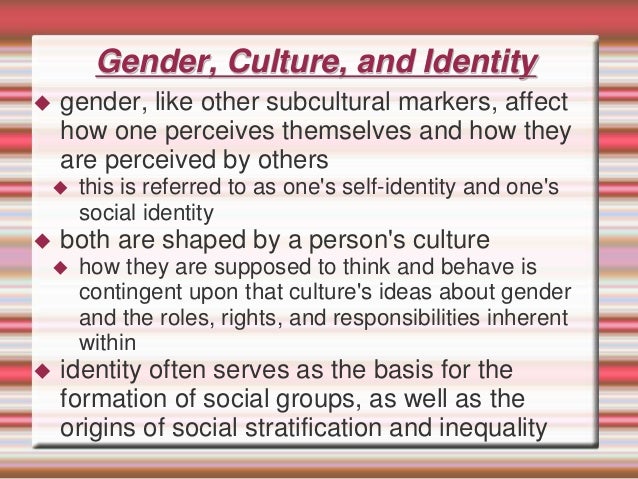
“When we think of gender, we often think of male or female; that’s only half of understanding gender. The denotations of male and female actually refer to biological and physiological sex. Gender is a sociological construct of values, ideals, and behaviors about what it means to be either male or female, and are often regarded in terms of masculine or feminine, respectively. Many people use sex and gender interchangeably, but one does not have to be male to identify as masculine, and vice versa.”
In addition to exploring the sexual orientations in the coming months we’ll be looking at different gender identities . We’ll discuss gender identity and expression and how you can use these to make your characters more diverse.
‘Why? Can’t I just have my character be male or female?’ You ask.
Of course you can but you’re here so you’re obviously interested in being more diverse in your writing.
The Culture of Gender
Ripley, the main character in Alien originally was to be male.
Have you ever thought about how your favorite book or movie might have been different if the main character had been a different gender? What would have made it different? Why?
In our society (I’m speaking as someone who lives in the US) identifying as male or female comes with a host of gender specific expectations: men are macho, women are feminine, men don’t cry, women are emotionally compromised, men like cars, women like shoes, ad nauseam. These gender stereotypes are social constructs and have little basis in biology or psychology.
“Gender theorists point to the variations in gender roles observed among different cultures in arguing that gender – our masculinity or femininity – is a social construct rather than an innate biological characteristic. Because there is no universal “right” way to be a man or a woman, they argue that our ways of “doing gender” are shaped by social cues and influences.”
This is why we as writers need to be more cognizant of the variety around us. Challenging these stereotypes can help us broaden our social consciousness and that of our readers.
‘But why should I worry about gender when I only write men or women?’ You wonder.
Because even cisgendered persons, or persons whose gender identity aligns with their gender assigned at birth, are impacted by society’s gender culture and expected to conform to certain norms. It’s not enough to throw a bunch of ‘masculine’ traits into a character’s personality and call her a ‘strong’ female. And conversely taking a female character and switching to masculine pronouns won’t give you the sensitive male you are looking for. They each will have skin-deep traits and no real depth to them.
It’s my hope that you’ll find the following articles interesting and maybe a little enlightening as we study the wide variation of genders and sexualities and how we can accurately write these identities.
If you enjoyed this and would like access to additional content, please consider supporting me on Patreon.
Do you struggle writing a certain gender? Why do you feel that is the case? Have you ever written a character and then decided to change their gender? What prompted the change and how do you feel it turned out?
I’ve been reading a lot of great books lately but it’s been a rare thing to find a book that hits all my literary kinks.
I’ve been searching for well crafted fantasy with queer characters for so long I almost decided to write something myself. Then I happened upon a review by Just Love that sounded promising.
Boy did it deliver.
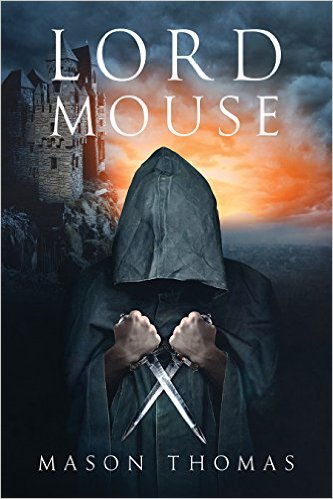
Lord Mouse is everything I’ve been lusting after in a fantasy novel. The main character is Mouse, a tiny little badass thief and assassin, and no he doesn’t have a heart of gold but he does pride himself on a job well done. If you can afford him. He’s never failed a job and when he gets a chance at a challenging job that pays more coin than he’s ever seen he’s not about to turn it down.
And that’s exactly what gets him into trouble.
Thomas does a fantastic job at throwing you right into Mouse’s world and a dark, dirty, gritty world it is. Thomas takes you from the cruel criminal underbelly, up the rungs of the social ladder in a way that feels natural, but not too easy. Mouse has to work for his contacts and information and sometimes it’s a blade and sometimes it’s a bed.
As an asexual I’m not a big fan of casual hook-ups but the sex scenes were never gratuitous and were mostly fade-to-black moments. This was something I appreciated. The story was about Mouse’s character growth, not about sexual escapades.
It was also very refreshing to read a book where being gay wasn’t something to angst over. It was just treated as part of who he is, which in my opinion, is as it should be.
I loved getting to know Mouse but I sincerely wish the story had been longer and I think it should have been. The first act is spent getting Mouse into position to do this big rescue mission and then we spend the next act of the book with him trying to escape. I did enjoy it very much, but I felt the last third was rushed and would have liked to have seen Garron and Mouse get to know each other better before the end. The big reveal at the end could have packed a lot more punch had we had a chance to get to know Garron better.
Ideally the rescue could have happened by the end of the first act and the second act could have had a longer build up to the finale. I feel that a longer second act would have helped with the rushed feel to their relationship and the finale. I would have happily read 80-100K words of these two.
I was also disappointed with the copy editing and found a few instances where a side character’s name was misspelled from one page to the next, which wouldn’t have been a big deal but it threw me out of the story for a moment as I tried to figure out who was being mentioned.
Overall, these issues were minor and I thoroughly enjoyed the story and am eager to read anything else Thomas writes.

 If anything is guaranteed in life, it’s that nothing is guaranteed. You have to eek out time to write, and time for more mundane activities like cleaning and pretending to be a functioning adult. This week has been full of irritating mundane issues for me, which is why I’m having to put off my next Going Over the Rainbow article for a bit.
 Spymaster Lafayette Goddard knows better than to trust anyone in their line of work. Now they sit in prison with information that could save the Queen yet they cannot bring themselves to trust the new Captain of the Royal Guard. Even if it means losing everything they’ve worked so hard for.

 , we might need to ask ourselves why. There is absolutely nothing wrong with using tropes but we need to make sure we are giving them our own special treatment. This is easily done by combining two or more tropes or even subverting or flipping them.



 Disclaimer: This post frankly discusses some aspects of sex and sexuality that some might find triggering including sexual kinks, fetishes and paraphilias. Please do not read further if you find any of these subjects triggering.

 Bran Lindy Ayres