I apologize for this post being late, but I spent some extra time to make sure I covered as many topics as possible.
For the last couple of weeks we’ve been looking at the asexuality spectrum and how to write asexual characters. Last week we discussed more about the spectrum and went over some terminology for various points on the spectrum as well as things to keep in mind and questions to ask yourself.
This week I’d like to show you how to put these things into practice. We’ll look at some examples of asexual characters in the media and why the character may or may not be a good representative of asexuals. We’ll also go over how to write romance with a character who identifies as asexual.
As you’ll hear me say many, many times over the course of this series; you are writing a person, not an orientation. This fact needs to be in the forefront of your mind at all times to avoid stereotypes and othering language.
Last week we discussed what asexuality is and the challenges faced by many asexuals. We really only dipped our toe in the water though, there is a lot more to being asexual than what I can cover in a couple of blog posts, so I very much encourage you to click through the links and do your own research too.
So how do you go about writing this mythological creature? First, lets see where on the spectrum your character might fit.
The above flow chart should give you a good idea where to start with your character. (You can also download the full chart here).
There are a lot of terms up there you are probably seeing for the first time. Don’t panic. Though if you need a moment to panic go ahead. No judging here. To help let me go through some definitions for you.
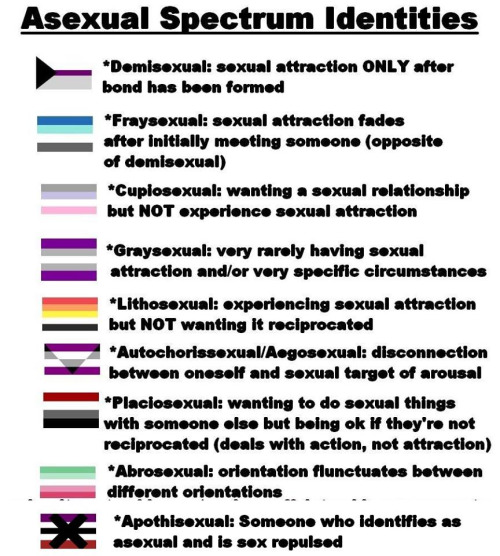
Image from Asexualscience on Tumblr
Demisexual: attraction only after an emotional bond is formed.
Fraysexual: attraction fade after getting to know someone (opposite of demi).
Cupiosexual: wanting a sexual relationship but not experiencing sexual attraction
Graysexual: very rarely having sexual attraction and/on in very specific circumstances.
Lithosexual: experiencing sexual attraction but NOT wanting it reciprocated.
Autochorissexual/Aegosexual: disconnect between oneself and target of arousal.*
Placiosexual: wanting to do sexual things with someone but being alright with the feeling not being reciprocated or acted on.
Abrosexual: orientation is fluid
Apothisexual: someone who is asexual and sex repulsed.
Okay, I’ll give you a moment to digest all that because it is a lot to take in all at once. Who knew there were so many ways to not want sex?
But wait, you say, how do I write a romance without sex being a part of the equation? Or how do I show that my character really loves their partner/significant other if they don’t find them sexually attractive?
Easy. No really it is easy. I promise.
You know how to write friendships. Of course you do! You know that there are ways to show affection, appreciation and consideration for another person that do not involve anything overtly sexual or physically intimate. There you go. (For a great list of non-sexual intimacies see Nonsexual Intimacies (Part 1 of 5) – The Wordsmith’s Forge).
Ah I see your brow furrowing. That’s just friendship, right?
Is it? You care deeply about your friends don’t you? You love them, want the best for them and care what happens to them. But we make the distinction between friends and those we are romantically involved with for our own reasons. While you love your friends, you may, or may not, find them sexually attractive. That’s the difference; the ability to feel sexual attraction. Of course, this can, and sometimes does change. It all depends on the person. There is no wrong way to be asexual.
On The Big Bang Theory it is hinted that the character Sheldon is asexual.
So while you consider that let’s look at some tips for writing asexual characters:
Keep in mind that asexual does not mean emotionless. Your character should still have emotional actions and reactions to events in line with their personality.
If the setting allows for it, it might be good to have your character specifically state they are asexual. This will help the reader understand where your character is coming from. Having other characters react and ask questions will help mitigate an info dump.
Be wary of having a plot that calls for the character’s asexuality to be a problem fixed by ‘good’ sex or a sexual relationship. In this instance it might be better to rethink your character’s orientation.
Do let your character have close intimate non-sexual relationships with other characters.
Try to avoid making your character asexual simply as a plot device. It should be an integral part of who they are, not a quirk.
If your asexual character is a minor character it might be best to avoid having them be the comedic relief as this can reinforce stereotypes of asexuals being socially inept, naive or virginal.
Asexual does not always mean aromantic and vice versa.
As with every other orientation keep in mind you are writing a person first and foremost. If you are still a bit unsure about how to go about this why don’t we focus on your character and who they are and how they practice their asexuality.
Decide where on the asexual spectrum your character lies. Does it change/fluctuate? Under what circumstances does it fluctuate? (Keep in mind that this can change over time)
How does your character think/feel about being on the asexual spectrum?
How does your character feel towards sex? Neutral, sex-repulsed, sex-positive? Does it depend on the circumstance/person?
If your character were to find themselves in a sexual situation, what would their reaction be?
How does your character tell people about being asexual (if they tell people at all)?
How do other characters react to your character’s asexuality? How does your character react/respond to these reactions?
How does the society in your story react to asexuality? How does this affect your character? What assumptions do others have about asexuality/your character?
When did/will your character realize that they are on the asexual spectrum? How does/will your character think/feel about this? Is the realization because of a specific event, a gradual understanding/coming to terms, etc?
Writing an asexual character isn’t any more challenging that writing any other character. We are just people after all. Please join me next week as I go further into ways to write asexual relationships using non-sexual intimacies and tropes to avoid.
*Autochorissexual was a term coined by psychologist Anthony Bogaert to describe identity-less sexuality and is listed as a paraphilia. To combat the negative stereotypes associated with paraphilias the term aegosexual might be more preferred. As someone who identifies as moderately aegosexual I take exception to it being listed as a paraphilia or fetish because, as defined, it doesn’t completely fit the definition of a paraphilia.
If you have any questions, comments or concerns please leave a comment. Next week I’ll go further into how to write your asexual character with examples and tropes to avoid and why.
If you enjoyed this post and would like access to exclusive content please consider supporting me on Patreon or please send me a coffee using the button above. Many thanks from this nerdy queer. ^_^
For this month’s Going Over the Rainbow post we are going to look at one of the more misunderstood orientations—asexuality. I’ve broken this post up across two weeks because there are a lot of misconceptions as to what being asexual is and I want to address those before getting into actually writing an asexual character.
So what does it mean to be asexual? It varies by person but the simplest definition is a lack of sexual attraction. It is not the same as abstinence nor it is a mental illness. Asexual persons may not experience the desire to have sex with someone who they might otherwise find attractive or appealing, but that doesn’t always hold true either. Mostly because asexuality is, itself, a spectrum.
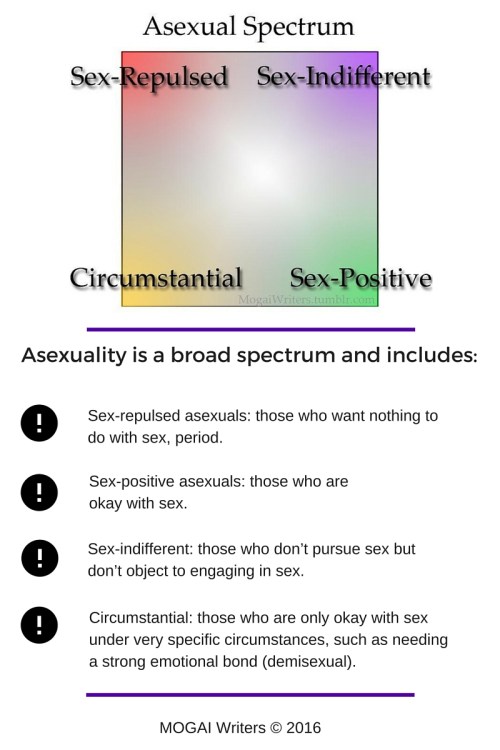
The asexual spectrum includes people who are completely repulsed by the thought of sex all the way to sex-positive individuals who may even enjoy sex with their partner. It’s a very personal thing for each asexual person and no one but them can tell you where they fall on the spectrum.
Many asexual persons will refer to a romantic orientation such as illustrated in the chart:
Looking at the two charts combined you’ll see that there is a vast number of possible combinations. I personally identify as panromantic demisexual. What that means to me might not mean the exact same thing to someone else with the same chosen labels. For me personally, I am romantically attracted to people regardless of gender while I have only ever experienced sexual attraction twice in my entire life. To those who don’t know me I might appear to be a monogamous heterosexual. This is a misconception. Monogamy is a choice. My being sexually active with my partner doesn’t make me heterosexual, I am still asexual. I do not look at other people and find them sexually attractive. In fact trying to imagine sex with someone results in feelings of revulsion and panic. I quite literally cannot fathom it.
This doesn’t mean that asexuals can’t get turned on or don’t have a libido. Sexual attraction and libido are two separate things. You can experience sexual attraction yet have a low libido and there are people with a desire for sex that doesn’t relate to their orientation. There are asexuals who do engage in sex or who masturbate for a variety of reasons including but not limited to: pleasing a partner, releasing tension, to get to sleep or because they enjoy it. They are still asexual.
Asexuals also face unique issues within the community and recently there has been a call by some for them to be dropped from the LGBT community. Some asexuals feel that they would be better served by having their own separate community since the majority of the LGBT community is highly sex focused. This is an ongoing debate and will probably never be fully resolved.
It’s also good to keep in mind the kinds of challenges asexual face in our society. Sex is seen as normal, healthy and something that is integral to being human. Its even listed as a basic human need along with eating and breathing in Maslow’s theory of the hierarchy of needs. Which any asexual will tell you is preposterous. No one has ever died because of a lack of sex. Lack of love, yes. But love is not sex. Sex can be an expression of love and intimacy but the act itself can be done for reasons outside of love. But, because of this view of sex and sexuality many asexuals report feeling broken or being seen as not wholly human by many, even being referred to as robots or plants or just being flat denied as existing. Acephobia is very common and often goes unrecognized and unchallenged.
Asexuals face being infantilized, fetishized as virginal, excluded by the LGBT community, labeled as mentally ill, and generally dismissed by society at large. These are all things your character might face as well. Don’t shy away from addressing these issues if your plot allows for it.
Next week we will delve deeper into how to actually go about writing an asexual character.
Yesterday I had the very fun priviledge of being a guest artist at a local comic book shop for Free Comic Book Day. I don’t often get a chance to talk with prospective readers … or people in general, so yesterday was a bit out of my comfort zone. That being said, I had a fabulous time. The local graphic artist I sat beside was not only talented but very interesting to talk to as well. Our range of subjects was pretty intense, from art and what it means to be an artist, to feminism and religion all the way to video games. It was fabulous and I plan to keep in contact with him. I also had the chance to meet a couple of people from the community, in particular one lovely young trans woman. We got to talking and I told her about my new series The Silver Peacock and how it will explore the whole spectrum of gender and orientation. To see her face light up when I told her there were trans men and women in the stories made my day.
This is one big reason why I am writing these stories. Not only do I love the characters and all their quirks, I know there are people out there who have never read a story with a character like themselves. My greatest hope is that people will read these and not only be entertained but find characters who they can relate with.
With that I’d like to introduce the first of the series: Pearl. Below is a short excerpt. You can find the full novella on Amazon for Kindle.
Pearl stared up at the dilapidated building. The three story house had once been grand, the fluted columns and ornate shutters on the large windows spoke to that. But like a once popular courtesan the years had done their damage; weathered wood showed under peeling paint, shutters hung from rusted hinges and only a few windows still had any glass. In some ways it reminded her of the woman waiting next to her. At one time beautiful and popular, now faded and clinging to the past.
“Just how old is this dump?” She turned to look at Evel Jorde. Her mother was tall and imposing. The years were just starting to settle over her, a spider’s web of fine lines showing around her eyes and mouth, the once white-blonde hair now more snowy than golden. The dress was carefully chosen to complement her coloring and enhance the slender figure. Pearl had her mother’s height, blonde hair and the same slim build but so far little of her ruthlessness, or so she liked to think.
My other short story The Regular is also available on Kindle.
If you like steampunk, adventure, conspiracies and grand masquerades along with technologically progressive lesbian queens, nonbinary spies and gay soldiers then my current WIP The Jeweled Dagger is probably right up your alley. Below is the introduction to Lafayette Goddard, one of the main characters.
The clang reverberated through the cell block, jolting Lafayette from where he sat leaning up against the bars of his cell. The movement set off a riot of aches and he gritted his teeth. Even as exhausted as he was sleep had been impossible with the stench, the pain, and the frustration. Blinking grit out of his eyes he reached up to pull his hair out of the way and winced as his shoulder protested. Getting slammed to the ground twice by that cretin after running all the way from the harbor made moving difficult. He should never have taken the shortcut through the garden. But he hadn’t been thinking clearly. He had only slept a handful of hours during the two days stowed away on the ship crossing the strait after running for his life in Galey. This week was becoming a string of miscalculations and bad decisions. Getting his papers stolen hadn’t even been the least of his problems.
If only he’d recognized the Captain’s uniform first off and not overreacted. He’d spent too long in Galey jumping at shadows. He was certain those same shadows had followed him back to Orandon. He lifted his head, peering down the corridor as footsteps echoed. It must be morning. His message was too late. He’d failed Rona and who knew what might happen now. He narrowed his eyes as the tall, dark haired Captain walked into view. The intent brown eyes regarded him for a long moment but his face remained impassive and Lafayette couldn’t discern what the man might be thinking.
“Get up.” The Captain man turned away and took the set of keys off his belt along with a pair of cuffs. “I’ll take you to the Queen.”
I’ve been reading science fiction since I was very young. I honestly don’t even remember the first sci-fi book I read. I do remember the first one that made a huge impact on me. It was a short story by Ray Bradbury calledAll Summer in a Day. After that I couldn’t get enough. Somewhere along the way I read I, Robot and Do Androids Dream of Electric Sheep by Phillip K. Dick and realized that science fiction wasn’t just great stories. It was a commentary on our society and our place in that society. The Snow Queen by Joan D. Vinge further cemented this in my mind. Then I read Ender’s Gameby Orson Scott Card. My whole perception of myself and my world view changed with that one book. It was profound thing for a young preteen to realize that other people, other beings, even those vastly different could have the same emotions. They might not be expressed the same way or be overtly recognizable as such but they were there if you kept an open mind.
In the years since, I have read much science fiction. Some of it was just fun others of it required a more cerebral approach. I also expanded my reading selection to include literary novels, mysteries and non fiction. I discovered something.
Science fiction is our modern day fairy tale.
Its the morality story, the cautionary tale. It serves as both entertainment, enlightenment and instruction. It takes a social problem, stigma or perception and shines the light of truth on it in a way that is not always obvious. Now this is not true of all science fiction. Not every novel can be The Handmaid’s Tale (Margaret Atwood) or Flowers for Algernon(Daniel Keyes).
Transformers, Sex and Intimacy
I was recently introduced to the IDW Publishing line of Transformer’s comics. Among them was the title More Than Meets The Eye, written by James Roberts. At first I was put off, nearly incensed by the story line, but I set aside my prejudices and allowed myself to be caught up in the story. I would have deprived myself of so much, had I not.
The way Roberts writes these characters is fantastic. As good as any of the sci-fi novel’s I’ve mentioned. The stories are in turn funny and poignant and at times down right sad. The issue that came out yesterday encapsulated all of that.
Issue #13 brought up some interesting discussions among fans about gender roles, sexuality and what makes a character identify ‘male’ or ‘female’ when their species has no gender bias. The interpersonal relationships have been expanded upon in ways that I had only ever seen in fan fiction. He treats these giant non-organic lifeforms as if they are actually people and not just giant weaponized automatons.
MTMTE #12
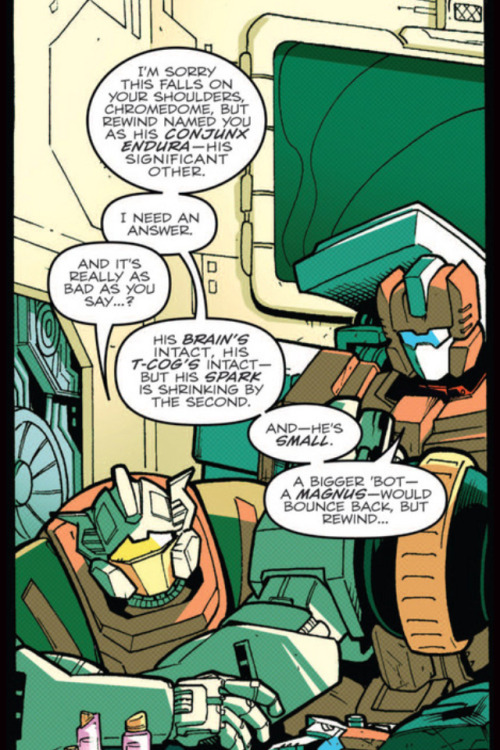
It is these relationships that intrigue me. Much is implied, and in issue #12 it was even stated that they have a relationship status called conjunx endura that is sealed by a ceremony involving the two ‘bots in question. Yet they are an alien race. They do not have genders or a need for genders of any kind. What they do have is a basic need for intimacy as any intelligent life does. Intimacy does not have to equal sex. Being intimate can be as simple as holding hands or as complex as taking care of someone with a chronic illness. Both require trust, commitment and love.
MTMTE #12
This point was eloquently stated in the latest post by DorkDaddy.com entitled: It’s Just Sex, Dammit!
“There are a thousand things necessary for a successful day and a successful life. Balancing the checkbook. Reading to the kids. Visiting your parents. Maintenance on the house. Laughing. Resting. Playing. Growing. Learning. These are the things of life. These are the things that determine whether we are fulfilled, whether we are successful in life. None of them require intercourse. And yet still we venerate sex as the ultimate goal in life, as if everything else is just a way of occupying time between sexual interludes. We high-five our friends when they “got lucky” or “got some” or “got some action” as if to say “Well done. You got that taken care of. Now you can move on to all the other stuff.”
Granted, there is no better way to foster intimacy with your partner than sex. It connects you and makes you vulnerable and draws you together with another person like no other way can. But when considering intimacy, it isn’t even necessary for that (blasphemy, I know). Imagine the potency of your partner gently running her fingers through your hair, or down your back. Picture those moments when you’re lost, looking into your partner’s eyes, and neither of you has to say anything. Think for a moment on the lasting rewards of gently holding hands, or on the way you can totally lose yourself in a deep, committed kiss. These too are the things of intimacy. Because of them, even if you never knew sex, surely you could still know intimacy.”
This is what I find so fascinating about this comic and the way Mr. Roberts has written these characters. They are realistic, deeply thought out and interesting. I care about them. I relate to their struggles, their insecurities, their quirks in ways I have never related to ‘human’ characters. They allow us to explore relationship dynamics without the added pressure of sex. There is no sex for the sake of intimacy. The intimacy comes from other means but is no less potent.
The Wordsmiths Forge on Livejournal lists multiple ways of displaying non-sexual intimacy. Among the things she lists are personal care, spacial closeness including sharing the same sleeping space. Living arrangements which include a measure of trust involved such as sharing passwords, bank accounts and/or living quarters and cleaning someone else’s room. She also talks about urgent situations up to and including risking your life or making medical decisions for someone.
Each of these things have been featured in the comic.
Comradewodka on Tumblr had some interesting things to say about the ‘married’ couple in the comic:
” . . . Chromedome and Rewind. I’m not sure what I could say about them that hasn’t been said, so— let me just say this. Any sentient race, regardless of whether they’re mechanical or actually capable of anything sexual or not, is going to feel emotions and form relationships, even to the point that they feel romantically about someone. Even to the point that they want to spend the rest of their lives with that someone. Every sentient race, if they find something pleasurable in life—even if that something is as innocent (and non-sexual by our standards) as fond, platonic or romantic touches—is going to seek out that pleasurable something with others. It’s biology.
Chromedome and Rewind aren’t “male”. They don’t have genders. They’re not unusual in considering each other “spouses” either, if everyone else’s reactions are any indication. But to a whole heck of a lot of people, they LOOK “gay”—and sometimes it’s almost easier for us humans to refer to them that way—so them being canonically in a romantic relationship isn’t just a big step for a franchise in which we’ve generally been given a grand zipola about how relationships work, it’s a big step for comics and media in general. One more pebble on the pile of change.
That being said, though I and many others really freaking appreciate Chromedome and Rewind for a number of reasons, I don’t think Roberts had some big overt gay rights agenda when writing them. Which brings me back to my main point— that he’s just THAT good at writing them as what they are—fully fleshed out characters that just happen to be giant gender-less robots. So they happen to look kind of masculine by human standards? Roberts don’t care. Roberts don’t give a fuck. He just write what he wants.”
She made a good point. Just because something ‘looks’ male in our perception does that mean it is male? Some fans had their worlds turned upside down by the appearance of holomatter forms of the Transformers. It was stated that these new forms were an exact representation of the robot’s psyche. So in other words, the human forms the program assigned them was based on their personality. Not all of them identified as male or even adult. Tailgate was an infant being carried around in a backpack by Swerve.
Comradewodka on Tumblr made some excellent observations on this subject as well:
“Yeah, most of them have features we associate with masculinity, and that’s fine and dandy, but they actually do not fall into any kind of gendered roles in their culture.
So why the hell CAN’T big warriors like Ultra Magnus or Whirl relate or identify, psychologically speaking, with representation as a human female—just so long as that human female still accurately represents who they are as a character?
Answer: there’s absolutely no reason why they couldn’t. They’re a blank slate, gender-wise. They can have the biggest most “masculine” bodies ever, be called “he”, have what I assume to be masculine voices and features, and still feel like a human female body is a more accurate representation of their psyche.”
Assigning gender roles to gender-less species is like saying pink is feminine. Pink is pink it has no gender. A hundred years ago women would never wear pink. Men did. Pink is a color that societal norms have shifted into a different perception. The terms male and female differentiate sexual reproduction roles. They do not apply to colors any more than they apply to a species that does not reproduce sexually.
The fact that giant robots might see themselves as better represented by a human female form should say a lot. I will leave that topic for my next post.
This is why I love science fiction so much. It allows us to explore themes that would be and are taboo in other forms of writing and it does so in a way that is digest able for the larger audience. It illuminates aspects of society that might otherwise go unnoticed and in doing so educates us about being human. Yes, we can learn from giant alien robots how to be more human.




 . Which any asexual will tell you is preposterous. No one has ever died because of a lack of sex. Lack of love, yes. But love is not sex. Sex can be an expression of love and intimacy but the act itself can be done for reasons outside of love. But, because of this view of sex and sexuality many asexuals report feeling broken or being seen as not wholly human by many, even being referred to as robots or plants or just being flat denied as existing. Acephobia is very common and often goes unrecognized and unchallenged.

 Bran Lindy Ayres