Characters · Going Over the Rainbow · lgbt · mogai · writing · Writing FUNdamentals

Going Over the Rainbow: Aromantic

When Romance is Not an Option

I was having a hard time deciding where to start, so I thought I’d just do this alphabetically. ^^ I personally am between pan and aro when it comes to romantic orientation. I don’t claim to understand everything about either, and my experiences will vary widely from other aromantics.

Aromanticism is:

not experiencing romantic attraction.

Aromanticism is not:  

a personal choice or lack of emotional connection.

Definition (From AVEN Wiki): An aromantic is a person who experiences lAromanticittle or no romantic attraction to others. Where romantic people have an emotional need to be with another person in a romantic relationship, aromantics are often satisfied with friendships and other non-romantic relationships. What distinguishes romantic relationships from a non-romantic relationships can vary diversely, but often includes physical connection (holding hands, cuddling, etc.) (Italics mine).The aromantic attribute is usually considered to be innate and not a personal choice, just as the lack of sexual attraction is innate to asexuals. It is important to note that aromantics do not lack emotional/personal connection, but simply have no instinctual need to develop connections of a romantic nature. Aromantics can have needs for just as much empathetic support as romantics, but these needs can be fulfilled in a platonic way.
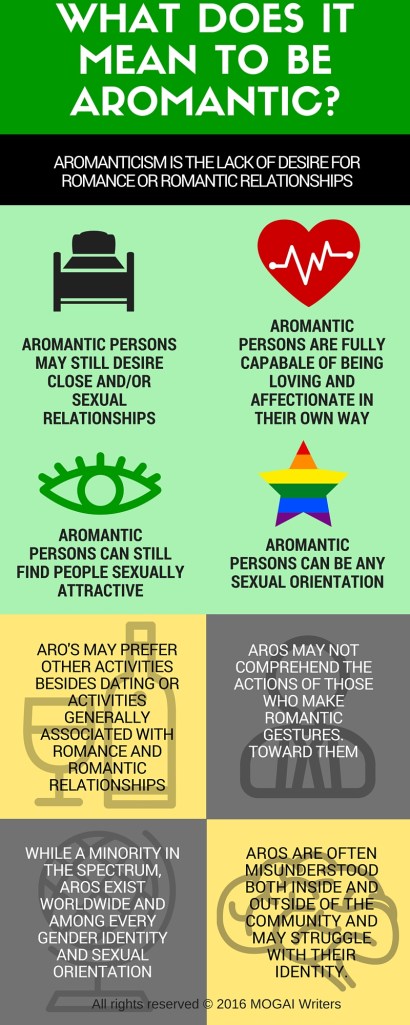
It is possible for an aromantic individual to be involved in, and enjoy, a devoted relationship with another person, but these relations are often closer friendships, naturally reflecting the closeness of the two individuals and not a purposely initiated monogamous separation as is often found in romantic couples. Aromantics may experience squishes which are the aromantic or platonic equivalent of a romantic crush. When an aromatic get’s into a relationship that’s more than friends – but less than romantic – that is known as a queerplatonic relationship.

Like all romantic identities aromatics can be of any sexual orientation.

Writing the Aromantic Character

The first thing to remember when writing an aromantic character is that being aromantic does not mean incapable of love, affection or sexual intimacy. It simply means they do not experience romantic attraction. They have friends and other relationships but not with a goal of a romance. (http://www.buzzfeed.com/mcrosswell/5-myths-about-aromanticism-tysc#.lvwnEXPxq)

Romantic Orientation – Describes an individual’s pattern of romantic attraction based on a person’s gender(s) regardless of one’s sexual orientation. For individuals who experience sexual attraction, their sexual orientation and romantic orientation are often in alignment (i.e. they experience sexual attraction toward individuals of the same gender(s) as the individuals they are interested in forming romantic relationships with). (AVEN Wiki).

As when writing any character, you need to ask yourself several questions:

  • Have I given them other meaningful, close relationships?
  • Have I fallen into the stereotype of the aromantic asexual as an unfeeling, friendless, virginal robot who hates everyone? Not all aromantic people are asexual.
  • Do I fully understand what it means to be aromantic? Is this my story to tell?
  • Have I tried to ‘fix’ the character’s or tried to show them suddenly being romantic when they find the ‘right’ person?
  • What are my reasons for having this character be aromantic? Have I made them a whole person or is their orientation their primary characteristic? Am I trying to fill a perceived quota?
  • Have I made the character aromantic due to mental illness, trauma, personal failing or some outside factor? If so, why and how does it serve the plot?
  • Have I made this character’s orientation the comedic relief?

Now some questions for your aromantic character:

  • Do they realize they are aromantic? How do they feel about this? Do they wish they were ‘normal’ or are they content with their orientation? Do they try to force themselves into romantic relationships? What are the consequences?
  • When did they discover their orientation? Was it a gradual understanding that took years. Are they still a teen and trying to come to grips with how different they might seem from all their peers?
  • Who else knows about their orientation or have they told anyone? If so, who and why or why not? How did those they told react? How did they handle this reaction?
  • How has their orientation affected their other relationships?
  • Do they want a close platonic or even sexual relationship?
  • Does their orientation intersect with other things such as gender identity, race, physical disability, mental illness, or other factors? How do they handle this intersectionality?

Once you’ve addressed these questions, it is important to remember that you are writing a person. A whole person not just an orientation. While a person’s orientation is integral to who they are and defines them up to a point it shouldn’t be the sole basis for their personality. This can lead to falling into the trope trap. While tropes themselves are not bad some can perpetuate harmful stereotypes. Aromantics are seldom, if ever, seen in media so there are very few tropes about them, though many of the asexual tropes can apply as well.

Don’t shy away from writing them just because they are rare. They are part of the spectrum and need to be favorably represented so that other aromantics can read their stories and see that they are not broken, ‘messed up,’ or ‘weird.’ They are normal people who just happen to not be interested in romance. This might feel like a challenge at first and if you are romantically inclined it might be difficult to comprehend. It’s okay. Their story might not be yours to write and that’s fine. But don’t let that scare you off from including their orientation in your stories. If anything the research can help you, as it has me, come to a better understanding of others and to have greater empathy.

Here are some more references I found helpful that I’d like to share with you:

Aromantic – AVENwiki

5 Myths About Aromanticism – BuzzFeed

ASK AN AROMANTIC (if asking questions please remember to be courteous and not assume things)

Anagnori : You might be aromantic if…

Resources for Aromantic Sexual People | The Thinking Aro

Asexual Romances Are Necessary

Going Over the Rainbow: Like a Moth to a Flame

Going Over the Rainbow: The Trope Trap

Going Over the Rainbow: Crush Those Stereotypes

Please share your thoughts with me. Were you aware of the aromantic orientation? Have you met an aromantic person? Would you consider including one in a story? What challenges do you think aromantics face in our society? How might this affect their portrayal in media? Do you know of any canon aromantic characters in a book, movie or game? 

If you enjoyed this post and would like access to exclusive content please consider supporting me on Patreon.

asexual · Characters · Going Over the Rainbow · lgbt · mogai · writing · Writing FUNdamentals

Going Over the Rainbow: Like a Moth to a Flame


GoingOver theRainbow (1)

This week has been chaotic at best and I apologize for the lateness of this article.

As writers who write living beings at some point our characters will probably experience attraction to another being and desire a relationship. But what kind?

Romantic relationships often seem to be the default in books and movies. Hero A must get with their OoD (object of desire) by the end of Act 3 or your story is a flop. The default romance has become such a staple of mainstream media that to not have it can make it feel as though your story is missing something. So is it?

No not really. Ever watched a show with a really great partnership/friendship. Those are relation(ship)s too. Just with a different kind of attraction. Mad Max: Fury Road was a great example of this. Max and Furiosa’s relationship is not one of sexual attraction at all. Even Capable and Nux don’t have a blatantly romantic relationship. Theirs is based more on shared comfort in a society that sees both of them as disposable objects.

So what kind of relationship did they have if it wasn’t a romantic one?

Yes, you’re on the right track. There are several different forms of attraction (and love but that’s for later). Don’t forget though, romantic attraction does not equal sexual attraction for everyone. Your character can be romantically attracted to someone without wanting to engage in sex.

Let’s look at what this means.

Sexual attraction is what people feel when they look at someone and their first thought is something along the lines of “I want to jump their bones” or “How do I get in those pants.” It’s a response to finding someone physically appealing. Think lust.


Marketing companies bank (literally) on our being sexually titillated to sell things. Sex sells, right?

Not always.herehaveanothersexyburgerpic_4f15384461b9daf422986fc8509e164c

(Personally, I have no idea what is appealing about this picture but it came up when I looked up sex in advertising.)

So if there are other kinds of attraction, like my attraction to that burger, what are they? Why do we as writers need to be aware of them and how can we be more diverse by writing characters with different attraction orientations?

Just as there are different sexual orientations, there are different romantic orientations. Just as there are asexual persons, there are aromantic persons. I consider myself panromantic with heavy aromantic leanings. Meaning: while my romantic attraction is not defined by gender I am less likely to engage in anything traditionally romantic or be romantically attracted to anyone regardless of gender. It does not mean that I don’t—or am not capable—of love. Remember earlier? Love and romance are not the same thing. It is entirely possible to love people without being romantically attracted to them.

There are many different types of attraction, including:

Sexual attraction: attraction that makes people desire sexual contact or shows sexual interest in another person(s).


Romantic attraction: attraction that makes people desire romantic contact or interaction with another person or persons.


Aesthetic attraction: occurs when someone appreciates the appearance or beauty of another person(s), disconnected from sexual or romantic attraction.


Sensual attraction: the desire to interact with others in a tactile, non-sexual way, such as through hugging or cuddling.


Emotional attraction: the desire to get to know someone, often as a result of their personality instead of their physicality. This type of attraction is present in most relationships from platonic friendships to romantic and sexual relationships.


Intellectual attraction: the desire to engage with another in an intellectual manner, such as engaging in conversation with them, “picking their brain,” and it has more to do with what or how a person thinks instead of the person themselves.

(https://lgbtq.unc.edu/asexuality-attraction-and-romantic-orientation)

maleficent-auroraMaleficent (2014) is an excellent example of True Love™. In the movie it was not the Prince’s kiss that could break the spell. Only Maleficent herself could do that. It was the fact that Maleficent was the only person who Aurora truly loved that allowed her to break the spell. This is platonic love.

This is the kind of attraction between characters who are very close friends. I’m pretty certain you don’t have any problems writing friendships.

Sensual and sexual attraction are much more common than aesthetic attraction in books and movies. Women in close, non-sexual, relationships are often shown as being sensually attracted to each other since cuddling, snuggling, hugging and holding hands are seen as more feminine type behaviors. Don’t be afraid to break stereotypes or expectations. Men can initiate cuddling, hand holding and other forms of non-sexual intimacies.

Knowing these various types of attraction can help us as writers be more diverse with our characters and their relationships. Hero A might not find the Hero B sexually attractive, but could be aesthetically attracted to them. Or Hero B might find Sidekick C sensually attractive and want to cuddle and watch Netflix with them.

Don’t be afraid to allow your characters other close relationships even if a romance is the primary focus of the plot. This will help round out all of your characters.

Next time we’ll dive into the various types of romantic orientations and how to write them.

If you enjoyed this post and would like access to exclusive content please consider supporting me on Patreon.


Characters · Going Over the Rainbow · lgbt · mogai · writing · Writing FUNdamentals

Going Over the Rainbow: Show and Tell

I recently ran across a post on Tumblr where the OP was rather distraught. They’d been told that using the word asexual to describe their character’s orientation was historically inaccurate for their setting.

This brought up the issue of explicitly stating a character’s orientation within the prose and when and how this should be done. Some writers might feel that they’d rather not label their characters and let their readers decide the character’s orientation. However, I caution against this.

El at Just Love Romance recently brought out how many romance novels feature asexual and demisexual characters yet this is rarely explicitly stated for the reader. Often in movies and television a character’s sexuality is left vague and for the viewer to guess. This can lead to what is called queer-baiting and is a huge source of frustration within the community.

I’m here to help you avoid this problem no matter what genre you write.

Transparency in Prose

The best way to let your reader know a character’s orientation is to tell them. Let your character state their identity. Be explicit. If your character is questioning or unsure, let them talk about it to other (hopefully queer) characters. Don’t be afraid to show them being unsure or looking for answers. You don’t have to be writing a coming-out story to allow a character to realize who they are.

Okay … don’t look at me like that. I know what you are thinking. It doesn’t fit in the narrative, they are a secondary character, the terms are too modern for my setting, I’m afraid of reader backlash, I don’t even know how they identify, blah, blah, blah.  Sorry, I’m not letting you off the hook on this one. No excuses.

Subtext is not enough. Readers want context. Which means you, my dear writer, have to be transparent when it comes to your character’s sexuality. It must be stated and shown for the reader.

But how?

Please allow me to show you.

Show and Tell

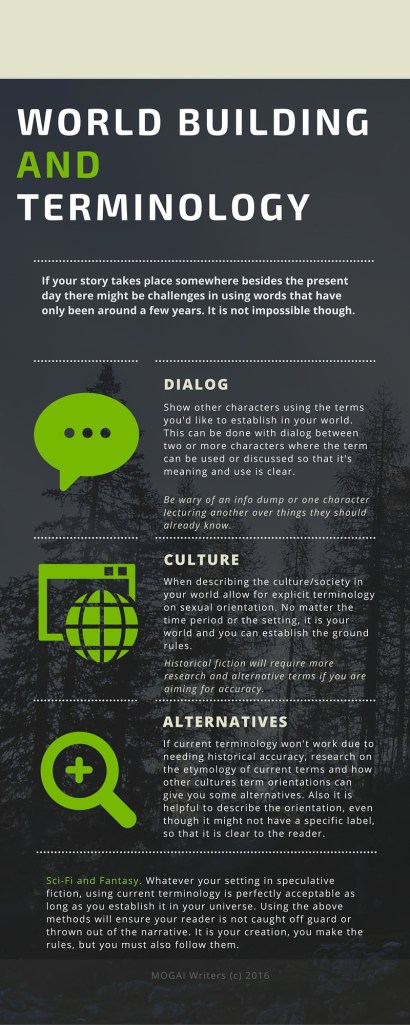
This is one of those times you can throw aside the advice to ‘show don’t tell.’ However, there are ways to show your character’s orientation. The graphic below lists the main ways to do this. As with any other characterization details there are a number of ways to get the information across to your reader.

Dialog

This is one of the easier ways to show the reader a character’s orientation. It doesn’t have to be a pages of discussion, it can be just a line or two of dialog. As long as it is clearly stated by someone. Here is an example:

Maggie stared at the curvy young woman behind the counter. A bump to her hip jolted her to the side. She glanced over to see her friend grinning at her.

“Come on Maggie, either ask her out or stop leering.”Ways to Show and Tell A character's Orientation

“I … uh,” Maggie blinked rapidly as her brain went on autopilot. “She’s probably not even interested in women.”

Okay let’s stop right there. ‘Interested in women’ could mean lesbian, bisexual, or pansexual. So let’s try this:

“I … uh,” Maggie blinked rapidly as her brain went on autopilot. “She’s probably not even a lesbian.”

“Actually I’m pan,” The woman smiled showing two cute dimples.

Simple, right?

Action

Another way to show it is by your character’s actions around those they find attractive. This works nicely if it’s difficult to work the terms into dialog or you want to add extra reassurance for the reader. This is like any other scene that shows characterization, it just deals with your character’s sexual orientation. Again there is no reason to spend multiple paragraphs, get the information out there and let the reader do the rest. If you’re unsure how to show attraction check out One Stop For Writers Emotion Thesaurus. There are several entries to help you show emotional attachment. And don’t forget there are plenty of non-sexual intimacies that can show your character being attracted to or in love with someone.

Internal Dialog

This is an often under-utilized tool for characterization. You are allowed to let your character think about things, dwell on them, process them. This helps your reader too. If you feel dialog or action isn’t appropriate for your character to express their orientation then this might be a good alternative. Of course balance is needed as with all plot and characterization tools.

External Circumstances

What I mean by external circumstances is that it is not the character in question who tells/shows the reader what their orientation is. It could be anther character discussing them or something that happens in the larger world around them. Something as simple as another character stating “X is asexual, they might be uncomfortable watching this movie” or you can even tell your reader as the following paragraph demostrates.

Alice talked to Bert about her feelings for Charlie. Bert informed her that Charlie’s asexual, so whilst he might be open to a romantic relationship, he’d not be likely to respond to sexual flirting. Maybe she should try another tactic to get Charlie’s attention.

Not fantastic but you get the idea. But what if you write historical fiction, fantasy or science fiction? Can you still use the modern terms?

Absolutely.

Here are a few quick, easy ways to do so.

Bran Lindy Ayres (1)


What are your thoughts on this? How would you approach revealing a character’s orientation? Have you read any books where you weren’t sure of a character’s orientation? 

If you enjoyed this post and would like access to exclusive content please consider supporting me on Patreon.


Characters · Going Over the Rainbow · writing

Going Over the Rainbow: Pronouns and Cons

On January 8, 2016 the American Dialect Society voted singular they as the word of the year.

The use of singular they builds on centuries of usage, appearing in the work of writers such as Chaucer, Shakespeare, and Jane Austen. In 2015, singular they was embraced by the Washington Post style guide. Bill Walsh, copy editor for the Post, described it as “the only sensible solution to English’s lack of a gender-neutral third-person singular personal pronoun.” – http://www.americandialect.org/2015-word-of-the-year-is-singular-they

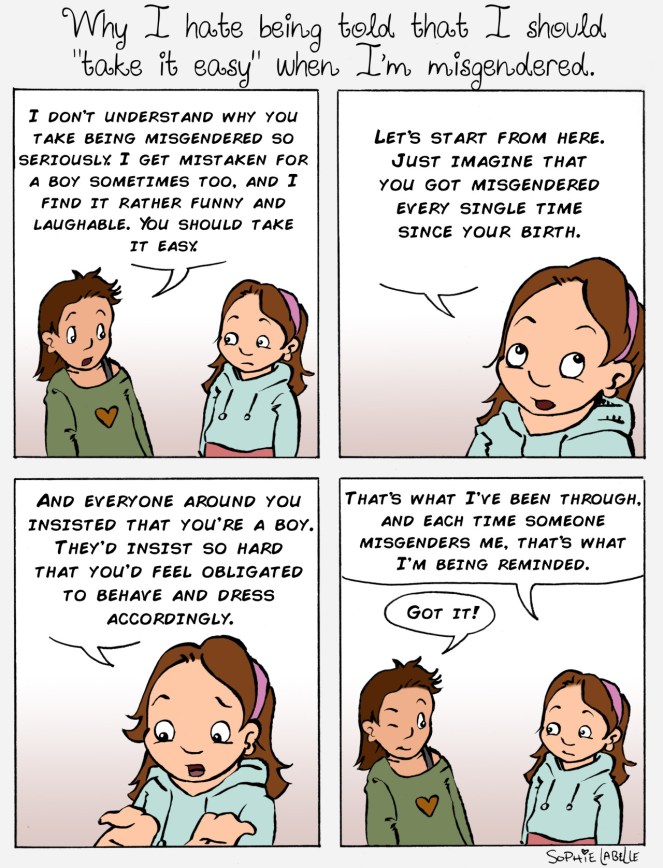
This is a big deal. Especially for people like me who are not comfortable with gendered pronouns. It means that people cannot tell me that it is improper grammar to use they as my pronoun. It might take some time for people to get used to the idea of singular they, but it’s not the first time English as a language as changed and it most certainly won’t be the last.

Even the argument that it will be awkward to say things such as: “I saw Bran today, they were working on a new project.” doesn’t fly with me. It might sound off to an English major but for the general populace it won’t matter.

However, it will matter a great deal to non-binary, trans and genderfluid people who are not comfortable with gendered pronouns.

I understand this might be a hard concept for cis-gendered persons to grasp and truly there is no way for them to sympathize. They simply do not have the mental framework for it.

When someone calls me by female pronouns, it really unravels all the daily work (mentally, physically and emotionally) that I have done for years in order to find a gender that feels comfortable to me. I do not see anything wrong with being a woman or feminine (if anything, I often wish I could identify as this because it would be easier in some ways), but I simply do not feel like a female-bodied person. I can hardly remember a moment in my life when I did. -Janke Seltsam (http://www.huffingtonpost.com/james-nichols/misidentification-and-transphobia-one-musicians-experiences-touring-america_b_3362069.html)


With that being said, this does not mean that cis-gendered persons cannot and should not try to understand other genders. It involves being open and sensitive to the knowledge that not everyone goes by he or she.

tumblr_nj4gt27kk31tm163xo1_1280

Identity Crisis

I’m a big Transformers fan. The cool thing about them is they are robots. They do not have gender or gender binaries. Some choose to identify as male or female and use the appropriate pronouns. But what if you are writing a character who is trans, non-binary or gender-queer? What do you do then?

You, my dear writer, use their correct pronouns.

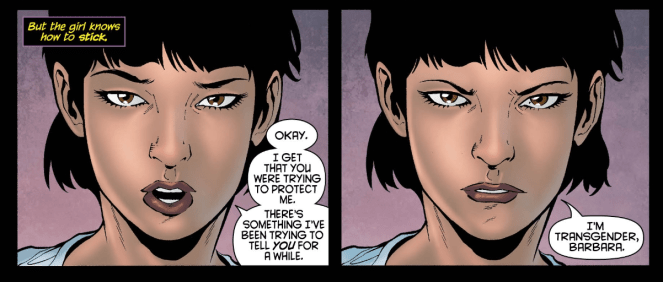
But, you say, what if they are a trans woman and the reader needs to know they are trans and were assigned male at birth?

A valid question; you want your readers to know how your character identifies but you also don’t want run the risk of turning your character into a walking stereotype, or make readers feel as though your character is wearing a sign that says ‘Hi I’m trans.’

transgender

That does not mean that the subject should not be addressed. It absolutely should. Below is a list of ways you can show, and tell, your readers which gender—if any—your character identifies with.

  • If a character’s gender is in question, have other characters comment on or think about it. This is perfectly alright. Here is an example from Masquerade, my upcoming short story prequel to The Jeweled Dagger:

He turned back to find Sivil staring at him with a strange expression. “I … apologize, from your dress and demeanor I thought you were a man. I should have realized, with the long hair and pretty face—”

“Sivil, does the Steward need a footman or a housemaid because I can do either.”

“A footman.” Sivil nodded, his gaze darting around the room, only settling briefly on Lafayette. “Is it true what they say about Kedonians then? That you don’t have genders?”

Lafayette stared at Sivil a strange cold knot tightening in his gut. He’d heard a lot of idiotic rumors about Kedonians but this one was new. He took a step closer to Sivil, “My gender is my own business. Not yours. If the Steward needs a footman, he will get a footman.”

  • If the character is a viewpoint character it is just fine to let them think about it, our gender identities and expression are a large part of how we socialize.
  • Let your character come right out and confirm their gender. This is best done in dialog with other characters, though depending on the story there are other ways to approach this as well.
  • Have other characters comment on their gender expression. Non-binary, trans and gender queer persons are beset with misunderstanding and misgendering on a daily basis, so it’s likely they will encounter this in your narrative.*
  • They can ask to be called by their correct pronouns or inform other characters of their correct pronouns.
  • Use description to show their gender expression. This one is a bit trickier and can come off as being transphobic and othering. Here is a good example of how to handle it without going overboard:

I was living in Vancouver’s West End, still wet behind the ears, having just arrived from the Yukon in a Volkswagen van. It was only the second apartment I ever rented, and the first time I laid eyes on Rosie it was raining, and there she was, skinny, wiry, restless-eyed Rosie right behind me on the sidewalk that led to our building’s front door with bother her arms burdened down with grocery bags. So I held the door open for her, just like my gran had taught me to.

“Chivalry lives,” she snorted as she clunked in past me in her skin-tight Levi’s and low-cut blouse and kitten heels. Of course I did not know the words for kitten heels. Yet.

Except her voice was low, like an eighteen-wheeler gearing down with its engine brakes grinding on a long steep hill down from the summit, and her bare skin above her black bra was covered in five o’clock shadow and painted with now bleeding-edged and sailor-flash faded tattoos.

I had never met any other woman quite like Rosie before.

Gender Failure

As the example shows, the description of Rosie is vivid but there is no mistaking that the narrator sees her as a woman. A little later in the story the narrator makes the mistake of calling her, he. Rosie is quick to correct them. Other than that, the fact that Rosie is trans is never really discussed. She is Rosie.

I see you squinting at the screen as you think … but the only pronouns I am aware of are he and she. Am I supposed to make up something?

Nope. As I mentioned above singular they is perfectly acceptable. My genderfluid character Lafayette, mentioned in the above excerpt, goes by he/she/they depending on the circumstances and who they are with. There are also several accepted gender-less pronouns. The only issue with the list below is that they are not very well known outside the genderqueer community and can draw your reader out of the story as they try to parse the new words. Personally, I like Spivak (ey,em, eir) as it is the least visually jarring but it is entirely up to you.

Please do not be afraid to let your character use these pronouns. They’ll never enter wider use if we don’t actually use them.

pronoun-cards-2
Image from the University of Wisconsin LGBT Resource Center

pronoun-card-1-1024x585

Contrary

You will likely get some irate readers asking why you decided to use ‘made-up’ pronouns. Be brave. Your desire to be inclusive of all genders is more important that their momentary discomfort.

Everyone deserves to be respected, even fictional characters. You cannot please everyone, but you could make a huge difference in someone’s life by showing them they have the right to be respected and treated as human no matter what gender they identify as.

As with all orientations and identities we must keep in mind that we are writing people. Which pronouns they prefer is a good clue to who they are and how they see themselves, but we must remember not to beat our reader over the head with this detail. It’s just another facet of who your character is as a person.

Ideally, your character’s gender should not be a major source of characterization. Relying on gender expression and society’s gender expectations to show character perpetuates and reinforces stereotypes. It is just fine to let gender be addressed, but a light hand usually works best. Treat it like backstory: leave it to a sentence or two here and there. The reader will do the rest.

*Sadly, in many instances (especially for non-white trans women) this situation is deadly. Please be careful how you approach this so that you’re not accidentally promoting transphobia. The only exception would be if you are writing a transphobic character.

Is there anything you feel I’ve left out? How would you handle writing a non-binary, trans or gender-queer character? Have you ever written one? If you haven’t, would you consider it?

If you enjoyed this post and would like access to exclusive content please consider supporting me on Patreon.

Characters · gay romance · lgbt · mogai · writing · Writing FUNdamentals

Going Over the Rainbow: Crush Those Stereotypes

Get rid of stereotypical characters as easily as Dorothy got rid of the Wicked Witch of the East.

There is a lot of great advice out there when it comes to creating our characters. From Nancy Kress’ Dynamic Characters to The Positive and Negative Trait Thesaurus by Angela Ackerman and Becca Puglisi there are many excellent resources for writers looking to create truly unique and realistic characters.  Even as comprehensive as these helps are, there is one area many writers neglect.

A character’s sexuality and sexual orientation.

‘But I don’t write romance!’ I hear you saying. Romance isn’t always about sex and sex isn’t always about romance.  A character’s sexual orientation can have a huge impact on how they are treated by society, their family, how they interact with others around them and how they perceive themselves. It can be a source of both internal and external conflict.

‘But I only write straight characters!’ You say.  Okay, nothing wrong with that, but why? Why only write straight characters?  It’s almost guaranteed that you personally know, at the very least, one person of a different orientation and the likelihood is that the number is much higher. Our lives are filled with diversity and it stands to reason that our stories should be as well.

Diversity is a huge buzz word right now in the entertainment industry and while there is a great focus on it, the actual results have been marginal at best. Unfortunately some well-meaning writers have perpetuated harmful stereotypes, misrepresented an orientation or been less than accurate in their portrayals of queer* persons.

So how can you add diversity and be inclusive without stumbling into the stereotype trap?

Click your heels and we’re on our way.

The first step is to realize writing diversity is not hard. Writing a queer character is no harder than writing any other character because, first and foremost, you are writing people; not an orientation.  A lesbian is not just a lesbian, she might also be a sister, mother, accountant, scientist, police officer, volunteer firefighter or any number of things that make up someone’s identity. Her orientation is just one aspect of who she is, but it is something that helps define her, just as core traits help define personality.

Fearless Defenders #12

The second step is to decide if the character’s story is one for you to tell. As I stated last week, some stories need to be told by writers from that particular background. We should recognize when a character’s story might not be ours to tell, especially if the story centers on experiences or hardships related to their race, orientation, physical ability or mental health.  As the term goes, stay in your lane. In other words know when to check your privilege and don’t assume any amount of research is going to give you true insight into their struggles. Instead, support authors who are part of those diverse backgrounds.

Kaidan Alenko is a romanceable option for Commander Shepard in Mass Effect 3

With that being said, there is nothing wrong with including diverse characters. You absolutely should.

The final step in writing with diversity is actually creating a character that is a fair representation. Everyone’s experiences are going to be different and there is no one right way to write a queer character. However, there are most definitely wrong ways to write them.

Over the next several months I will be going through both the sexual orientation spectrum and the gender identity spectrum and helping you to avoid stereotypes and harmful misinformation. My goal is to help you not only understand your characters better but to feel more comfortable writing with diversity. I myself am a queer person. I identify as an agender/nonbinary panromantic demisexual. That’s probably is a bunch of gibberish right now, but I promise, if you stick with me I’ll show you what those labels mean and what they can mean for your character.

The first place we are going to start with is the Character Sexuality Worksheet. I designed this worksheet to help you answer orientation specific questions about your character. This should give you a launching point for your research. I’ve also included two handy flowcharts to help in case you are not sure where on the spectrum your character might fall.

Character Sexuality Worksheet

Please feel free to download and print the worksheet for your private use.

Over the next several months I will be exploring each of the various sexual orientations and gender identities in an effort to help my fellow authors write with more diversity. I will be inviting people of other orientations and gender identities to offer their advice and experiences as well. I sincerely hope you find this of value and please feel free to ask questions.

If you enjoyed this and would like access to additional content, please consider supporting me on Patreon

What orientation you are most curious about? What else would you like know about sexuality, sexual orientation, and gender identity? Have you written a character from the sexual orientation spectrum?  What challenges have you encountered in your effort to add diversity to your writing? Do you have any suggestions or comments for the worksheet or upcoming topics? I look forward to hearing from you.

*As someone who identifies as nonbinary and panromantic demisxual, I am comfortable using the term queer when describing myself or my characters. I am aware that many in the community still feel this is an insult. If you do not identify as part of the spectrum, please refrain from using the term.

Uncategorized

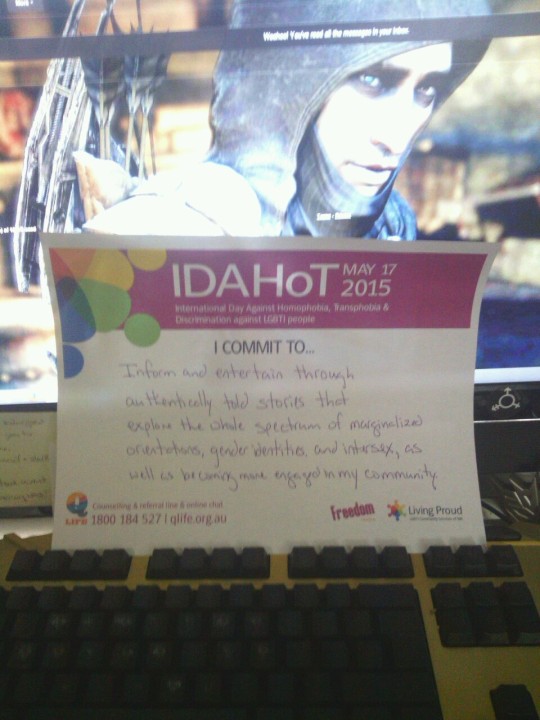
International Day Against Homophobia, Transphobia & Discrimination against LGBTI People

Above is my commitment for this year and I thought I’d expand on it a bit because I find the choice of wording isn’t as inclusive as it should be. You might notice the I used the MOGAI definition in my statement. I feel this is much more inclusive and less cumbersome than the LGBT+ acronym. So it will also be my goal to make MOGAI more visible and to promote its use so that asexuals and others not included in LGBT will feel a part of the community.

If you have suggestions on ways I can be more inclusive in my writing, I welcome your comments.

excerpt · gay romance · lgbt · mogai · short story

Just Your Average Everyday Romance

Yes, it’s Upworthy. Chill. I liked this because this is exactly why I am writing stuff like The Jeweled Dagger and The Silver Peacock series. I want to read about people like me and I know there are a lot of us out there who want the same.

We deserve amazing adventures featuring characters who are as real and vibrant as we are.

I’m very excited about both The Jeweled Dagger and The Silver Peacock. Each feature a broad spectrum of orientations and gender identities but that’s not the sole focus. There are plenty of literary novels that splendidly detail the struggles of being different. No, my books are entertainment that just happens to feature characters who are not heterosexual or even cisgender.

If you are interested you can read the first in The Silver Peacock series for only $0.99 on Kindle, or support me for as little as $1 a month on Patreon and get access to all kinds of freebies and exclusive content.

Here is a sneak peek at part of a scene from Chapter 16 of The Jeweled Dagger.


“It’s not polite to eavesdrop on private conversations.”

Genevieve jumped at the voice in her ear and turned. Roderick smirked at her and Genevieve wished she could slap it off his face. As much as she wanted to she couldn’t just deck the man and leave. She couldn’t afford the scandal that would cause. It had taken her years to gain the standing she had at Court as the Marchioness. One mistake and it would all be for nothing. Her stomach tightened uncomfortably at the thought of playing along with Roderick’s delusion. It wouldn’t be the first time she’d used someone’s romantic interest in her to gain access to information. It just wasn’t something she generally found pleasant.

No. She couldn’t, not with Roderick. Not only was the risk too great, she simply couldn’t. She did many terrible things, things that seared her conscience and gave her nightmares, but she drew the line at this. She’d kill the man before willingly leading Roderick on. Galey had taught her just how quickly things could spiral out of control. Right now she needed to regain command of the situation.

“I don’t know what you are referring to. I am simply enjoying a quiet moment to refresh myself.” Genevieve was glad she still had her drink. The suspicious look didn’t leave Roderick’s eyes.

“Come walk with me. There are some things I wish to discuss.”

asexual · mogai · short story · writing

Free Comic Book Day Fun and a New Series

Silver Peacock Pearl

Yesterday I had the very fun priviledge of being a guest artist at a local comic book shop for Free Comic Book Day. I don’t often get a chance to talk with prospective readers … or people in general, so yesterday was a bit out of my comfort zone. That being said, I had a fabulous time. The local graphic artist I sat beside was not only talented but very interesting to talk to as well. Our range of subjects was pretty intense, from art and what it means to be an artist, to feminism and religion all the way to video games. It was fabulous and I plan to keep in contact with him. I also had the chance to meet a couple of people from the community, in particular one lovely young trans woman. We got to talking and I told her about my new series The Silver Peacock and how it will explore the whole spectrum of gender and orientation. To see her face light up when I told her there were trans men and women in the stories made my day.

This is one big reason why I am writing these stories. Not only do I love the characters and all their quirks, I know there are people out there who have never read a story with a character like themselves. My greatest hope is that people will read these and not only be entertained but find characters who they can relate with.

With that I’d like to introduce the first of the series: Pearl. Below is a short excerpt. You can find the full novella on Amazon for Kindle.

Pearl stared up at the dilapidated building. The three story house had once been grand, the fluted columns and ornate shutters on the large windows spoke to that. But like a once popular courtesan the years had done their damage; weathered wood showed under peeling paint, shutters hung from rusted hinges and only a few windows still had any glass. In some ways it reminded her of the woman waiting next to her. At one time beautiful and popular, now faded and clinging to the past.

“Just how old is this dump?” She turned to look at Evel Jorde. Her mother was tall and imposing. The years were just starting to settle over her, a spider’s web of fine lines showing around her eyes and mouth, the once white-blonde hair now more snowy than golden. The dress was carefully chosen to complement her coloring and enhance the slender figure. Pearl had her mother’s height, blonde hair and the same slim build but so far little of her ruthlessness, or so she liked to think.

My other short story The Regular is also available on Kindle.

The Regular Cover

gay romance · mogai · short story

New Short Story: The Regular

The Regular Cover

Read the latest short story by Bran Lindy Ayres, available on Amazon for Kindle.

All Gentry Devlin wants is to bartend and flirt with the gorgeous bouncer, but some people won’t take ‘no’ for an answer.

Support me on Patreon for exclusive content, free books, invitations to private events and many other perks! Help me reach my goals to educate and inform my local community.